
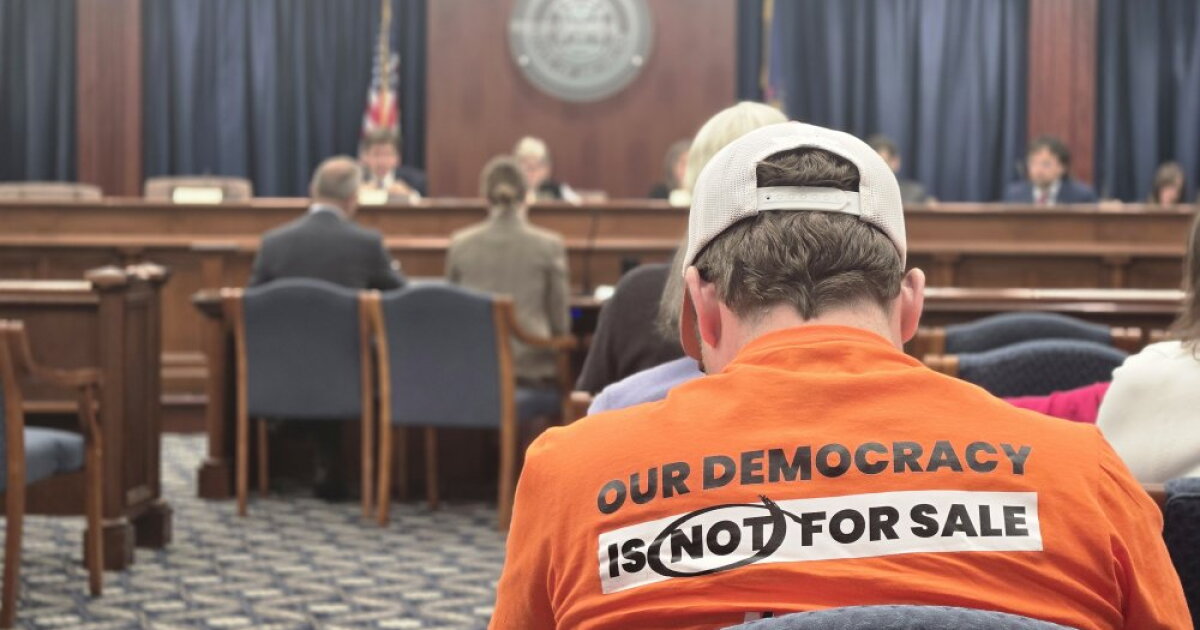
A voter-approved Michigan campaign finance measure is now at the center of a legal battle — and the people who fought to pass it want a seat at the table in court. The outcome could shape how money flows into Michigan politics for years to come.
Michiganders for Money out of Politics, the coalition behind the successful ballot initiative known as Proposal 2, has filed a motion to intervene as a defendant in two federal lawsuits seeking to block the measure. If the proposal survives legal challenges and takes full effect, it will cap campaign donations from regulated utilities and large state government contractors, while introducing new transparency requirements for political messaging.
Two opponents have already filed suit to stop it. Public utilities and the Mackinac Center for Public Policy are each challenging the measure in federal court on First Amendment free-speech grounds. Both lawsuits name Michigan government officials as defendants — not the ballot campaign itself — which is exactly why the coalition argues it needs to be part of the legal fight.
Why the Campaign Wants In
Sam Bagenstos, the lawyer representing Michiganders for Money out of Politics, made the case Tuesday that the coalition brings a unique perspective the state cannot fully represent on its own. The group’s filing also includes Democratic state Rep.-elect Joanna Whaley.
“The proposed intervenors have very distinct interests that are not the same as the state because they are regulated by Proposal 2, and they participate in the political process that’s going to be governed by Proposal 2,”
Bagenstos said.
He argued that because coalition members and the incoming lawmaker personally navigate the political system, they have a direct stake in seeing the law upheld — a perspective he says a government attorney simply cannot replicate.
“They want to have access to the disclosures of independent expenditures that will be required by Proposal 2. They want to participate in the political process where regulated utilities can’t skew that process,”
Bagenstos said.
Opponents Say Intervention Isn’t Necessary
Patrick Wright, vice president for legal affairs at the Mackinac Center for Public Policy, pushed back on that reasoning. He argued that once a ballot measure becomes law, its original sponsors no longer hold any special ownership over it.
“Once the law becomes the law, it’s the state of Michigan’s law. It’s no longer Mop Up Michigan’s law, or it doesn’t have really any ownership stake in it anymore,”
Wright said.
Wright also contended that the groups seeking to intervene would not add anything beyond what the state’s attorney general would already argue in defense of the measure.
“There is really nothing unique that any of these groups that are attempting to get in offer that the attorney general’s not going to argue in defense of this law,”
Wright said.
What Happens Next
The legal calendar is moving quickly. The judge overseeing the Mackinac Center lawsuit has asked for a reply by November 20. Michigan’s state elections board is scheduled to meet on November 23 to certify the final results of the election. Under the measure’s own language, it would take effect 10 days after certification — meaning, absent a court-ordered delay, it could begin applying as early as December.
The utility-led lawsuit has already requested a temporary block on enforcement. Wright confirmed the Mackinac Center intends to seek the same, setting up a race against the clock as courts weigh whether to let the new campaign finance rules take hold.





Comments are closed.