
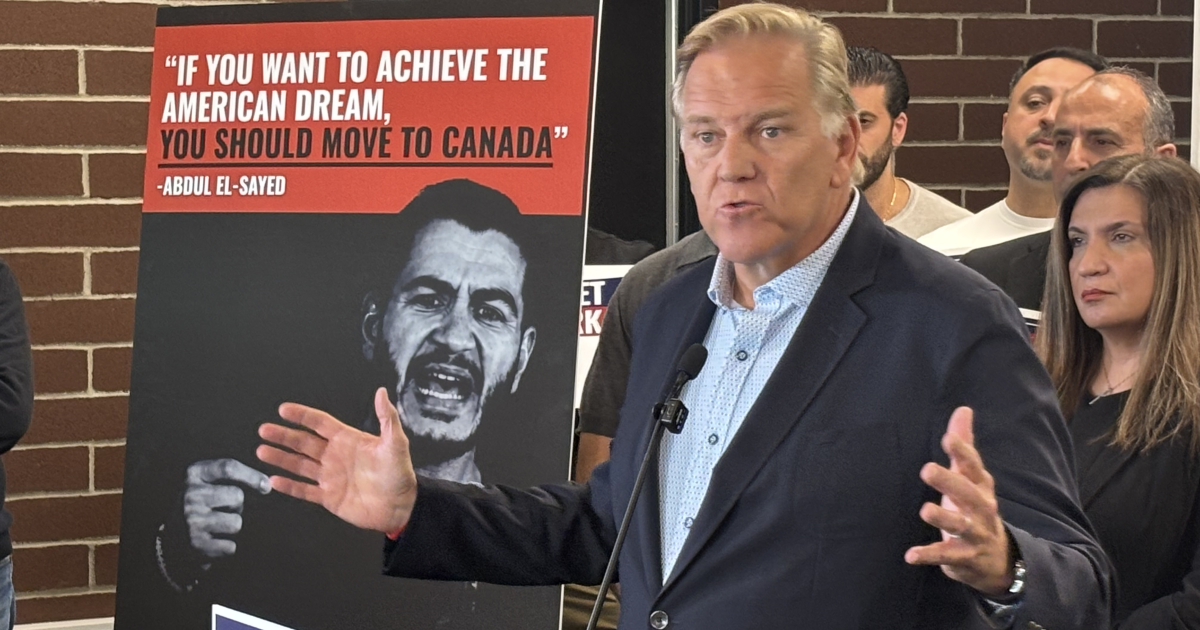
When a candidate’s family becomes the target of terrorism accusations in a Senate race, voters deserve to know whether those claims hold up — or whether fear is being used as a political weapon. Michigan’s U.S. Senate race has taken that question to an extreme, with Republican Mike Rogers leveling serious accusations against Democrat Abdul El-Sayed‘s birth mother — accusations that, when examined against the available evidence, simply don’t hold up.
At a Grand Rapids debate earlier this month, Rogers accused El-Sayed’s birth mother, Fatten Elkomy, of funneling money to terrorist groups while working for a charity in the late 1990s and early 2000s. It was the latest in a series of accusations Rogers has made linking El-Sayed and his family to Hezbollah, Hamas, and the Muslim Brotherhood — none of which have been supported by evidence. Rogers, a former congressman, denies the attacks have anything to do with El-Sayed being Muslim.
“It’s not about the way he prays,” Rogers said. “It’s about the way he thinks.”
But a factual review of the record tells a different story.
What Rogers Claims — And What the Record Actually Shows
El-Sayed’s parents divorced when he was three years old. He was raised primarily in Rochester, Michigan, by his father and stepmother. His birth mother, Elkomy, worked as a nurse in a Kenyan orphanage for the Islamic American Relief Agency (IARA-USA), a Missouri-based humanitarian aid organization. That group was an offshoot of the Islamic African Relief Agency, based in Sudan.
Leaders of the Sudan-based organization — who were also board members of IARA-USA — were later convicted of violating sanctions by routing money to Iraq through a person believed to have terrorist ties. As a result, IARA-USA had its assets frozen and operations halted. The ripple effects were devastating for the children in Kenya the charity served — many wrote to the court explaining they could no longer afford school and had returned to scavenging for food.
Detroit attorney Shereef Akeel, who represented IARA-USA and similar organizations, was direct about what the cases actually involved.
“I saw violations of tax filings, violations of where aid was distributed in violation of some sanction, like blankets or things of that nature,” Akeel said.
IARA-USA ultimately pleaded guilty to violating Iraq sanctions, transferred its remaining assets to another humanitarian organization in Africa, and dissolved. Critically, Elkomy does not appear anywhere in the indictment related to this case.
Barbara McQuade, a University of Michigan Law professor and former U.S. Attorney who prosecuted cases similar to the IARA matter, explained how financial crimes in these situations actually work — and why guilt-by-association claims are legally and factually problematic.
“If you can instead put together a case that’s clean on paper because of some financial transaction that is prohibited, whether it’s a tax charge or financial support that violates sanctions – that certainly can dismantle a terrorist pipeline of money,” McQuade said.
As for the idea that Elkomy, working as a nurse overseas, would have known about financial misconduct happening at leadership levels in a separate organization in another country, McQuade was unambiguous.
“Just because you work for a particular charity – I don’t know, hypothetically the Red Cross or Doctors Without Borders, some organization that’s doing great work overseas – if you’ve got some corrupt members at the highest level, it certainly is not an indictment or guilt by association of everybody who works in the organization,” McQuade said.
There is also an inconvenient fact for Rogers in this story: one of IARA-USA’s most prominent advocates was a Republican. Former GOP Congressman Mark Siljander of southwest Michigan lobbied on behalf of the charity in the mid-2000s, then pleaded guilty to obstruction of justice and failing to register as a foreign agent. He served just over a year in prison. The judge in his case said plainly: “this is not a case about somebody aiding a terrorist.” President Trump later pardoned him in 2020.
The Muslim Brotherhood Accusations
Rogers and some conservative media outlets have also tried to link Elkomy — and by extension El-Sayed — to the Muslim Brotherhood, citing her time living in Egypt in the 1970s. The basis for this claim is largely three social media posts made by El-Sayed’s half-sister in 2012 and 2013.
The Muslim Brotherhood was founded in Egypt in the 1920s and played a role in the rise of former Egyptian President Mohammad Morsi following the pro-democracy Arab Spring movement in 2011. The U.S. Department of Treasury designated the group a terrorist organization earlier this year. El-Sayed has consistently and firmly rejected the idea that his family has any ties to the organization.
“To the best of my knowledge, nobody in my family’s been a member of this organization. It’s, like, an insane thing to assume,” El-Sayed said.
The accusations have found their way onto the campaign trail in a particularly staged manner. At a recent El-Sayed campaign stop in Caro, an audience member named “Tommy” repeatedly pressed El-Sayed to disavow the Muslim Brotherhood — without ever explaining why he was asking. El-Sayed did disavow the group, and the exchange went viral. But the confrontation turned out to be orchestrated. Independent journalist Marisa Kabas of The Handbasket was first to report that “Tommy” — Tommy Teepell — is not from Michigan, is the son of a well-known Republican operative, and worked for U.S. Sen. Josh Hawley of Missouri earlier this year.
Why the Fear Tactics, and What It Means for Voters
The broader context helps explain why these attacks are being made in the first place. Democrats have an edge in enthusiasm heading into the midterms, a common pattern for the party out of power. With President Trump’s approval ratings at historic lows and fuel prices biting into household budgets, Republicans are searching for ways to energize their base.
Former Republican Congressman Mike Bishop of Michigan, who served on the Homeland Security subcommittee, acknowledged the political reality directly.
“I think there is an enthusiasm gap, and that happens when you’ve got a president at his midterms,” Bishop said.
Bishop stopped short of calling Rogers’ approach Islamophobic, but acknowledged that something was needed to close the gap — and that stoking fear and anger was part of the strategy.
“I think there is fear and anger out there, and there are folks out there that are stoking that furnace,” Bishop said.
Michigan’s Senate race — which you can follow through coverage tagged under 2026 Midterm Election and Politics & Government — has become a test case for how voters respond when unverified terrorism accusations are used as campaign tools. For voters trying to make an informed choice, the evidence here is clear: the charges against El-Sayed’s family don’t match the facts. Related coverage includes Rogers, El-Sayed debate gets hostile as candidates clash in pivotal US Senate race, Rogers and El-Sayed clash on ICE, Social Security and more in final US Senate debate, and JD Vance, Mike Rogers keep up attacks on Abdul El-Sayed during Monroe rally, reported by Colin Jackson.


Comments are closed.