
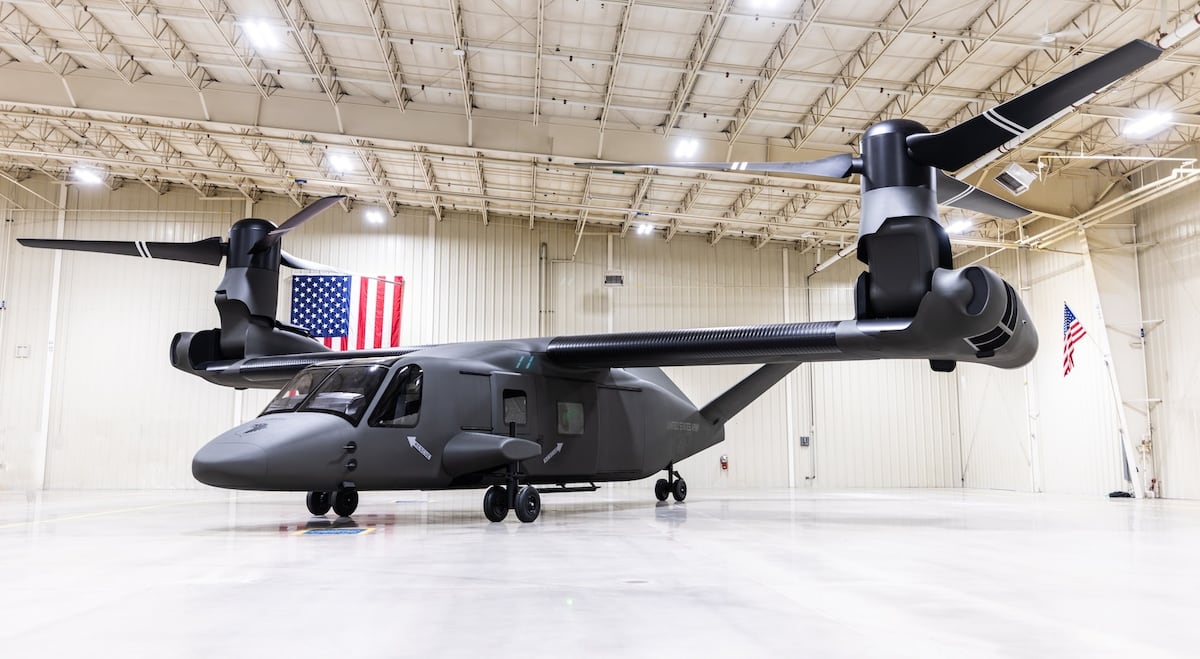
Every few years, Congress makes decisions about military spending that shape the future of American national security — decisions made by elected officials who answer directly to voters. The U.S. Army’s next-generation tiltrotor aircraft, the MV-75 Cheyenne II, sits at the center of one of the most significant — and expensive — defense investments in recent memory, and whether it gets built on schedule depends heavily on whether Congress can pass a budget.
That’s not just a defense industry problem. It’s a question of how well American democratic institutions function — and whether the people voters send to Washington can do the basic work of funding the government on time.
At the 2026 Association of the United States Army annual conference in Washington, D.C., Bell’s director of MV-75 Sales & Strategy, Frank Lazzara, made the case for why the Cheyenne II is more than just a faster helicopter. But woven throughout his remarks was a candid acknowledgment that the program’s future depends on Congress fulfilling its most basic fiscal responsibility: passing a budget.
What the Cheyenne II Is — and Why Congress Controls Its Fate
The Cheyenne II is the Army’s next-generation tiltrotor assault and utility aircraft, designed to replace a significant portion of the UH-60 Black Hawk fleet. It can fly at over 300 miles per hour — more than double the speed of current systems — carry up to 14 soldiers, and support an external load of up to 10,000 pounds. Its missions span long-range assault, medical evacuations, humanitarian assistance, and utility operations.
The aircraft was specifically designed with the Indo-Pacific theater in mind, where vast ocean distances demand speed and range that current helicopters simply cannot provide. But it’s also built for close-in fights, special operations, and deterrence in other regions.
According to budget documents, the Army’s fiscal year 2027 funding request allotted $2.1 billion for the Cheyenne program under the Research, Development, Test and Evaluation framework — a dramatic jump from $350 million in fiscal year 2026. A 2025 Congressional Research Service report projected that by the end of fiscal year 2040, the Army could field up to 334 of these aircraft.
Those numbers exist on paper. Whether they become reality depends on Congress.
What Makes It “Revolutionary” — and Who Decides Upgrades
Bell and Army officials describe the Cheyenne’s most significant innovation not as its speed or range, but as its software architecture. The program is the Army’s first “digital-first” weapons system, built around a modular open systems approach, or MOSA. That structure allows the Army — not private defense contractors — to control future upgrades, maintenance, and data rights, avoiding the kind of vendor lock-in that has driven up costs and limited flexibility on past programs.
This matters to taxpayers: vendor lock-in has historically meant that the government — and by extension, the public — ends up paying premium prices to a single contractor for every upgrade or repair, because the contractor owns the intellectual property. MOSA is designed to break that cycle.
“The Army is trying to set the standard for the government to have control over their maintenance, their upgradeability, like they’ve never had before,”
Lazzara said. He framed it as a new model for government acquisition — one where taxpayers get more value and the government retains real control over a weapons system throughout its life.
“This is the model for what the government should get when they acquire a weapon system of this level and an acquisition at this level. That’s what gets lost out there.”
Lazzara also emphasized the long-term payoff of building the aircraft right from the start, rather than retrofitting old platforms:
“You can hang another system on an old aircraft, and you might have a little bit more capability, but you’re never going to have the capability you have in this aircraft, plus the ability to much more easily upgrade and maintain your aircraft through its life cycle. That’s where the payoff really happens.”
The Future Long Range Assault Aircraft (FLRAA) project office conducted design evaluations that brought together operators, trainers, and engineers from the 101st Combat Aviation Brigade at Fort Campbell, Kentucky — the first unit slated to receive the aircraft. Soldier feedback directly shaped design choices, including seating configuration and the decision to build the cockpit without doors. Bell notes it is now at a stage where the design must be finalized to keep development on track.
The 101st is expected to receive its first Cheyenne II aircraft in 2027 — a timeline significantly accelerated from the original 2031–2032 delivery window, an acceleration announced in January of this year.
The Congressional Budget Problem — and What It Means for Voters
Here is where the story becomes relevant not just to defense insiders, but to every American who votes for a member of Congress.
The federal government is currently operating under a short-term continuing resolution — a temporary funding measure — through December 11. A continuing resolution, or CR, essentially freezes spending at prior-year levels. For the Cheyenne program, that would mean being limited to roughly $350 million in fiscal year 2026 funding, rather than the $2.1 billion requested for fiscal year 2027.
Lazzara was direct about what that would mean:
“We’re obviously concerned about a [continuing resolution] because that becomes a challenge if we are under continuing resolution for a long period of time. So a lot of what the government and our team will be talking about … is that as well. What are the contingency plans?”
He noted that congressional support for the program has been strong in terms of approving the funding request, but that a prolonged CR would create real operational obstacles:
“It’s a very well-supported program. Funding requests went through almost as exactly as we asked for it. So clearly supported on the Hill through funding. That funding for next year or ’27, this year now fiscal, is significantly more than ’26. So if we’re limited to ’26 funding, you have to find ways to work through those challenges, and that’s what they’re working on now.”
This is a concrete example of how Congress’s ability — or inability — to pass a full budget has direct consequences for military readiness and the programs American service members depend on. Voters who want to understand how their representatives are handling national security spending can look at how their senators and House members vote on continuing resolutions and annual defense appropriations bills. Those votes are public record, and they determine whether programs like the Cheyenne II stay on schedule or get delayed.
Bell is currently under contract to deliver six training test aircraft and two limited-use test aircraft, and program leaders are in ongoing discussions with Army leadership — which has seen changes at both the secretary and chief levels — about the schedule and funding path forward. Lazzara described those talks as an effort to align on a realistic baseline without sacrificing capability.
For more defense and military news, visit Military Times. Related coverage includes reporting on the 2027 cost-of-living increase for retirees and veterans, the Army’s response to parents being blocked from teen medical records, a planned DEERS outage affecting Tricare beneficiaries, and renovation efforts at Fort Bragg. Service members and military families planning to vote by absentee ballot should also review guidance on absentee voting deadlines. Additional video coverage includes the Pentagon’s push for $50 billion in drone production funding, a profile of Medal of Honor recipient Retired Maj. Nicholas Dockery, Leonardo DRS’s cancer initiative at AUSA, and TAPS founder Bonnie Carroll on supporting Gold Star families.





Comments are closed.