
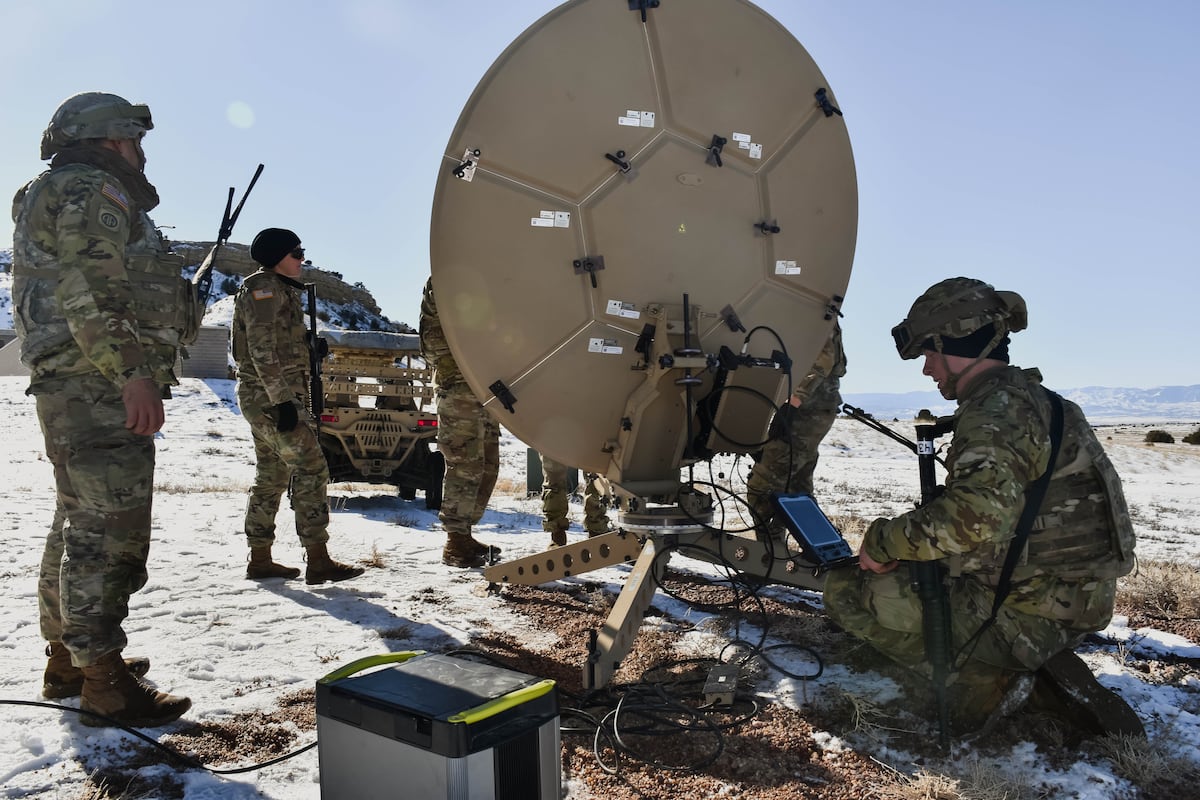
For military families, healthcare access is never just about proximity to a hospital — it depends on satellites, communications infrastructure, and the trained personnel who keep those systems running. A major shift in how the Army builds and retains its space workforce could have lasting consequences for the health security and family stability of hundreds of thousands of service members and their dependents who rely on military systems for everything from medical evacuations to Tricare eligibility checks.
The U.S. Army has officially transferred more than 600 enlisted soldiers into its newly established Space Operations Branch, creating the branch’s first-ever permanent enlisted cadre. The soldiers voluntarily applied and were selected to reclassify under Military Occupational Specialty 40D — Tactical Space Operations Specialist. Out of nearly 3,000 applicants from across the active-duty Army, National Guard, and Army Reserve, these 600 were chosen for their demonstrated excellence in their current roles.
Command Sgt. Maj. Rickey Jackson, command sergeant major of the U.S. Army Space and Missile Defense Command, described the caliber of those selected:
“We had nearly 3,000 soldiers apply, and selected over 600 of the most capable, professional soldiers in the Army. We drew talent from Military Intelligence, Air Defense Artillery and the Signal Corps, but the 40D MOS is open for anyone to apply. Ultimately, we are looking for soldiers who master their current jobs and consistently stand apart from their peers.”
Why Space Operations Matter for Military Families’ Health Security
It may not be immediately obvious why an Army space branch matters to a military spouse managing her family’s Tricare coverage or a veteran trying to reach a VA facility in a rural area. But the connection is direct. The Army itself notes that space systems support soldiers — and by extension their families — through navigation, weather forecasting, long-distance communications, and early warning capabilities. These are the same systems that coordinate medical evacuations, enable remote healthcare consultations, and ensure that personnel records — including insurance eligibility — are accurately transmitted across the globe.
That last point carries particular weight at a time when even routine outages in military administrative systems can disrupt care. A planned DEERS outage recently warned that pharmacies and healthcare providers might be unable to verify a patient’s Tricare eligibility — a reminder of just how deeply military healthcare depends on functioning digital infrastructure, much of it satellite-dependent.
Soldiers in the 1st Space Brigade — the Army’s only unit singularly focused on space operations — maintain theater missile warning capabilities and long-distance satellite communications. These aren’t abstract strategic assets. They are the backbone of the communication networks that link forward-deployed service members to military medical providers, coordinate mass casualty responses, and keep healthcare logistics flowing in austere environments where no fiber optic cable runs.
From Rotating Assignments to Stable Careers — and What That Means for Families
Before this change, the Army patched together its space capabilities by temporarily pulling soldiers from other specialties, then returning them to their original branches once their rotations ended. That approach meant hard-won expertise walked out the door — and for the families of those soldiers, it also meant repeated career disruptions that complicated healthcare coverage continuity, school enrollment, and household financial planning.
Lt. Gen. John L. Rafferty, commanding general of U.S. Army Space and Missile Defense Command, explained the problem plainly:
“For too long, enlisted soldiers with specialized space training and experience rotated through critical space assignments, eventually returning to their basic branches. The rotational system served the U.S. Army well in the past but will not meet the demands of the future, which requires a professional and sustainable approach to training, career progression and leader development for Army Space soldiers.”
For military families, stable career progression isn’t just a professional benefit — it directly shapes health coverage. Tricare enrollment, access to on-post medical facilities, and eligibility for certain benefits are all tied to a service member’s career status and assignment history. Soldiers caught in limbo between temporary rotational assignments and their home branches face administrative gaps that can translate into real disruptions for their families’ healthcare access. A formalized, permanent career path under MOS 40D helps close those gaps.
The Space Operations Branch was officially established in June, uniting the new 40D enlisted specialty with the existing Space Operations Officers, known as Functional Area 40As. Those officers have been part of the force since 1999 but lacked a dedicated enlisted corps — until now. The Army opened applications in January to soldiers in grades E-4 through E-9 across all components.
The newly designated Tactical Space Operations Specialists will train at the Space and Missile Defense Center of Excellence in Colorado Springs, Colorado. Col. Felix Torres, the center’s commandant, emphasized the specialized nature of that preparation:
“Our space operations soldiers bring unmatched value to the Army and joint force because of the education and training they receive to execute space integration and interdiction missions — specifically counter-SATCOM, stratospheric warfare, navigation warfare and counter-sensing.”
For families following these developments, the broader picture is one of institutional investment in the people and systems that underpin military life — including the communications infrastructure that healthcare delivery in the military depends on. Related coverage worth watching includes reporting on nearly 500,000 veterans receiving a three-month break from life insurance premiums, as well as updates on housing renovations at Fort Bragg — both signals of how military family support extends well beyond the battlefield.
For more on military news affecting service members and their families, including updates on benefits and housing, follow ongoing coverage. Recent stories also include Coast Guard Academy’s 150th anniversary stamp commemoration and the lasting benefit improvements championed by outgoing AAFES director Tom Shull. Video coverage includes Medal of Honor recipient Retired Maj. Nicholas Dockery discussing his mission beyond service, Leonardo DRS’s cancer initiative at AUSA Annual, TAPS founder Bonnie Carroll on supporting families of fallen service members, and the latest Defense News Weekly full episode. Load more stories for additional coverage of the issues that matter to military families.







Comments are closed.