
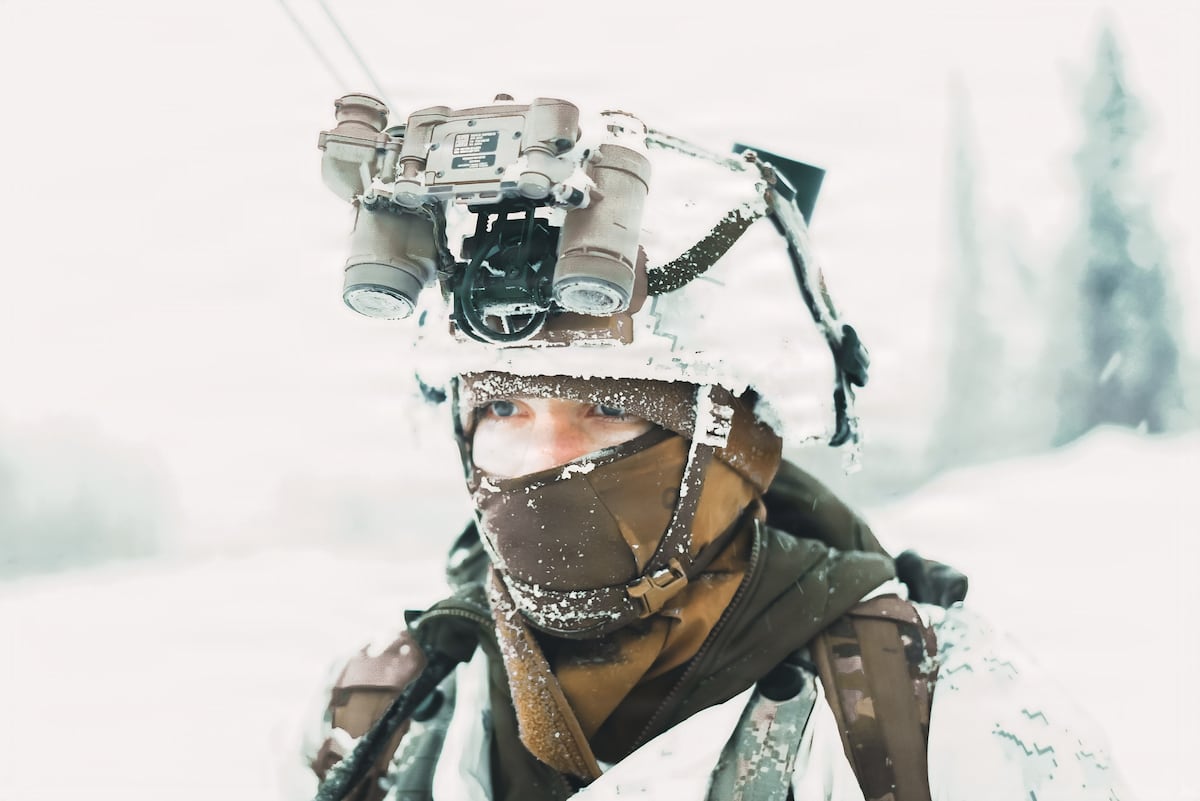
At the far edge of the American continent, where temperatures plunge to 40 below zero and darkness swallows entire months, U.S. Army soldiers stationed in Alaska face health risks that most Americans will never encounter. For the families of those serving with the 11th Airborne Division — the military’s only Arctic division — access to quality medical care, mental health support, and physical injury treatment isn’t a policy abstraction. It’s a daily reality shaped by extreme isolation, brutal cold, and the demands of one of the most physically punishing assignments in the U.S. military.
Understanding what it means to keep troops and their loved ones healthy in America’s most remote military posting requires understanding the environment itself. Maj. Gen. John Cogbill, the commanding general of the Arctic Angels, puts it plainly: “We have a saying that everything breaks at 40 below.” The human body is no exception — and the healthcare infrastructure built around Alaska’s Joint Base Elmendorf-Richardson (JBER) carries the weight of keeping thousands of service members and their families whole.
Frostbite, Injuries, and the Physical Cost of Arctic Service
Training service members to fight in Arctic conditions means accepting that injuries will happen. Frostbite, hypothermia, and musculoskeletal damage from hauling heavy gear through waist-deep snow are occupational hazards for paratroopers stationed in Alaska. Cogbill has spoken openly about the stakes: “If you violate a standard in the Arctic, people lose a finger, a hand, a leg or a life.”
That physical danger is not abstract. During the division’s most recent Joint Pacific Multinational Readiness Center rotation in February, soldiers operated in temperatures ranging from -20 to -40 degrees Fahrenheit. At those extremes, the body’s ability to regulate temperature is constantly under siege, and medical personnel must be equipped and positioned to respond quickly — often in locations far from conventional hospital infrastructure.
The soldiers of the 11th Airborne train to sustain themselves in the field, but that self-sufficiency has limits when serious injuries occur. Getting a severely frostbitten or hypothermic soldier out of a remote training area like the Yukon Training Area to definitive medical care is a logistical challenge unique to Alaska — one that families of deployed troops are acutely aware of.
Mental Health Under Pressure: The Hidden Cost of Isolation
Beyond the physical risks, the psychological demands of Arctic service are significant. Soldiers arriving at JBER for the first time often come, as Cogbill describes, with “trepidation in their eyes.” Extended field operations in darkness, extreme cold, and geographic isolation from family and support networks create conditions that can erode mental well-being.
Cogbill frames the solution in terms of trust and leadership: “When I see them six months later, after they’ve been through their cold-weather indoctrination course and gone out to the field, they realize their team leader, their squad leader, their platoon sergeant — they’re being taken care of. We’re not going to give them something they can’t handle. Then they start to build that trust in their leaders and trust in themselves. That’s when they truly become Arctic-tough.”
But building mental resilience in troops is only part of the equation. For military families living in Alaska — often far from extended family networks and civilian community support — the isolation multiplies. Spouses managing households alone during extended field exercises, children adjusting to remote postings, and the cumulative stress of repeated Arctic deployments all place pressure on family stability in ways that ripple outward into healthcare utilization, mental health service demand, and financial strain.
Healthcare Access at the Edge of the World
JBER is home to one of the military’s more substantial installation healthcare systems, but geographic reality still shapes what is accessible and when. Cogbill notes that Alaska sits at a “crucial convergence” of three combatant commands — U.S. Pacific Command, U.S. Northern Command, and U.S. European Command — which underscores the installation’s strategic importance. That strategic weight, however, does not automatically translate into civilian-equivalent healthcare access for families.
For military families relying on TRICARE — the military’s health insurance program — distance from major metropolitan medical centers can mean longer wait times for specialist care, limited access to certain pediatric services, and fewer options when mental health appointments are needed urgently. Alaska’s sparse civilian healthcare infrastructure means that when the military system faces capacity constraints, the alternatives are far more limited than at bases in the continental United States.
The division’s own operational demands intensify this picture. With soldiers conducting exercises every 90 days and brigades cycling through combined arms live-fire rotations at JBER, the tempo of operations keeps service members away from home — and away from their families’ day-to-day healthcare needs — with regularity.
Innovation in the Field — and in Medical Readiness
The 11th Airborne’s approach to operational challenges mirrors its approach to medical readiness: innovate constantly, learn from peers, and close gaps quickly. Cogbill describes a division that collaborates with the SkyFoundry initiative and academic partners at the University of Alaska, Fairbanks, to solve engineering problems that standard military equipment cannot handle at extreme temperatures. The same engineering rigor applies to sustaining human health in the field.
Water delivery, for example, cannot be handled in bulk in Arctic conditions. Fuel must be delivered in cubed form. These logistical realities extend to medical supply chains — ensuring that medications remain effective, that IV fluids don’t freeze, and that medical personnel can function effectively in conditions where battery-powered devices may operate at a fraction of their rated capacity.
The division has also partnered with units like the 101st Airborne Division and the 25th Infantry Division to share lessons learned and adapt best practices. That collaborative model, Cogbill suggests, is the only way to stay ahead of an environment that does not forgive gaps in preparation.
Family Stability When the Mission Comes First
Cogbill speaks of the ANGELS acronym his command uses to remind soldiers of expectations: Arctic tough, Night fighters, Great teammates, Experts in the fundamentals, Lethal, and Standard bearers. Each element carries a health dimension that extends beyond the individual soldier.
“Standard bearers” is perhaps the most medically significant. As Cogbill explains, standards in the Arctic are not bureaucratic checkboxes — they are the line between a soldier returning home whole and a family receiving devastating news. “If you violate a standard in the Arctic, people lose a finger, a hand, a leg or a life,” he says. “It’s a natural risk to operate in this environment, so we need leaders who are very engaged, who know the standard, who uphold it and model it themselves. That builds trust in the organization.”
For families watching their loved ones serve in one of the most demanding environments on the planet, that standard-bearing culture is ultimately what stands between danger and safety. The Joint Pacific Alaskan Range Complex — two and a half times the size of the National Training Center in Fort Irwin, California — offers vast training opportunities, but it also represents vast distances from emergency medical care when things go wrong.
Cogbill captures the essence of what draws people to this assignment — and what keeps them: “Once you’ve served in Alaska, you kind of never want to leave. Most people come here a little bit nervous, but they leave kicking and screaming.” For the families who share that journey, the health system supporting them in the world’s most extreme military posting matters just as much as the mission itself.




Comments are closed.