
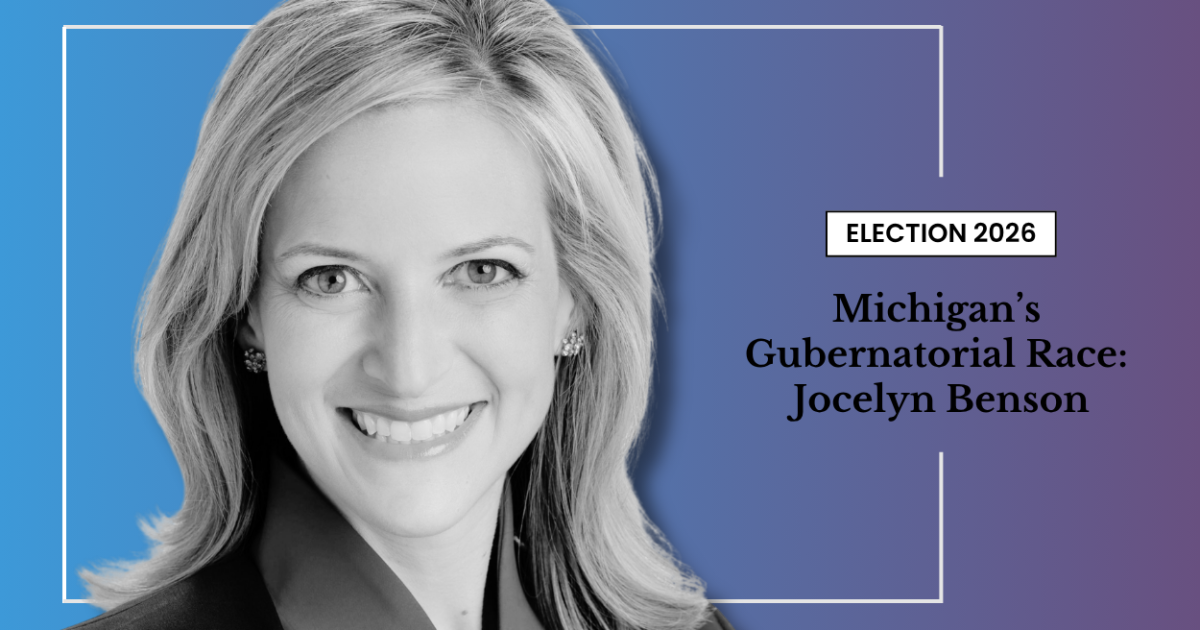
With Michigan’s governor’s seat up for grabs this November, millions of families across the state are watching closely — because whoever wins will have direct influence over the costs they pay for health care, housing, child care, and electricity. Democratic candidate Jocelyn Benson, Michigan’s Secretary of State since 2019, sat down with Michigan Public‘s Stateside host April Baer to explain what she would do differently for Michiganders struggling with rising prices and economic uncertainty.
From Secretary of State to Governor’s Race
Benson is a familiar name to most Michigan voters, having spent the last several years running the state’s election and motor vehicle systems. Now she’s making her case to lead the entire state government. In her conversation with Michigan Public‘s Stateside, she framed her decision to run in deeply personal terms.
“I’m a mom of a 10-year-old little boy, and it’s not lost on me that everything we do over the next eight years will define my kid’s future. And it will define the future of our loved ones all across the state.”
She pointed to her record at the Secretary of State’s office as evidence she can improve how government works for everyday people — including transforming the state’s Department of Motor Vehicles from a source of frustration into a model of efficiency. Michigan’s elections, she noted, climbed from a national ranking of 30th to second in safety, security, and accessibility on her watch.
Tariffs Are Hitting Michigan Harder Than Anywhere Else
For Michigan families — and particularly for workers in the auto industry — federal tariffs have become a real kitchen-table issue. Benson was direct about the financial pain they’re causing.
“One of the reasons why we’re seeing a lot of costs go up recently are these tariffs, tariffs with Canada that are hitting Michiganders harder than any other state.”
As part of the broader Michigan governor’s race, Benson’s approach to tariffs has become a defining contrast between the candidates. She said she would pursue what are called “subnational agreements” — deals negotiated directly between the state of Michigan and Canada — to carve out exemptions for specific products, particularly auto-industry supplies, from tariff burdens.
She pointed to Maine as an example of how this has worked in practice:
“Maine has done this on rock salt for their roads. Say, when this particular product just goes between Michigan and Canada or vice versa, we want to exempt it from tariffs.”
She added that governors can then work with the federal Department of Commerce to get those exemptions formally approved.
Health Care, Housing, and the Daily Cost of Living
On the stump, Benson says voters keep coming back to one topic above all others: health care costs. She described the stories she’s been hearing on the campaign trail as
“heartbreaking stories, particularly about the cost of health care, which is skyrocketing for small business leaders and families alike.”
She contrasted her position with that of her opponent in the gubernatorial election, arguing that
“my opponent voted three times to raise health care premiums while I have a plan to lower them.”
That plan includes pushing the state’s Department of Health and Human Services to help residents fight back against unfair insurance denials, tackle medical debt, and demand greater transparency in medical billing — changes that could directly affect what Michigan families pay out of pocket.
Beyond health care, Benson outlined plans to increase the supply of affordable housing, crack down on bad actors she says are driving up home prices, and make child care more affordable — all issues that weigh heavily on household budgets across the state. She also called for investment in clean energy infrastructure as a way to bring electricity costs down over time.
Former President Barack Obama recently rallied alongside Benson in Detroit, energizing the Democratic base in the race’s final stretch. And party leaders are pushing hard to turn out voters, with nearly 680,000 Michiganders already casting early ballots as of mid-October.
Public Schools and Workforce Investment
Benson placed education near the top of her economic agenda, arguing that decades of school funding cuts have left Michigan students falling behind — and that weaker schools ultimately hurt the state’s workforce and economy. She called for better teacher pay, restructured school funding to meet each district’s unique needs, and continuing the free school meals program expanded under the current administration.
On workforce development, she described a vision that goes beyond traditional schooling:
“investing in talent workforce development, not just in better schools, but in apprenticeships and other opportunities that will help our businesses grow and find the talent they need to thrive.”
She said that kind of investment pays off doubly — it helps businesses find workers and creates well-paying jobs for Michigan residents.
Data Centers and Local Control
One issue that has emerged as a flashpoint in communities across Michigan is the rapid expansion of data centers, which critics say strain local water supplies and drive up energy costs. Benson called for a moratorium on new data center construction until the state puts protective guardrails in place.
“That means protections for our water, protections for our energy costs, and above all, protecting local voices to ensure they have a say in community benefits agreements that will bring costs down in their own communities.”
She also proposed creating an online portal where residents could see and weigh in on data center proposals affecting their communities — a direct response to concerns that local families are being left out of decisions that affect their daily lives.
Democracy and Election Security
As the state’s chief election officer, Benson said protecting voting rights remains a top priority. She described the threat in stark terms, saying that as Secretary of State she had seen firsthand how far some actors would go to block people from casting ballots or overturning results.
“The battle over the future of our democracy is still ongoing. It’s one that we saw firsthand in 2020, when the president of the United States and my opponent spent millions of dollars trying to overturn fair and free elections.”
She argued that electing state leaders committed to protecting voting rights is the most direct way Michigan residents can safeguard democratic participation.
The candidates faced off in a second gubernatorial debate earlier this month, where rising gas prices and education funding took center stage. Early voting is already underway across Michigan ahead of the November election.
For additional coverage of the politics and government stories shaping Michigan, including reporting by Colin Jackson, Steve Carmody, and Tracy Samilton, visit Michigan Public‘s Michigan governor coverage hub.



Comments are closed.