
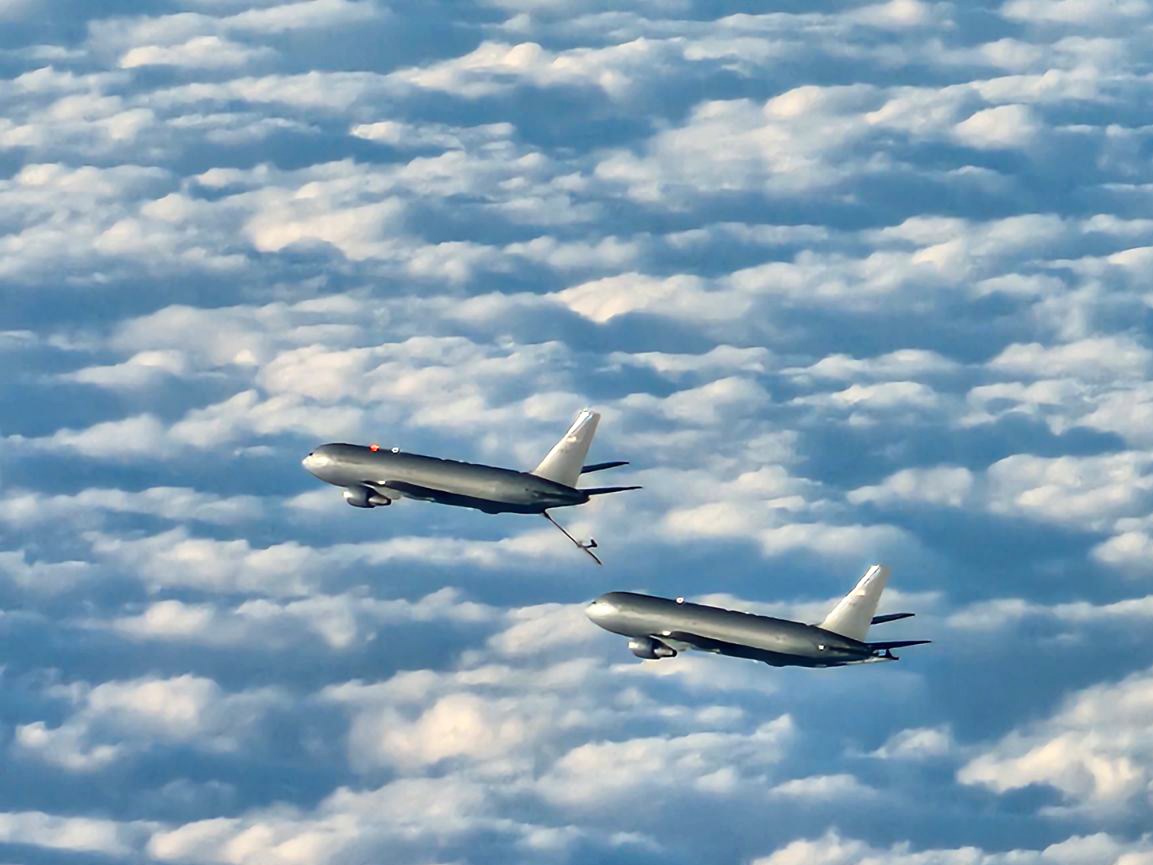
Aerial refueling is one of the most technically demanding skills a military aviator can master — and right now, judging how well it’s done depends largely on human eyes and human memory. The U.S. Air Force wants to change that, and it’s turning to artificial intelligence to do it.
The Air Force has issued a Small Business Innovation Research (SBIR) solicitation seeking technology that would use cameras mounted on tankers to automatically analyze aerial refueling operations in real time and deliver immediate feedback — known as a “hot wash” — directly to flight crews after a mission. The application deadline is November 25.
What the Technology Would Do
According to the SBIR solicitation, the Air Force wants a system that can
“leverage advanced computer vision, machine learning, and aviation (flight dynamics) analytics techniques to automatically extract operationally relevant performance metrics from aerial refueling events, quantify deviations from desired flight profiles, and generate actionable post-flight feedback to improve aircrew proficiency, reduce human-factor-driven mishaps, and enhance mission readiness.”
In practical terms, the system would use onboard cameras to automatically track the tanker aircraft, its refueling boom, and the receiving aircraft simultaneously. It would gather precise measurements including position, velocity, alignment, and closure rate — then flag any deviations from standard operational parameters.
Beyond raw data collection, the system would generate visual tools for pilots, such as graphic AI overlays, heat maps, event timelines, and immersive or interactive debrief environments. The Air Force also envisions it connecting with existing training infrastructure, including simulators, virtual and augmented reality systems, and other computer-based training platforms.
Why the Air Force Says It’s Needed
The push for AI-assisted evaluation comes from a recognized limitation in how crews are currently assessed. As the SBIR noted,
“Current aerial refueling training and post-flight assessment processes rely heavily on instructor observation, pilot self-assessment, manual video review, and subjective evaluation of performance.”
That reliance on human judgment introduces inconsistency. Instructors can hold different standards. Pilots may not accurately recall their own mistakes. Manual video review is time-consuming. An automated AI system, the Air Force argues, could deliver more consistent, objective, and timely performance data — ultimately making crews safer and more effective.
The solicitation is focused specifically on the KC-46 Pegasus tanker, which is already equipped with a remote vision system that allows operators to control the refueling boom through cameras and a 3D display. The KC-46 has faced well-documented technical problems with that vision system, though the Air Force has said most issues are expected to be resolved soon.
A Building Block for the Broader Military
The Air Force is treating this effort as more than a single-platform fix. Officials see the system as a prototype for AI-driven training assessment across the Department of Defense. The solicitation spells out the ambition clearly:
“The desired end state is an operationally demonstrated capability ready to implement for at least one type of receiver aircraft and that can support transition into existing aviation training ecosystems and provide a scalable foundation for future AI-enabled aviation performance assessment across the Department of Defense.”
This initiative fits into a broader wave of AI adoption across the military services. The U.S. Marine Corps recently made its Maven AI battlefield management system available service-wide, while the Air Force demonstrated an F-22 pilot directing an unmanned aircraft in flight. The Navy has expanded its AI-assisted maintenance contract with Gecko Robotics to $300 million, and the Army’s rollout of its Next Generation Command and Control system continues to hinge on available funding.
For now, small businesses have until November 25 to submit proposals for the Air Force’s refueling AI system — an opportunity that could shape how the military trains aviators for years to come.







Comments are closed.