
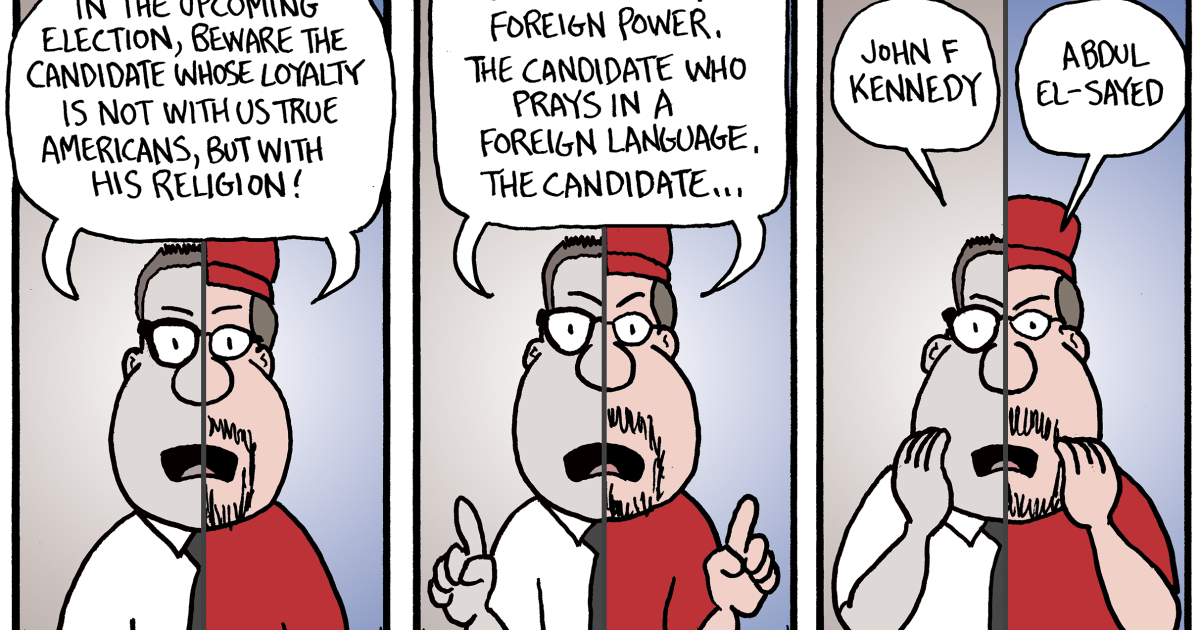
Religious intolerance is not a new phenomenon in America — but how a society responds to it says everything about its values. A recent political cartoon and a viral video have reignited a conversation about one of the most fundamental promises the United States made to itself at its founding.
John Auchter, a Michigan-based freelance political cartoonist whose work appears regularly in Auchter’s Art on Michigan Public, recently turned his pen toward the subject of religious bigotry in America — specifically as it is being experienced by Abdul El-Sayed, a prominent Muslim public figure in Michigan.
Auchter says the idea for the cartoon came before he saw the now-viral “Tommy” video circulating on social media — a video in which El-Sayed addresses anti-Muslim bias head-on. When Auchter finally watched it, he found it reinforced exactly what he had already set out to illustrate.
A Founding Principle Under Pressure
At the heart of Auchter’s commentary is a historical argument: that the United States was built, in part, as a sanctuary for people fleeing religious persecution. That principle, he argues, is not incidental to American identity — it is central to it.
As Auchter writes,
“being a refuge for those who have experienced religious intolerance is a critical part of our country’s origin story — it is literally foundational to how we intended our country operate.”
He is careful to note that America holds no special claim to this failing. Religious intolerance, he points out, is
“a universal human fault.”
But that universality does not make it any less urgent to confront, particularly in a country that was explicitly designed to be different.
El-Sayed’s Experience Echoes a Long History
What El-Sayed is navigating as a Muslim in American public life — the suspicion, the bias, the othering — is, according to Auchter, far from unprecedented. Many religious minorities throughout U.S. history have faced similar treatment: Catholics, Jews, Mormons, and others were each, at various points, targets of organized discrimination and public hostility.
The pattern is old. What changes is the target. And what matters most, Auchter argues, is the public’s response.
“What is critical now is that we don’t reward it,”
he writes.
That line — spare, direct, and deliberate — is the moral core of his message. Intolerance may be a recurring human tendency, but endorsing it through votes, clicks, or silence is a choice. And choices have consequences in a democracy.
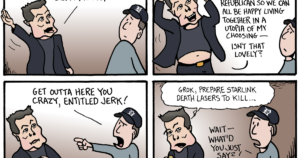
Auchter has addressed other aspects of Michigan’s political landscape in recent cartoons, including pieces on Elon Musk’s influence on Michigan elections, the dynamics between Senate candidates in the state, and the flood of political text messages targeting voters from both parties.
Other stories from Michigan Public this week include coverage of the James campaign’s environmental platform in Macomb County, a new study on oil spills in the Great Lakes, Secretary Benson’s statewide bus tour, election interference warnings from the ACLU and Attorney General Nessel, updates on fuel loading at Palisades nuclear plant, and a roundup of 28 things to do across Michigan this weekend.






Comments are closed.