For millions of working-class families across the Midwest, who wins at the ballot box can determine whether factories stay open, whether wages rise, and whether daily expenses remain manageable. The United Auto Workers union — once a powerhouse of American labor politics — is fighting to remind its members of exactly that as the Nov. 3 midterms approach.
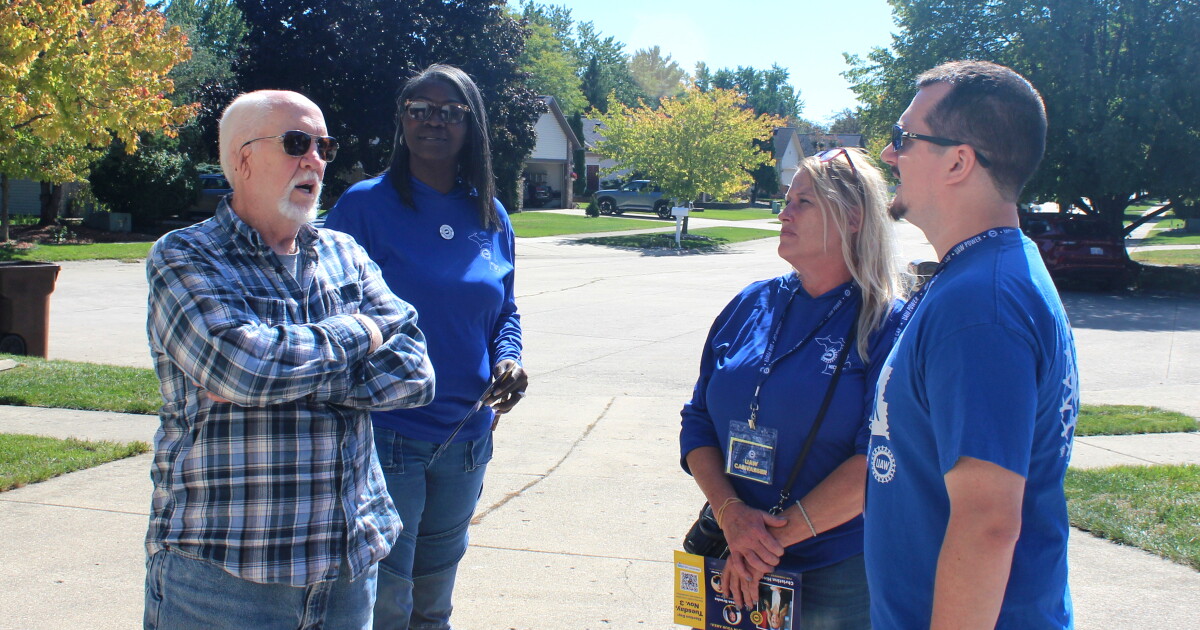
In the suburbs north of Detroit, UAW canvassers are going door to door in neighborhoods filled with current and retired autoworkers, making the case that their endorsed candidates will do more to protect working-class wallets. But inside the union itself, deep divisions over politics, trust, and economic priorities are making that case harder to make.
A Union Divided Over Who Speaks for Workers
When UAW canvassers knocked on Walter Usakowski’s door in Shelby Township, the retired Ford Motor Co. worker didn’t need much convincing. He was already backing the union’s slate of Democratic candidates. But Usakowski, who spent more than 45 years at Ford’s Sterling Axle Plant, was less certain about his former coworkers.
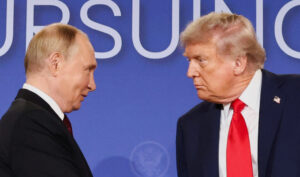
Many of the men he worked alongside have supported Republican President Donald Trump — a reflection of how broader political rifts have split a union that once reliably delivered votes for Democrats.
In 2024, voters who were union members — or lived in a household with one — split between Trump and Democratic nominee Kamala Harris. More than half went for Harris, but 44% backed Trump — a sign of just how much ground traditional labor politics has lost with its own base.
Canvassers working Macomb County — a battleground county Trump won by nearly 14 percentage points in 2024 — found that split playing out on nearly every street. The cost of living was the top concern for most residents they spoke with. But they did not agree on which party would better address it. One resident said she blamed billionaires for economic hardship and planned to vote Democrat. A couple on the next block said they both supported Trump and turned away the UAW’s candidate flyers.
Betty Anderson, a UAW member, said the internal divide goes beyond politics — it’s personal. She expressed frustration with fellow union members who voted for Trump, saying she believes they were misled about whose interests he would actually protect.
“I don’t think those people are ever going to be on our side. They think they have an opportunity to be in an elite class.”
— Betty Anderson, UAW member
Corruption and Closed Doors Hurt the UAW’s Credibility
Part of what’s driving that distrust isn’t just politics — it’s the union’s own troubled recent history. Since 2017, more than 10 UAW officials have pleaded guilty in a corruption investigation that revealed millions of dollars in union dues were stolen. Members also faulted leaders for conducting contract negotiations behind closed doors, cutting rank-and-file workers out of decisions that directly affected their jobs and paychecks.
UAW President Shawn Fain, elected in 2023 on a promise of transparency, has tried to change that culture. His victories in labor disputes with Detroit’s three major automakers helped restore some confidence among members. On Friday, Fain won reelection to lead the union for four more years, though results have not yet been certified.
Usakowski said he sees progress.
“I think the UAW members now are starting to fall a little more in line.”
The union hosted open forums where members could directly question candidates — a deliberate departure from its past secrecy. It endorsed progressive Democrat Abdul El-Sayed in Michigan’s U.S. Senate primary over rival Haley Stevens, a four-term congresswoman who had served as chief of staff on an auto industry bailout task force. The union cited El-Sayed’s support for universal healthcare and opposition to corporate money in politics.
Mark DePaoli, director of one of the UAW’s southeast Michigan regions, acknowledged the decision raised eyebrows.
“I don’t think anybody expected us to endorse him.”
El-Sayed spokesperson Cole Wozniak credited the UAW’s backing with helping his candidate win a primary despite being financially outmatched:
“The UAW’s backing of Abdul was critical in winning a historic primary despite being outspent by tens of millions of dollars, and will be just as critical in winning”
next month, Wozniak said.
Republican Senate candidate Mike Rogers, meanwhile, is centering his campaign on opposition to Biden-era federal regulations that would have required automakers to ramp up production of electric vehicles — rules that some autoworkers feared could lead to plant closures and job losses. Rogers spokesperson Alyssa Brouillet said in a statement:
“Mike knows the challenges our autoworkers face, and he’ll be their champion in the U.S. Senate. The same can’t be said for Abdul and UAW national leadership.”
Turnout Is the Real Test
Even with improved leadership and a clearer message, the UAW faces a numbers challenge. In the 1980s, more than 600,000 active and retired UAW members lived in Michigan. Today, that figure sits around 350,000 — still the largest union in the state, but a fraction of its former reach.
Robert Bruno, a professor in the School of Labor and Employment Relations at the University of Illinois Urbana-Champaign, said the UAW’s real leverage comes not from endorsements, but from showing up.
“You don’t win campaigns off of your endorsements. You win campaigns at the door, or at the bar, or at the union hall.”
The union reported roughly 113,000 members voted early during Michigan’s August primary, and it has mobilized volunteers for canvassing and phone banking in the weeks before Election Day. In September, UAW held a conference of its Michigan political arm — the first such gathering since 2018.
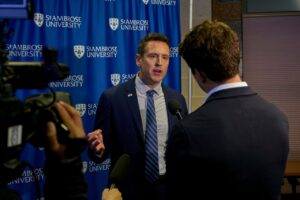
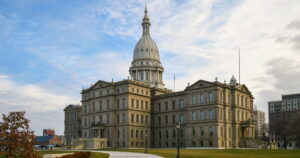
At that Lansing event, Fain told reporters that the union wants its members driving its direction, with a focus on issues like affordability that hit family budgets hardest.
“We are as active as we can be right now.”
JJ Jewell, part of the UAW’s Community Action Program executive committee, offered a clear-eyed summary of where the union stands. Winning this election, he said, would be a start — not a finish.
“It’s not going to be an overnight thing. Even if this election goes fantastically, that’s not mission accomplished. That means we’re 1% of the way done.”
For autoworkers and their families wondering whether the union that once defined the American middle class can still fight for them, the answer may not come until Election Day — and perhaps not fully for years after that. For more on Michigan’s political landscape and UAW coverage, including a look at the new era of UAW leadership and the politics behind presidential visits with the union, Michigan Public has tracked these developments closely. Reporting for this story was supported by Report for America, a nonprofit program placing journalists in local newsrooms to cover undercovered issues, with original reporting by Jacqueline GaNun.

Comments are closed.