
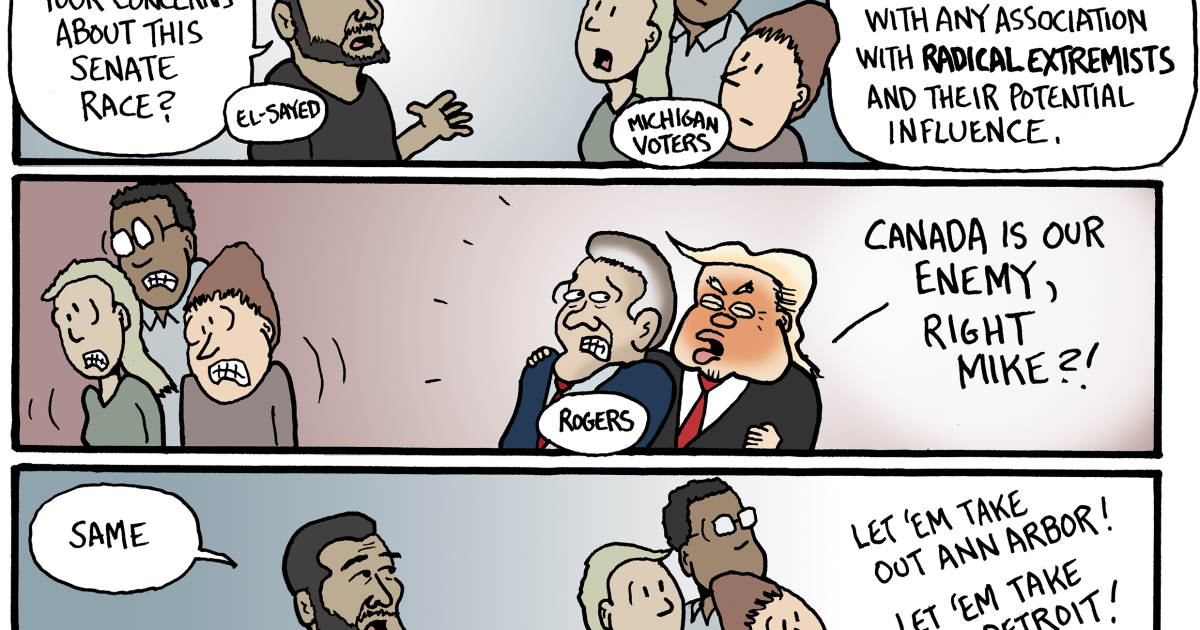
Michigan’s U.S. Senate race is heating up, and both major candidates are spending nearly as much energy managing political baggage as they are making their case to voters. With the debate between Abdul El-Sayed and Mike Rogers drawing national attention, the question isn’t just where each candidate stands — it’s who they’ve stood next to.
El-Sayed and the Piker Problem
For El-Sayed, scrutiny has centered on a past association with online streamer Hasan Piker, whose rhetoric targeting Israel has drawn sharp criticism. Political cartoonist John Auchter, writing for Michigan Public, noted that Piker’s views are “extreme and not in line with Michiganders” — and that voters have every right to be uncomfortable with that connection.
El-Sayed has moved to put distance between himself and Piker, publicly condemning antisemitic rhetoric and making clear his opposition to any speech that threatens the Jewish community. Whether those efforts satisfy voters depends on the individual. For some, the clarification is sufficient. For others, the prior association remains a sticking point that no statement can fully erase.
Rogers and a Much Bigger Shadow
Mike Rogers faces a different challenge — and by most measures, a significantly larger one. Rather than distancing himself from a fringe internet personality, Rogers has found himself navigating the fallout from his ties to President Donald Trump himself.
As Auchter observed in his political cartoon commentary, Trump has built his political career on saying and doing as he pleases — a style that has proven costly for the Republicans who run under his banner. According to Auchter,
“the horrible things he says and terrible decisions he makes aren’t working well for his Republican underlings.”
Rogers, like many in his party, appears to be recalculating. The effort to put space between himself and the president is a move Auchter suggests may win over only a narrow slice of the electorate:
“For maybe a few voters, that will work. For most, it will not.”
The Rogers-El-Sayed debate was described as hostile, with both candidates clashing sharply in what many consider a pivotal contest for the state and for control of the Senate. The race is unfolding against a crowded political backdrop in Michigan, which also includes a contested Secretary of State race focused on election integrity and a high-profile state lawsuit against Blue Cross Blue Shield.
Auchter, a longtime Michigan political cartoonist who has been covering state politics since 1995, acknowledged in his piece that his cartoon deadline fell before the debate itself, leaving open the possibility that new developments could shift the conversation. His broader point, however, stands: both candidates are defined as much by their associations as by their platforms — and Michigan voters are paying close attention.
Other races on Michigan’s ballot are also drawing scrutiny. Voters can learn more about Michigan Supreme Court candidate Jody White, while reporting continues on how Michigan traffic stops are contributing to deportations — a policy issue that could influence voter sentiment heading into November. For those looking to stay engaged locally, weekend community events across the state also offer a reminder that civic life extends well beyond the campaign trail.
Earlier commentary from Auchter has tracked these tensions throughout the election cycle. In a prior piece, Auchter’s Art: Lose My Number, he wrote about the flood of political attack texts hitting Michigan residents from both parties. And in Auchter: Intelligence Concerns, he criticized the administration’s approach to trade and tariffs. His piece Auchter Art: Challenges Ahead also called out Rogers directly over the GOP’s posture on government intervention in private enterprise.



Comments are closed.