
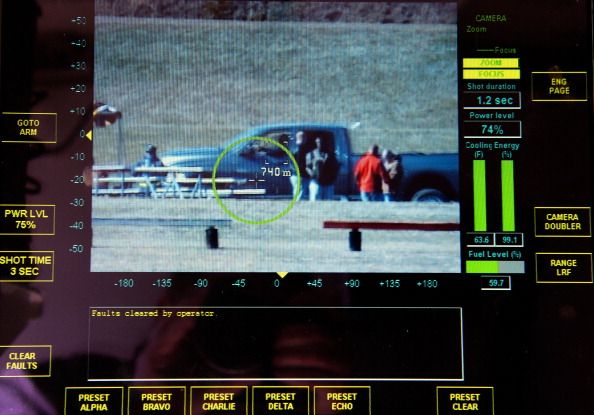
The U.S. military is lending a powerful directed-energy weapon to the Department of Homeland Security for testing near the U.S.-Mexico border — a move that would mark an unprecedented expansion of military-grade crowd control technology in domestic immigration enforcement. The authorization has drawn scrutiny not only for its border implications, but for what internal government discussions reveal about broader potential uses closer to home.
The Pentagon has authorized a temporary, seven-month loan of one Active Denial System (ADS) to DHS, beginning in September. The authorization memo specifies that the system
“shall not be operated by Department of War personnel,”
placing sole responsibility for its use — and for developing related tactics and procedures — on DHS.
What Is the Active Denial System?
The U.S. military describes the ADS as a nonlethal weapon that fires an invisible beam of electromagnetic waves capable of reaching just over half a mile. According to CNN,
the energy beam causes a burning sensation when it comes into contact with the human skin — which Pentagon officials have previously compared to feeling a blast of heat when opening a hot oven.
Military officials have said the resulting
“tingling effect”
lasts between 10 and 15 minutes but also generates
“an instinctive and irresistible urge to run from the effect.”
The weapon has been in the U.S. military’s arsenal for years but has never been deployed operationally at the U.S. border. Its potential use by Customs and Border Protection against migrants would represent a significant and historically novel step in border enforcement strategy.
Border Use — And Potentially Beyond
The DHS request did not specify exactly where or how the weapon would be tested or ultimately deployed. However, according to CNN, there have been internal discussions over the years about potentially using the ADS for crowd dispersal along the U.S.-Mexico border, based on accounts from current and former CBP officials.
Perhaps more striking is a separate disclosure from CNN: U.S. officials had also considered deploying the system during moments of domestic unrest, including at the end of President Donald Trump‘s first term when protests erupted over the murder of George Floyd, according to a former U.S. official familiar with those discussions.
That revelation raises questions about the scope of how the government envisions using military-grade crowd-control technology — not just at the border, but potentially in American cities during periods of civil unrest. Critics have drawn connections between immigration enforcement actions and broader patterns of militarized policing in communities of color, noting that ICE operations have been concentrated in cities like Chicago, Los Angeles, Minneapolis, and New Orleans.
The administration has also been sending the National Guard to several of those same cities — deployments that have not been without consequence. In Memphis, a Black man was killed by National Guard members during one such operation.
Context: A Shifting Chain of Command
The memo’s reference to the “Department of War” — the formal name change from the Department of Defense pushed under the current administration — reflects the broader rebranding effort championed by Secretary of War Pete Hegseth. Questions about Hegseth’s qualifications and judgment have followed the administration since his confirmation, and this latest development is likely to intensify that scrutiny.
The authorization also comes in the context of the MAGA-aligned administration’s broader effort to expand the role of military assets in domestic law enforcement — a trend that legal and civil liberties advocates have flagged as a potential violation of the Posse Comitatus Act, which restricts the use of federal military forces in civilian law enforcement.
The DHS has not yet made public any specific plans for testing or operating the ADS system, and no timeline has been given for when or whether it might be deployed in the field. For now, the authorization remains a loan — but the implications of what comes next are drawing close attention from lawmakers, civil rights groups, and the public alike.
For more on related developments, see coverage of Rep. Ilhan Omar’s account of a government raid on her home and ongoing reporting from the Covfefe Chronicles with Dr. Stacey Patton.




Comments are closed.