
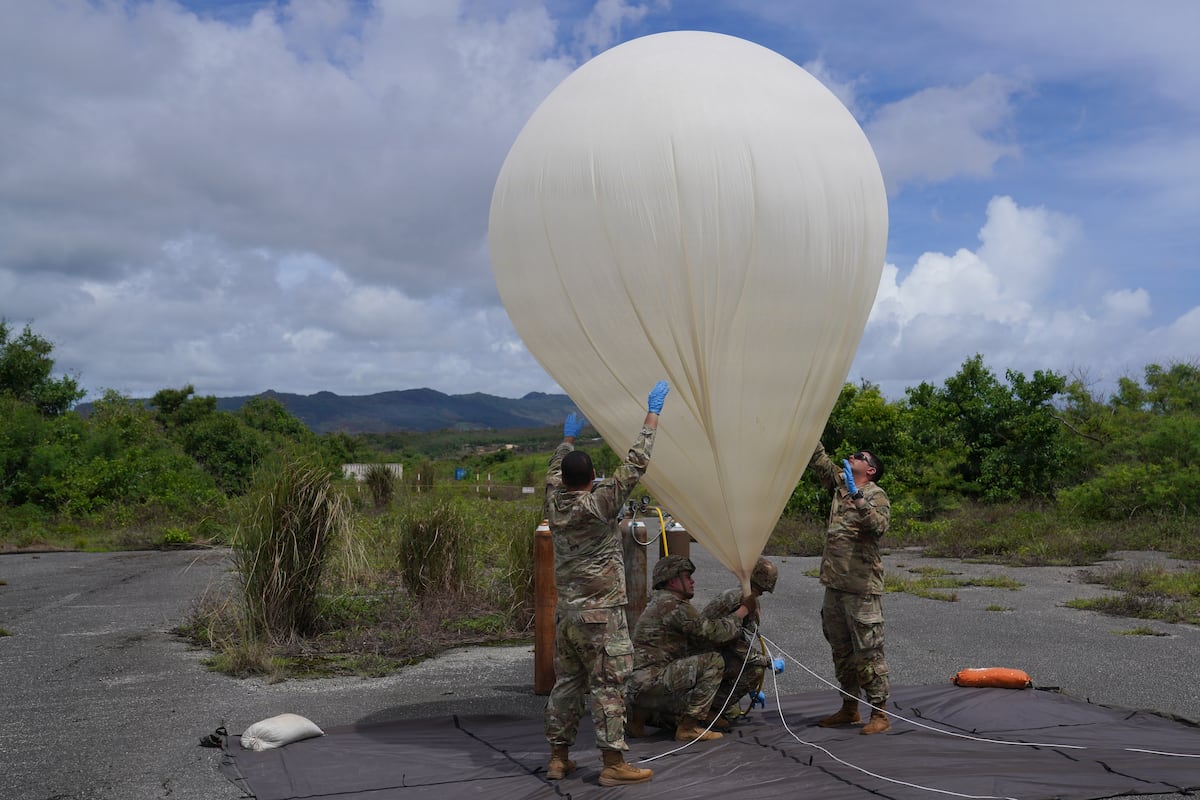
High-altitude balloons may seem like a relic of a previous century, but the U.S. Army is betting they could become one of its most flexible tools in the modern battlespace — and the American public, through its elected representatives in Congress, has a stake in understanding exactly what that means. As the military expands testing of these systems across multiple continents, the question of democratic oversight and transparency becomes increasingly important for voters who elect the lawmakers responsible for holding the Pentagon accountable.
At the Association of the United States Army’s annual meeting this week, senior military officials laid out an ambitious vision for stratospheric balloon systems — one that explicitly leaves open the possibility of arming them. Col. Joseph Mroszczyk, director of U.S. Army Space and Missile Defense Command’s Transformation Integration Directorate – Space Superiority, told reporters the Army is pursuing what he called “a family of stratospheric systems” spanning balloons of all sizes.
The goal, Mroszczyk explained, is to occupy a strategic altitude band between conventional aircraft and satellites — a zone the Army refers to as the “space littorals,” borrowing language from the Navy’s term for shallow coastal waters. This stretch runs from roughly 60,000 to 100,000 feet above Earth, and it offers something neither planes nor satellites easily provide: persistent, broad-area coverage at relatively low cost.
“What that enables us to do is provide space-like capabilities, really exploiting a transition point between what is normally considered the aerial layer and the space domain,”
Mroszczyk said.
Armed Balloons on the Table
Perhaps the most striking disclosure at the briefing was that the Army has not ruled out using balloons as weapons platforms. As Ukraine has reportedly done, the U.S. military is considering equipping balloons with kinetic — meaning lethal — payloads, though officials acknowledge that poses greater challenges than using them purely for surveillance or communications.
Mroszczyk was direct about the Army’s openness to the concept:
“I wouldn’t say that we’re going to hold back from opportunities and options that would include something that could be kinetic in nature. But right now, we’re doing experiments across the board with all types of different payloads.”
That candid acknowledgment — made publicly at an industry conference — is exactly the kind of information that enables citizens and their elected representatives to ask informed questions about military priorities, budgets, and risk. Members of Congress, chosen by voters to exercise oversight of defense programs, rely on public disclosures like these to shape legislation and appropriations decisions.
Testing Expands Across Three Continents
The Army’s balloon program has moved well beyond concept. Lt. Gen. John Rafferty, commander of U.S. Army Space and Missile Defense Command, confirmed at the briefing that systems have been deployed for testing and demonstration in Europe, the Pacific, and Morocco. Breaking Defense also reported this week that small swarms of a few dozen drones were deployed in the Middle East for testing, after a plan for a much larger demonstration in the Pacific was scrapped.
Col. Wade Germann, commander of the Army’s 3rd Multi-Domain Task Force, told Military Times that his unit is actively developing new operating concepts around the balloons, including a tiered approach that combines premium, long-endurance platforms with cheap, rapidly deployable ones.
“We work them in a format called constellation approach, where we’ll put a couple of the high, high-end, really exclusive ones up there with different payloads and systems on them. And then we’ll work in a different venue where we’ll look at cheap, very expendable, rapidly employable, in that you can put up hundreds at a time and create multiple dilemmas for the enemy on,”
Germann said.
Germann added that the Army is working with industry partners to refine not just the payloads, but also the lifting gas and launch methods used.
“That’s the way that we’re working with our partners out in the field to gain that real-time feedback and make these things happen,”
he said.
A Concept with History — and New Urgency
High-altitude balloons are not new to military thinking, but recent events have sharpened American attention on the technology. In 2023, a Chinese balloon drifted into U.S. airspace, triggering national security alarm and revealing that several prior incursions had gone entirely undetected by American defenses. That episode prompted serious questions — in Congress and among voters — about the vulnerability gaps in America’s surveillance and defense architecture.
Military analysts had seen the potential coming. In a 2019 Army University Press article, Lt. Col. Anthony Tingle argued that as the space domain grows increasingly contested, balloons offer a resilient and redundant alternative to satellites for missions including surveillance, communications, missile warning, and precision navigation.
“As the space domain becomes increasingly precarious, balloons offer resilience and redundancy against overhead capability shortfalls,”
Tingle wrote.
Rafferty said firsthand observation of the systems in the field had made him a convert to the program’s potential.
“Every time they are demonstrated in the Pacific or in Europe, there are more and more; they gain more and more support. So we’re, I think, really excited about this next year, about what we’re going to do to further the program,”
he said.
Over the coming year, Mroszczyk said, the Army plans to conduct multiple balloon experiments aimed at determining the best ways to, in his words, “exploit the stratosphere.” For voters following defense policy, the expansion of this program — and its potential to include armed platforms — underscores why congressional oversight of military technology programs remains one of the most consequential responsibilities that elected officials carry on behalf of the public they serve. Citizens who want to hold their representatives accountable on these decisions can start by knowing the programs exist.
For more coverage of the military and national security, visit related reporting on military issues affecting service members and their families, including the 2027 cost-of-living adjustment for retirees and veterans. Service members and military families planning to vote can find guidance on voting by absentee ballot. Additional reporting covers topics ranging from century-old homes being renovated at Fort Bragg to a planned DEERS outage that could affect Tricare beneficiaries.






Comments are closed.