
A Ukrainian village already devastated by a deadly Russian airstrike earlier this week became a target again on Sunday — this time, as rescue workers combed through the rubble searching for survivors. The repeated strikes on Komyshuvakha have killed at least 55 people and left dozens more unaccounted for, underscoring a pattern that Ukrainian officials say Russia uses deliberately to maximize casualties.
A Russian drone hit emergency responders conducting search-and-rescue operations at a former school and nearby shelter in southern Ukraine on Sunday. No personnel were injured, but specialized rescue equipment was damaged, according to Ukraine’s State Emergency Service. The site had already been devastated Monday when multiple Russian guided bombs struck while civilians gathered there to receive humanitarian aid.
Ukraine has long accused Russia of deliberately striking the same location twice — first to cause casualties, then to kill the first responders who arrive to help. Sunday’s drone attack on the village of Komyshuvakha fits that pattern precisely.
As of Sunday afternoon, 45 people remained listed as missing, according to Mykhailo Semikin, the acting head of the regional military administration in Zaporizhzhia. Many recovered bodies have yet to be identified, and DNA analysis is ongoing.
Among those still searching for answers is Mykola Krasnov, a 72-year-old village resident who spoke to The Associated Press on Saturday. His wife went to pick up humanitarian aid and never returned.
“She went to get humanitarian aid, and a 3-ton bomb was dropped there. Where is she?”
he said.
“She didn’t come home, and they didn’t find her body there. She isn’t in the morgue, and she isn’t here alive.”
Funerals Held for Officers and Civilians
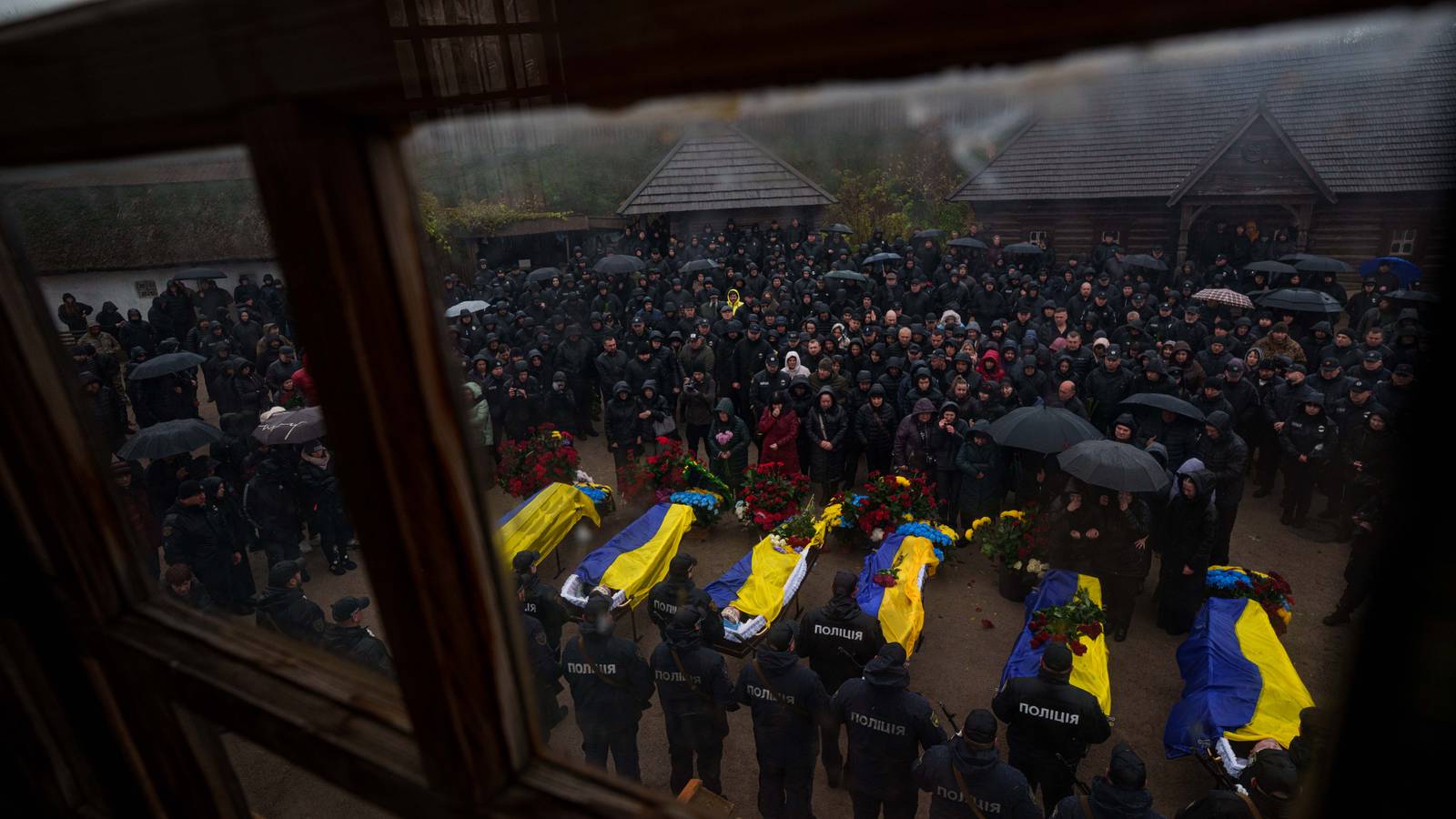
On Saturday, a farewell ceremony in Zaporizhzhia honored six police officers killed in the strikes on Komyshuvakha, including four who died near the former school. Rain fell as grieving families stood beside coffins while officers held portraits of their fallen colleagues.
Police Lieutenant Colonel Andrii Khomenko, who had served alongside the victims, addressed the gathering with words that reflected both grief and anger.
“They used every skill at their disposal to protect themselves. But when the enemy deliberately gathered civilians in one place and then launched strikes against them, no skills could have helped,”
he said.
Three local residents were also mourned at separate services. Yurii Karapetian lost his wife, Natalia, who was distributing bread to people sheltering at the site when the bombs hit. He called on the world to take notice.
“This pain, I would say, is unbearable,”
he said, before issuing a stark warning:
“The whole world must understand that if (the Russians) are not stopped, they will not stop. They will not stop at Ukraine. They will not stop anywhere.”
President Volodymyr Zelenskyy condemned Sunday’s drone strike on rescue workers in a post on X, calling it
“absolute cynicism and brutality.”
European Nations Push Into Peace Talks
Diplomatic developments are also unfolding. French Foreign Minister Jean-Noël Barrot announced Sunday that France and other European representatives plan to participate in U.S.-mediated negotiations between Russia and Ukraine scheduled for Abu Dhabi on November 10–11.
“France will be there and will ensure that Europe’s voice is heard,”
Barrot told RTL radio, without specifying who would represent France or whether European officials would sit directly at the negotiating table.
The talks had previously been framed as a trilateral meeting among Washington, Moscow, and Kyiv. U.S. President Donald Trump has described the anticipated deal as “very big” — one that could extend beyond Ukraine to encompass “all of Europe.” That framing raised alarm among European governments worried about being excluded from decisions directly affecting their own security.
Power Outages and Nuclear Plant Concerns
Russian strikes on Ukraine’s Dnipropetrovsk region knocked out electricity for more than 600,000 people, Zelenskyy reported on X Sunday. Russia’s defense ministry claimed its forces targeted an electrical substation supplying Ukrainian military-industrial facilities. Other regions of Ukraine also experienced outages.
Zelenskyy said Russia launched 115 missiles, 1,900 guided aerial bombs, and more than 3,000 drones against Ukraine over the past week alone — many of the missiles manufactured this year. He called on Ukraine’s international partners to sanction entities involved in Russian weapons production.
“If the world does not have enough anti-ballistic capabilities to protect Ukrainian skies, then the missiles must be stopped on the production lines,”
he said.
Adding to the anxiety, the Zaporizhzhia Nuclear Power Plant — the largest in Europe and currently under Russian control — lost its external power supply Sunday after a damaged line was disconnected for safety reasons. The plant switched to backup diesel generators after an automatic protection system shut down the affected line. Ukraine’s state nuclear operator, Energoatom, confirmed the plant was relying on generator power.
The plant has been offline since early in the war but requires continuous power to run cooling systems. Its external power supply has been cut multiple times throughout the conflict, raising repeated concerns about the risk of a nuclear accident if outages become prolonged. Both Moscow and Kyiv have blamed each other for strikes that have damaged nearby power infrastructure.
Overnight into Sunday, Russia launched 164 drones across Ukraine, 137 of which were shot down, the Ukrainian Air Force reported. Later Sunday, one person was killed and three others wounded when Russian forces struck a residential neighborhood in Dnipro, according to local administration head Oleksandr Hanzha. Russia’s defense ministry, meanwhile, reported that its forces destroyed 142 Ukrainian drones during the same period — over Russian territory, Russian-occupied areas of Ukraine, and the Azov Sea.
For continued coverage of the conflict, visit the AP’s Russia-Ukraine war hub. Additional Military Daily News updates are available as the situation develops.







Comments are closed.