
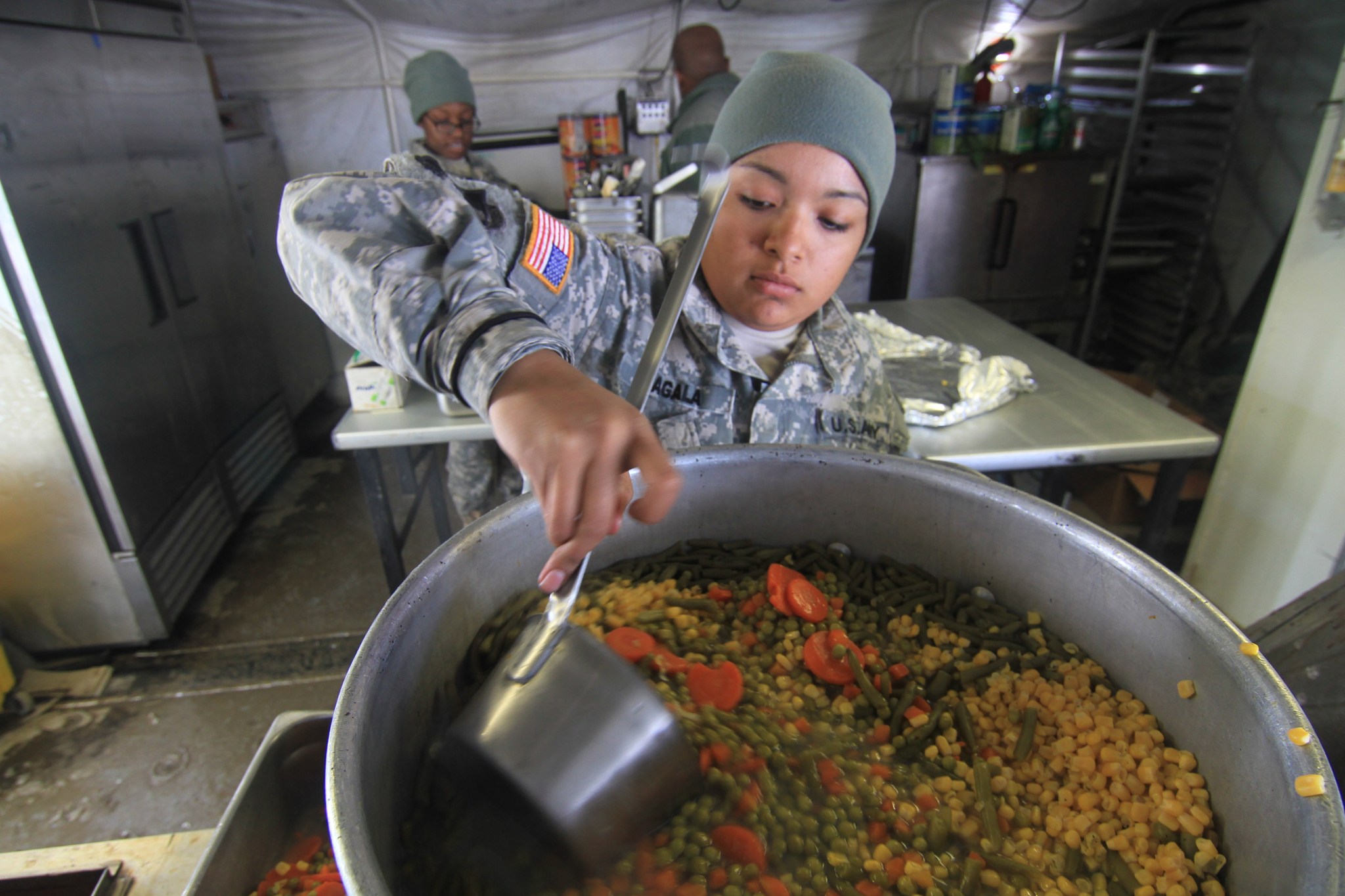
The U.S. Army has officially retired the term “culinary specialist” — and the job title replacing it reflects just how much the battlefield has changed. Soldiers who once carried the 92G designation will now be called “tactical field feeding specialists,” a name the Army says better reflects the operational demands of modern combat.
The redesignation was unveiled during a late-October ceremony at Fort Lee, Virginia, and was first reported by Stars and Stripes. Army leaders say the shift is not cosmetic — it’s tied directly to the service’s broader push to prepare for large-scale combat operations, where feeding troops in contested environments requires as much tactical thinking as it does culinary skill.
Col. Stacy Moore-Callaway, Quartermaster commandant, made clear that the new title carries real meaning.
“When we change an MOS title in the Army, we do it not for superficial rebranding or administrative convenience; we do it because the character of war has changed,”
she said.
“We formally redesignate our culinary specialists, stepping forward under the title that truly captures the 92G’s operational weight, and that is to turn them into tactical field feeding specialists.”
The Army has a long history with the role. The position was first formalized in the 1960s under the designation 94B Food Service Specialist, then updated in 1995 to 92G Culinary Specialist. The latest change marks the most significant shift in both name and scope since that redesignation three decades ago.
Beyond the title, the job itself demands a broad and demanding skill set. These soldiers manage the full arc of field nutrition — from coordinating supply chains and tracking inventory to operating Army Field Feeding Systems and Mobile Kitchen Trailers under combat conditions. The role blends logistics, food science, and battlefield awareness in ways the old title never conveyed.
Sgt. Maj. Paul Denson, Installation Operations Directorate, Army G-4, spoke at the ceremony and framed the role in unmistakably operational terms, saying “Our tactical field feeding warfighters deliver endurance to the force.”
He went further, arguing that nutrition on the battlefield is inseparable from combat effectiveness.
“I submit to you that a well-fed warfighter is a lethal, agile, and adapted soldier that will win in a prolonged close fight,”
Denson said.
“We’re not simply producing food; we’re sustaining warfighters; a tactical field feeding specialist has to understand food production, nutrition, and food safety.”
The redesignation underscores a wider recognition within the Army that support roles are combat-essential — and that the language used to describe them should reflect that reality. Coverage of the change has drawn attention from military affairs reporters and outlets including Military Times, which has tracked the Army’s ongoing efforts to modernize its force structure ahead of potential large-scale conflict.





Comments are closed.