
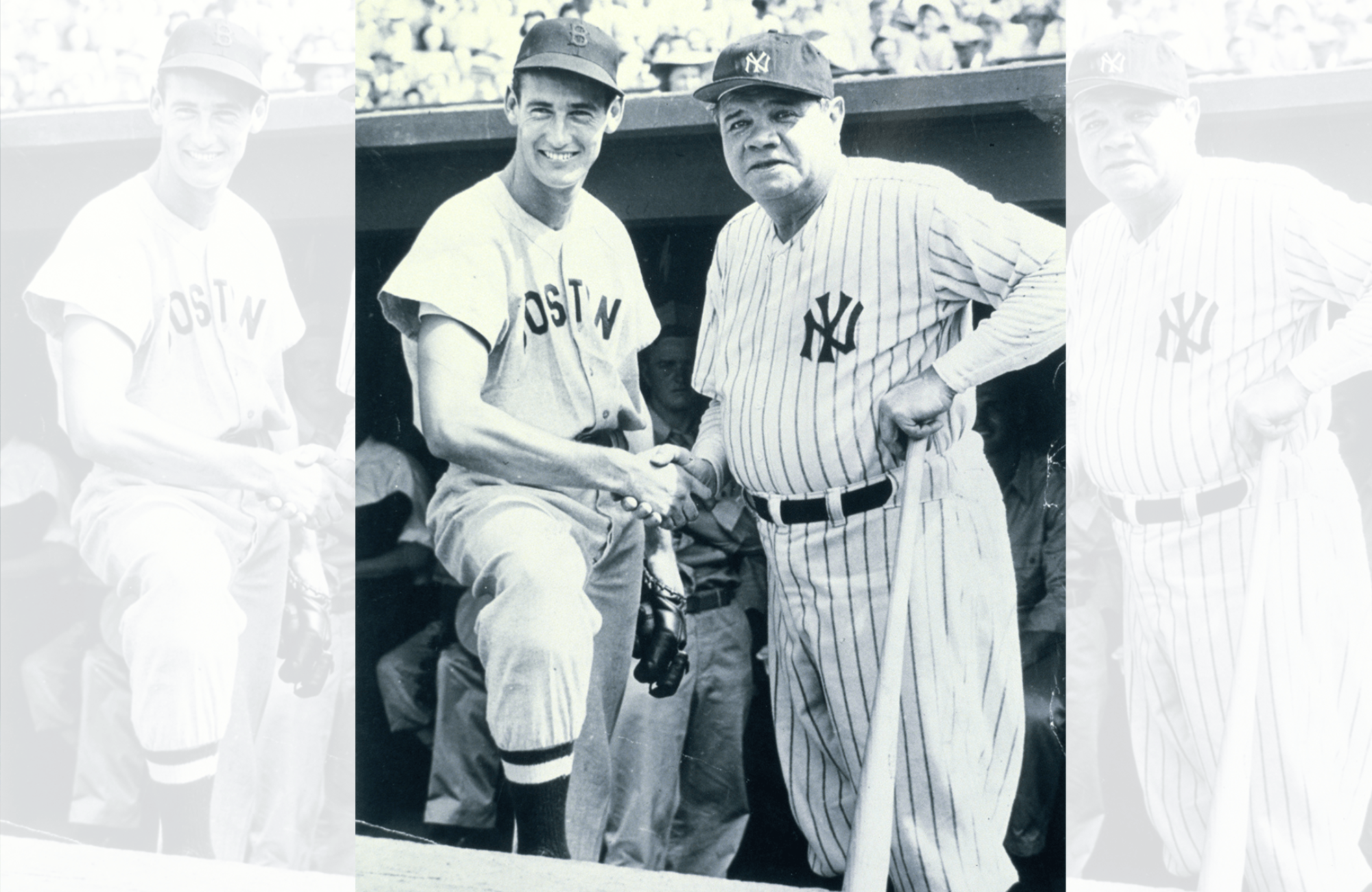
On a sweltering July day in 1943, two of baseball’s greatest names — Ted Williams and Babe Ruth — shared the same field at Yankee Stadium, not for a pennant race, but for their country. The game raised funds for war-relief efforts and the American Red Cross, and the story behind it is only now getting the full attention it deserves.
The matchup pitted a Navy squad known as the “Cloudbusters” against a team of former Yankees and Cleveland Indians players called the “Yanklands,” managed by Ruth himself. Williams, then an Aviation Cadet, led the Cloudbusters alongside fellow major leaguers Johnny Sain, Harry Craft, Johnny Pesky, and Buddy Hassett — all of them in Navy flight training at the University of North Carolina at Chapel Hill. They were part of a remarkable group of roughly 500 major league players who left the diamond to serve in World War II.
The Cloudbusters won 8-5, with Williams contributing a run-producing single. But the moment fans came for arrived in the sixth inning, when a 48-year-old Babe Ruth — already beginning to suffer from the throat cancer that would claim his life five years later — stepped in as a pinch-hitter against Johnny Sain.
The Last At-Bat
Catcher Al Sabo came out to the mound with specific instructions: don’t throw Ruth any curveballs. Don’t risk embarrassing the legend. Sain later described what followed:
“Taking away my curveball was like cutting off two of my fingers, but it was Babe Ruth in Yankee Stadium. Then, it became obvious that the home plate umpire wasn’t going to call any strikes on him. So I threw five medium fastballs, almost batting practice pitches. Ruth took one, then hit a long foul ball and then walked on the last three pitches.”
That account comes from the Society for American Baseball Research, and it captures both the reverence players held for Ruth and the unique theater of wartime baseball. Sain’s connection to history didn’t end there — on April 15, 1947, pitching for the Boston Braves, he threw the first major league pitch ever faced by Jackie Robinson of the Brooklyn Dodgers.
A New Book Tells the Full Story
The story of the Cloudbusters has been largely overlooked — until now. Author Anne R. Keene pieced it together after discovering a scrapbook her father, James Raugh, kept after serving as a batboy for the team. The result is The Cloudbuster Nine: The Untold Story of Ted Williams and the Baseball Team That Helped Win World War II, which explores how wartime barnstorming brought Major League Baseball to communities that had never seen it live — only in newsreels.
In a foreword to the book, Ted Williams’ daughter Claudia Williams described her father’s relentless drive:
“He never did anything half-assed. He firmly believed that ‘Perfection is attainable if you dare to work hard enough.'”
That intensity apparently spread through the roster. The Cloudbusters’ coach, Lt. George D. Kepler, told the Burlington Times-News:
“Since the arrival of Cadet Williams, Pesky and the other ex-major leaguers, most of our games have been won by one-sided scores. We have been getting good hitting and pitching, and both the cadets and officers on the team love to play baseball.”
Science Meets the Swing
One of the more surprising chapters in Keene’s book involves the science of hitting. While stationed at Amherst College, Williams received informal physics lessons from Professor Harold Irving “Doc” Ewen, who taught aerodynamics and celestial navigation to flight cadets. Ewen took Williams into a lab to explain wind velocity and the mechanics behind a curveball’s break.
Ewen also explained that
“a bat of a certain density would drive a ball farther than one of lighter density”
— meaning a medium-weight bat swung at higher speed would outperform a heavier bat swung more slowly. Williams took those lessons back with him to the Boston Red Sox after the war.
His teammate Johnny Pesky recalled that Williams would study the flags above the stadium the moment they took the field, constantly reminding Pesky:
“If a little bit of wind affects a 100,000-pound aircraft, what do you think it does to a baseball?”
Williams the Warrior
Williams served stateside as a flight instructor during World War II before returning to the Red Sox. But his military service wasn’t finished. When the Korean War began, Marine Capt. Theodore S. Williams flew 39 combat missions in a Grumman F9F Panther jet — in the same squadron as John Glenn, the future astronaut and U.S. Senator from Ohio.
Glenn later reflected on his famous squadronmate, telling MLB.com:
“Much as I appreciate baseball, Ted to me will always be a Marine fighter pilot.”





Comments are closed.