
When a district votes the same way for decades, it can start to feel less like a democratic choice and more like a foregone conclusion. That’s exactly what changed in West Michigan’s 86th House District this election cycle — and the story of how it happened raises important questions about voter engagement, democratic access, and what it really means for communities to have a representative who shows up.
The 86th District, which covers Holland and portions of Allegan and Ottawa counties, has elected a Democrat for the first time in memory. Twenty-nine-year-old Joseph McClusky unseated 72-year-old Republican incumbent Nancy DeBoer in a close race — a result that caught many political observers off guard and that reflects a broader story about what happens when campaigns make a deliberate effort to reach voters who have long been overlooked.
70,000 Doors and a Different Kind of Outreach
At the heart of McClusky’s campaign was an unusually intensive voter engagement operation. Speaking with April Baer on Stateside, McClusky described making four complete passes through the district and knocking on a combined 70,000 doors. What his team found was striking: many residents had simply never been contacted by a Democratic candidate.
“We knocked on 70,000 doors, and a lot of people that we talked to had never had a Democrat step foot on their front porch (and) ask them what’s on their mind. It opened the door a little bit to be able to talk about what a Democrat actually is and what the Democratic Party can be.”
That gap in outreach matters for democratic participation. When voters in a given area never hear directly from candidates of one party, their choices on Election Day are shaped by an incomplete picture. McClusky’s campaign tried to change that — not with television ads or mailers alone, but by showing up in person. Some residents initially responded with skepticism, with a few suggesting that Democrats were communists. McClusky said he would simply reply that he was not, and that the exchange often opened a genuine conversation.
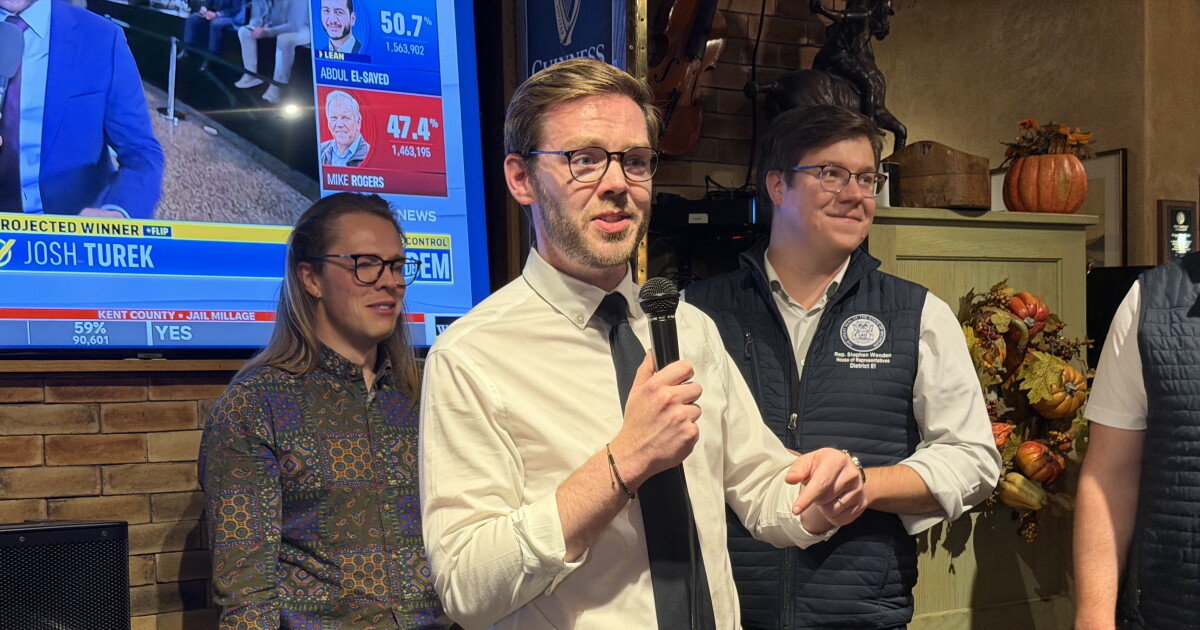
Campaign coverage from journalist Michelle Jokisch Polo documented the race as it unfolded, including on-the-ground visuals from the district that captured the energy of a genuinely competitive contest in a region that had rarely been treated as one.
Latino Voters and the Question of Inclusion
One of the most significant factors in the race was the engagement of Latino voters and other communities that had not been strongly mobilized in previous elections. McClusky was direct about what that engagement means beyond a single election cycle. Winning votes is not the same as building trust, and he acknowledged the difference.
“Whether you voted for me or didn’t vote for me, my job is to make sure that I’m doing everything I can to protect you from overzealous corporations, from an overreaching federal government, making sure that I’m bringing money and resources back to the district.”
He also pointed to a troubling dimension of civic life in the district: some residents feel unsafe simply going about their daily lives — taking their children to school, going to the grocery store. When people feel that way, their ability to participate fully in civic and democratic life is diminished. McClusky framed representation itself as a form of protection for those communities.
“Right now, we have neighbors who feel unsafe going to the grocery store. We have neighbors who feel unsafe going to school to pick up their children, who are relying on other families to pick up their kids. That’s not the kind of community that I want to see.”
A Candidate Who Came From the Community
McClusky grew up in Burton, Michigan, in a working-class family. His father, a radiology technician, was injured on the job during McClusky’s middle school years, forcing his mother to transition from staying home to working in the school cafeteria. During that period, the family relied on government assistance to stay afloat — an experience that McClusky said directly shaped his understanding of what government policy means in real people’s lives.
“I know what it’s like to be in a family that’s one emergency, one injury or one setback away from the edge. And how important it is to have leaders who understand that the decisions made in Lansing are not abstract but they affect whether we can afford rent for groceries.”
He and his husband, Steven Rumler, whom he married in 2023, are currently renting and saving toward homeownership — a goal that feels out of reach despite both of them working and saving diligently. That personal experience, McClusky said, resonated with voters in ways that more abstract policy arguments often do not.
“My spouse and I are currently renting. We would love to own a home and we both work hard, we’re both saving but it just feels out of reach and being able to talk about my experiences resonated with a lot of voters.”
What a Competitive District Means for Democracy
McClusky’s path to the Democratic Party was not a sudden switch. He attended Hope College in Holland, where he initially joined the campus Republican club, consistent with his upbringing. He attended the 2016 Republican National Convention in Cleveland as a guest of the Michigan Delegation. What he witnessed there — including the reception given to Senator Ted Cruz when Cruz urged delegates to
“vote your conscience”
and was booed off the stage — began to shift his thinking.
“For a while, I thought I could still be in the party and just disagree with the head of the ticket, but what I saw at that convention was the party and the man becoming one.”
His journey away from the Republican Party also ran alongside his coming out as gay and a broader faith journey — both of which shaped his view of what community and representation should look like. He and Steven Rumler have built their lives in Holland, a strongly faith-based community, and McClusky has been deliberate about framing his candidacy not as a disruption of local values but as an expansion of them.
“I still stay true to the values that I was raised with: to work hard, tell the truth, love my neighbor as myself. More often than not, those values are found more in the Democratic Party than the Republican Party.”
For a district that had not seriously contested this seat in recent memory, the 86th’s results this cycle signal something important about democratic participation: when candidates engage directly with voters — especially voters who have felt ignored — the electorate can look very different than it has in the past. McClusky is set to be sworn in at the beginning of 2027.






Comments are closed.