
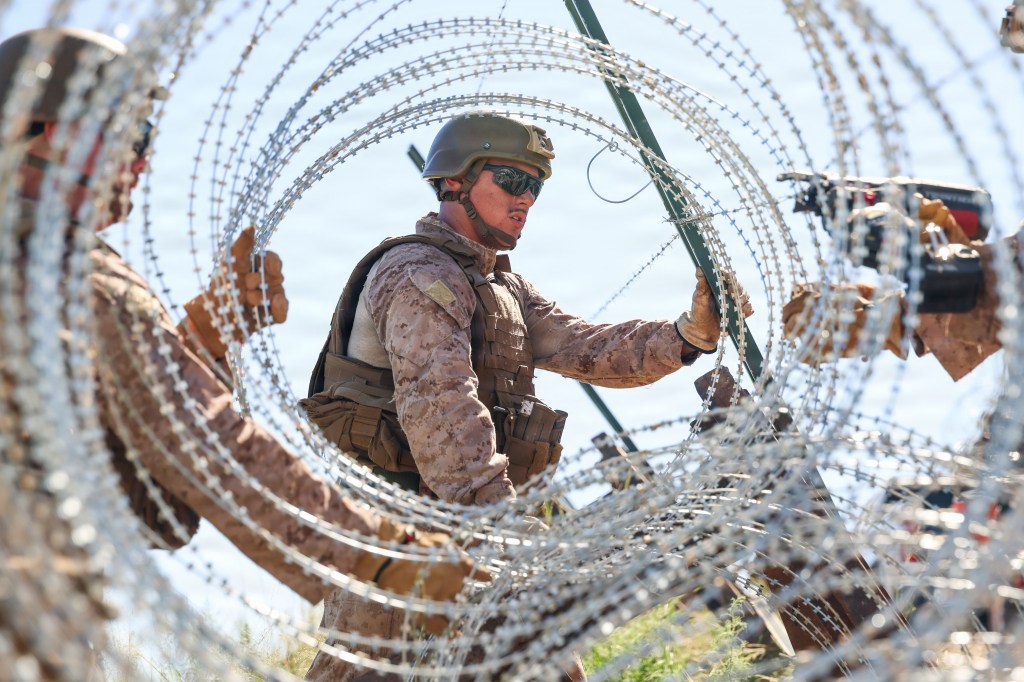
A legal battle is unfolding in federal court over whether the U.S. government has the right to convert more than 100,000 acres of public land along the New Mexico-Mexico border into a military zone — and what that means for the civilians, conservationists, and humanitarian workers who have long relied on that land. The case raises a fundamental constitutional question: can the president declare public land a military installation simply by executive action?
Three nonprofit organizations — the New Mexico Wildlife Federation, Battalion Search and Rescue, and Southern Border Communities Coalition — have filed a federal lawsuit arguing that the Trump administration unlawfully used so-called “national defense areas” to give the military authority over public lands and, in turn, over civilian law enforcement activities at the border.
Brian Netter, legal director at Democracy Forward — one of the legal teams representing the plaintiffs — described the designation in stark terms:
“an extraordinary abuse of power with devastating consequences for the people who live, work, worship, recreate, and carry out lifesaving humanitarian work along the border.”
He continued:
“Public lands do not become military installations simply because the president says so, and the military cannot be handed sweeping new authority to police civilians by drawing a line around land that belonged to the public. Our Constitution and laws impose clear limits on the use of the military for civilian law enforcement for a reason.”
How the Land Was Reclassified
The Trump administration began deploying troops to the New Mexico border region in March 2025 to support border security operations and has since expanded the military’s presence in other border states as well. By April of that year, the Defense Department assumed jurisdiction over 109,651 acres previously managed by the Department of the Interior.
The area was officially designated the New Mexico National Defense Area and classified as an expansion of Fort Huachuca for a three-year period. Defense Department officials said the designation would allow troops to detain individuals accused of trespassing in the military zone after crossing the border illegally.
The lawsuit, however, challenges the legal foundation of that move.
“No statute authorizes the creation of ‘national defense areas,’ let alone permits carving one out of formerly public land,”
the complaint states. The plaintiffs also argue that the Defense Department has historically applied similar land restrictions only on a short-term basis to protect people or property during accidents or emergencies — not as an ongoing immigration enforcement mechanism.
“Creating a semi-permanent military zone along the southern border for purposes of immigration enforcement is directly contrary to the agency’s longstanding practice,”
the lawsuit adds.
The Human Cost: Search and Rescue Cut Off
Beyond the legal arguments, the plaintiffs say the reclassification is having real consequences on the ground. James R. Holeman, founder of Battalion Search and Rescue, described how his all-volunteer organization works to locate people in distress in remote border regions and recover the remains of migrants who died attempting to cross. Over the past three years, the group’s monthly searches along the Arizona and New Mexico border have uncovered more than 100 death sites.
“Imagine how many more people could be found if we had the access, resources, and support to search systematically. Instead, we’re being locked out,”
Holeman said. He noted that vast stretches of borderlands are already
“virtually inaccessible to humanitarian searchers”
because of federal designations — and the new military zone is making that worse.
“Now the government is closing off even more territory. We don’t find weapons or drugs. We find Bibles, prayer cards, love notes, and the belongings of people simply trying to survive. There is no meaningful, systematic government effort to search for the missing and the dead. They don’t search, and now they’re preventing us from searching.”
The other plaintiffs say the military zones are also disrupting conservation efforts, recreational use of public lands, and services to border communities. The case is now in federal court, where a judge will ultimately decide whether the administration’s use of emergency powers to transfer and reclassify these lands was legally justified. For more on related military and Pentagon developments, visit the Pentagon & Congress news section.






Comments are closed.