
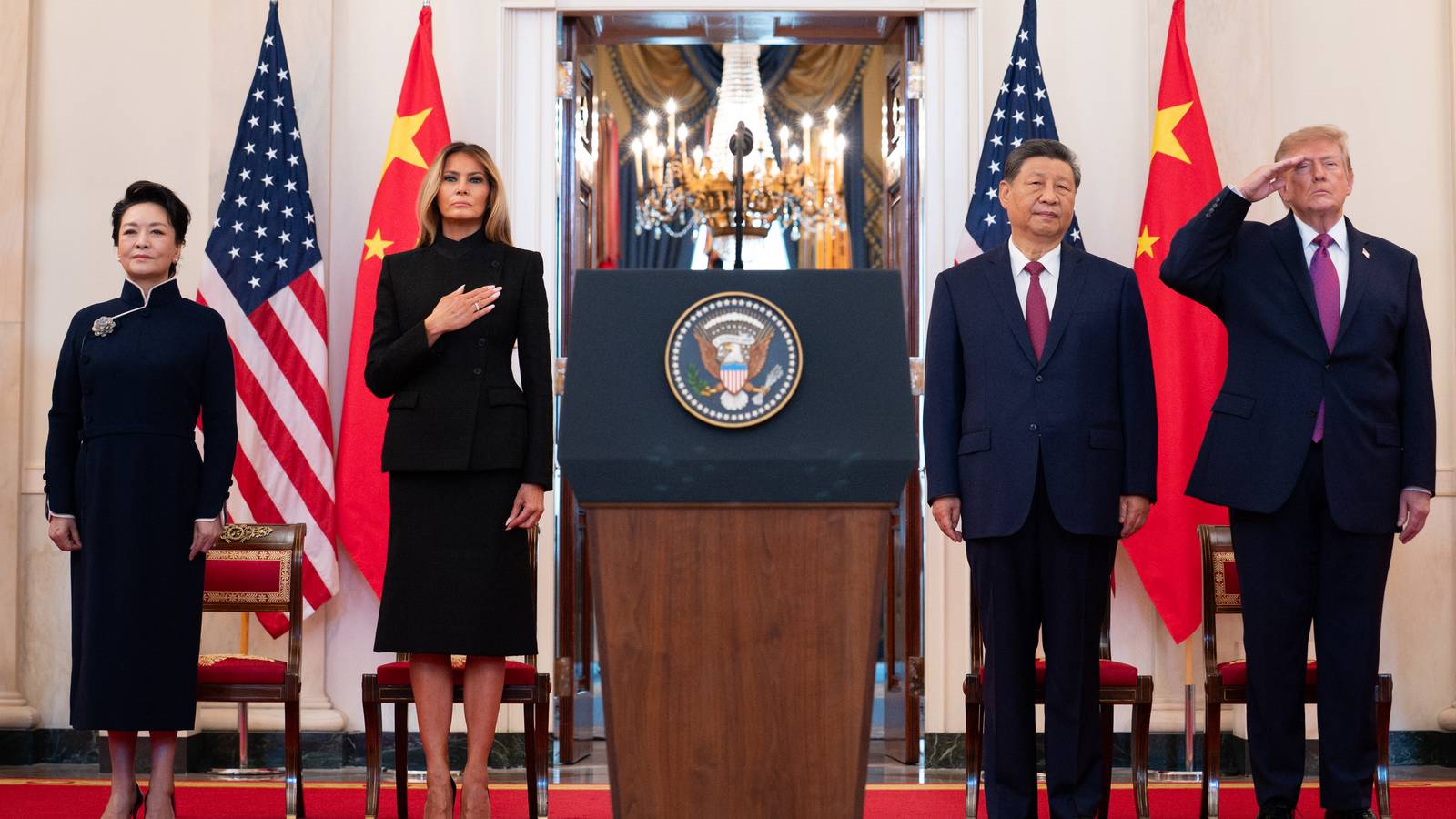
For the first time in modern history, the leaders of the world’s three largest nuclear powers are set to sit down together in the same room. The planned meeting between Donald Trump, Xi Jinping, and Vladimir Putin next Thursday is drawing global attention — and plenty of skepticism.
Plans for the three-way summit were confirmed Friday by the White House. The leaders will meet on the sidelines of the Asia-Pacific Economic Cooperation summit in Shenzhen, China — a coastal city that grew from a small fishing village into a global technology hub in just a few decades. While the gathering is historic in its own right, analysts caution that the meeting is likely to be more about optics than outcomes.
The summit comes at a complicated moment in U.S. relations with both countries. Trump has warmed significantly to Xi after the two nations reached a truce in their short-lived trade war last year, even as tensions remain over the ongoing U.S. war with Iran. At the same time, Trump has worked to strengthen ties with Putin despite Russia’s nearly five-year war with Ukraine and Moscow’s deepened military, intelligence and diplomatic partnership with Iran.
What’s on the Agenda
According to a senior U.S. official who spoke to reporters on condition of anonymity, Trump intends to use the meeting to raise two main topics: the U.S. war with Iran and the possibility of a three-way nuclear arms agreement. Ukraine, notably, will not be on Trump’s agenda for the meeting.
The nuclear arms discussion comes against an already tense backdrop. The last nuclear arms pact between the U.S. and Russia — known as New START — expired in February, leaving the two largest atomic arsenals in the world without formal limits for the first time in more than 50 years. When Russia asked to extend the existing two-country deal, Trump rejected the offer and instead called for “a new, improved and modernized” deal that includes China.
The U.S. official described the Shenzhen meeting as the
“beginning of hopefully a conversation”
on nuclear disarmament that could be
“productive going forward,”
while making clear that no agreements are expected to come out of it.
Getting China on board with any nuclear framework won’t be easy. Beijing’s arsenal is estimated by the Pentagon at more than 600 warheads — a fraction of the more than 5,000 warheads each held by the U.S. and Russia. With such a stark disparity, China has historically shown little interest in joining nuclear limitation talks. Still, one U.S. official framed the meeting as an opportunity for China to
“step up … to the adult table”
on a matter of global importance.
What Each Leader Stands to Gain
Each of the three leaders brings different motivations to the table. For Xi, hosting the meeting in Shenzhen and agreeing to participate at all may be a calculated move to showcase China’s rising international stature. For Putin, the summit offers something arguably more valuable: the image of Russia as a co-equal superpower sitting alongside Washington and Beijing.
Edgard Kagan, a former U.S. ambassador to Malaysia now at the Center for Strategic and International Studies, explained the Kremlin’s calculus this way:
“I think the key for Putin was that this was very much about signaling a desire to talk to the president and talk to Chairman Xi in a way that suggests that they’re making decisions on Ukraine, which obviously the Ukrainians and the Europeans don’t like.”
But the meeting also carries risks for China. Hoo Tiang Boon, a professor of Chinese foreign policy at Nanyang Technological University, noted that the trilateral summit could undercut Beijing’s broader diplomatic messaging.
“You sort of run counter to Chinese support of multilateralism,”
he said. China has worked to cast itself as a champion of free trade and multilateral institutions at APEC — a message that a closed-door three-power summit could complicate.
A Long History of One-on-One Meetings
While a three-way summit is unprecedented, any two of these leaders meeting is not. Putin and Xi have cultivated a close personal relationship over more than a decade, meeting more than 40 times since Xi took power in 2013 and referring to each other as “dear friend.” Before Russia’s invasion of Ukraine in 2022, the two declared their nations shared a “no-limits friendship.”
Trump and Putin have met face-to-face seven times, most recently in Alaska in August 2025. Trump and Xi have met eight times, including a state visit to Washington by Xi last September.
China has also become Russia’s most important economic partner since the Ukraine war began. Beijing ramped up purchases of Russian energy and became Moscow’s primary supplier of key technologies, including components used in Russian weapons systems — ignoring Western demands to halt those supplies. Trump, for his part, recently struck a diesel deal with Russia, waiving sanctions and allowing for the sale of millions of tons of fuel. He has blamed rising energy prices on Ukraine’s attacks on Russian oil facilities, though analysts say the increases are due mostly to the Iran war.
Ukrainian President Volodymyr Zelenskyy has voiced concern that the summit could be used to negotiate a Ukraine settlement without Kyiv at the table. The meeting has drawn comparisons to the 1945 Yalta Conference, where U.S., British, and Soviet leaders redrew the map of postwar Europe. Kremlin spokesman Dmitry Peskov pushed back on the comparison, arguing that any decisions reached in Shenzhen wouldn’t be imposed on outside parties.
“It’s clear that a meeting between the leaders of countries such as Russia, China and the United States is extremely significant,”
Peskov said.
“However, let’s not forget that the vision for a global order is that no one tries to impose any particular view of global order, and it should be based entirely on mutual benefit and mutual respect.”
For more defense and foreign policy updates, visit the Military Daily News section.







Comments are closed.