
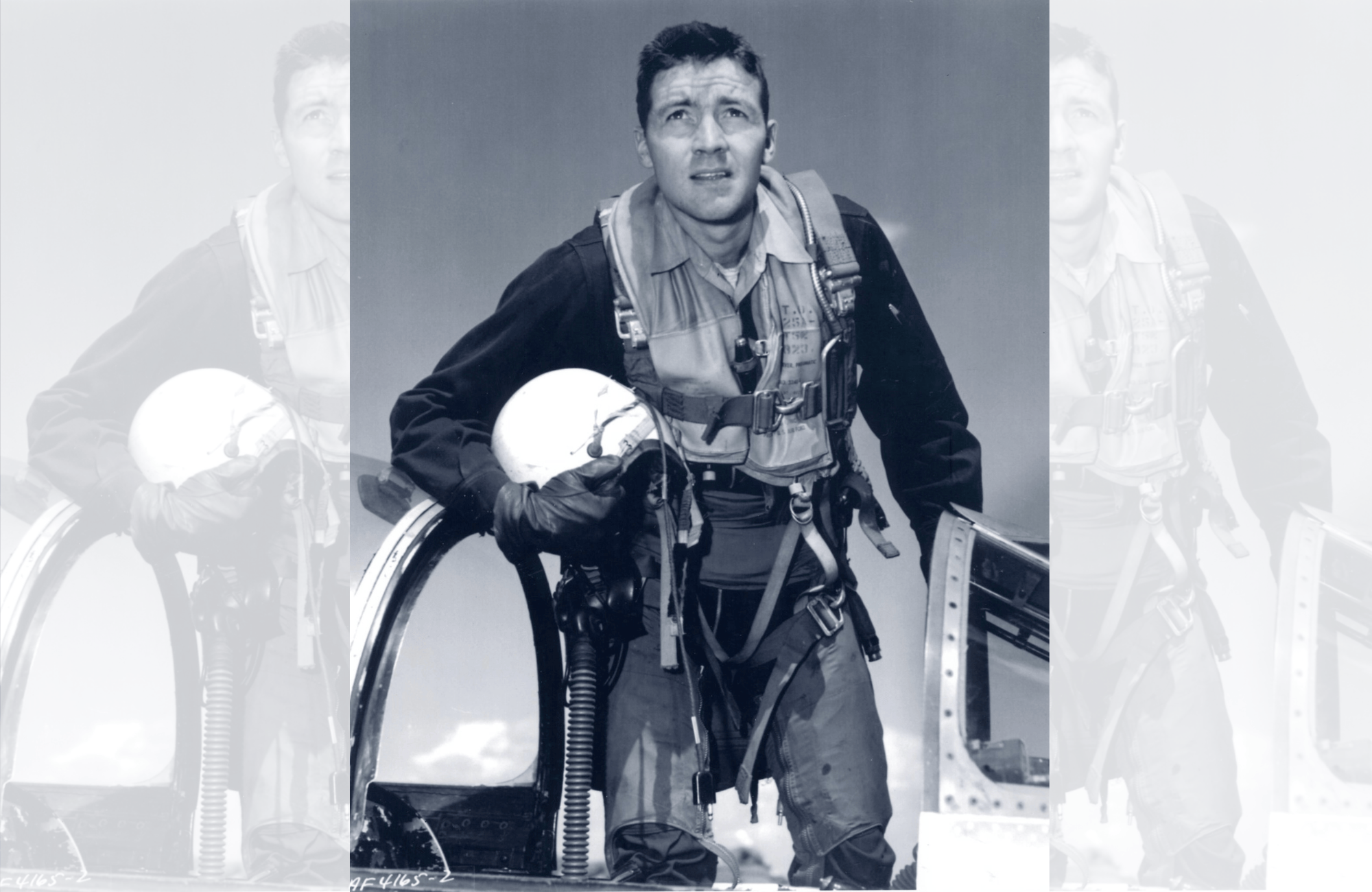
Few weapons in the U.S. military arsenal have shaped modern air power as profoundly as the F-15 Eagle and F-16 Fighting Falcon — and fewer still can trace their origins to a small band of renegades who worked in secret to change the course of American defense. The story behind these iconic jets is as much about culture, ego, and ideology as it is about engineering.
At the center of that story stands Col. John Richard Boyd, a Korean War veteran and tactical theorist whose influence on fighter aircraft design is difficult to overstate. Born in Erie, Pennsylvania, in 1927, Boyd entered the U.S. Army Air Forces near the end of World War II, spending a quiet year in Japan before his discharge in 1947. When the Korean War broke out, he reenlisted, trained on the North American F-86 Sabre at Nellis Air Force Base in Arizona, and eventually flew combat missions in Korea — earning credit for damaging a MiG-15 in the war’s final weeks.
Returning to Nellis as a flight instructor, Boyd quickly built a reputation for blunt criticism of superior officers. His detractors later called him profane, crude, and even treasonous. His admirers compared him to Sun Tzu. Whatever one’s view of Boyd the man, his impact on American military aviation is undeniable.
A Fighter Culture in Crisis
To understand why Boyd mattered, it helps to understand what fighter pilot culture meant — and what it had lost. During World War I, fighter pilots were romanticized as “knights of the air,” noble and fearless individual warriors dominating the skies. That mythology persisted for decades.
But the Vietnam War shook that image. Century Series fighters underperformed in air-to-air combat, and the Air Force’s primary front-line fighter, the two-seat F-4 Phantom, seemed to signal a move away from the individualistic dogfighting tradition. The idea of the lone fighter pilot winning battles through instinct and skill had seemingly been replaced by complex, expensive machinery.
As author Michael W. Hankins writes in Flying Camelot: The F-15, the F-16, and the Weaponization of Fighter Pilot Nostalgia,
“Military culture is different from civilian culture, military aviation culture is distinct from both, but fighter pilot culture is a world unto itself.”
Boyd set out to reclaim that world.
The Fighter Mafia Takes Shape
Boyd assembled a loose coalition of like-minded pilots, engineers, and analysts who came to be known — by their own choosing — as the “Fighter Mafia.” The group included pilot Everest Riccioni, civilian mathematician Thomas Christie, and aeronautical engineer Harry Hillaker. Together, they argued that the American defense establishment of the 1960s and ’70s had gone badly off course, prioritizing costly, complex weapons systems over effective, affordable ones.
Riccioni captured the group’s core philosophy plainly:
“No amount of electronic or optical equipment can substitute for a pilot’s ability to turn his head and see his antagonist.”
As Gerald A. Schiller writes of the group’s worldview,
“the Pentagon’s sole function was hardly defense; it was merely a bureaucracy created to get Congress to fund expensive weapons systems — systems that often performed poorly when tested, and whose price tags kept escalating at alarming rates.”
Boyd and Christie had already given the movement a scientific foundation. Using their co-developed energy maneuverability theory — a formula designed to calculate the specific energy rate of any aircraft — they demonstrated conclusively that the Soviet MiG-21 outperformed the American F-111 in combat. The Air Force itself acknowledged in 2025 that
“Department of Defense 1960’s era aircraft, such as the F-105, F-4, and F-111, while adequate in air-to-ground roles, were significantly disadvantaged in air-to-air maneuvering.”
Hankins describes the Fighter Mafia’s argument as one
“steeped in specific cultures, with specific beliefs, assumptions, behaviors, and values. The F-15 Eagle and F-16 Fighting Falcon, originally designed to focus on air-to-air combat, are the strongest examples of the influence of culture on technology within the US Air Force.”
Secret Meetings and “The Lord’s Work”
What followed was an unconventional — and legally questionable — campaign to redesign American air power from the inside. Boyd and his followers privately referred to their mission as “the Lord’s work.” According to one of Boyd’s closest friends, Col. James Burton, the group spent years working the
“hallways, back doors and alleys of the Pentagon and the aircraft industry.”
Their methods were anything but routine. As Hankins documents,
“the Fighter Mafia had spent several years in secret, illegal meetings with two contractors (General Dynamics and Northrop) to design an aircraft; then the Fighter Mafia co-wrote the RFP for that plane; then they participated in a source selection committee that also contained many of their devotees who shared their values; and finally, amid numerous possible outcomes and other potential factors affecting the selection process, the winners were the two companies the Fighter Mafia had been secretly meeting with all along.”
The outcome of that process was the YF-16, developed by General Dynamics under engineer Robert H. Widmer. Its first test flight took place on February 2, 1974. The aircraft entered service four years later and has since been refined into one of the most widely used multi-role fighters in the world.
Hankins notes that Boyd and his followers were
“selling a powerful idea: Defense technology could be both cheaper and more effective, and that we used to have it right but had lost our way. In the late 1970s, coming out of the difficult Vietnam War experience, the desire for more efficient, less complicated technology found a lot of traction, and it’s still with us.”
Author Robert Corum, writing in Boyd: The Fighter Pilot Who Changed the Art of War, concluded that Boyd’s physical theory would forever change how fighter planes were designed — and that Boyd himself was, simply,
“the fighter pilot who changed the art of war.”


Comments are closed.