In a competitive U.S. Senate race, even a small group of voters can shape the outcome — and Michigan’s Jewish community is making that reality impossible to ignore. With deeply held concerns about candidate Abdul El-Sayed’s stance on Israel and Jewish safety, Jewish voters across Southeast Michigan are wrestling with a decision that reflects something fundamental about how democracy works: when voters feel unheard, they organize, demand answers, and make candidates earn their support.
Jewish voters represent roughly 1.5% of Michigan’s electorate — a modest share on paper, but potentially decisive in what polling shows is a tight race. The community’s response to El-Sayed has been anything but passive. Hundreds of Jewish Michiganders have signed competing petitions — one pledging support for the candidate and another taking a stand against him. The competing petitions, organized house parties, and a formal candidate accountability campaign all illustrate something important about democratic participation: voters don’t just cast ballots, they apply pressure, demand accountability, and force candidates to reckon with their concerns.
A Community Organizing for Accountability
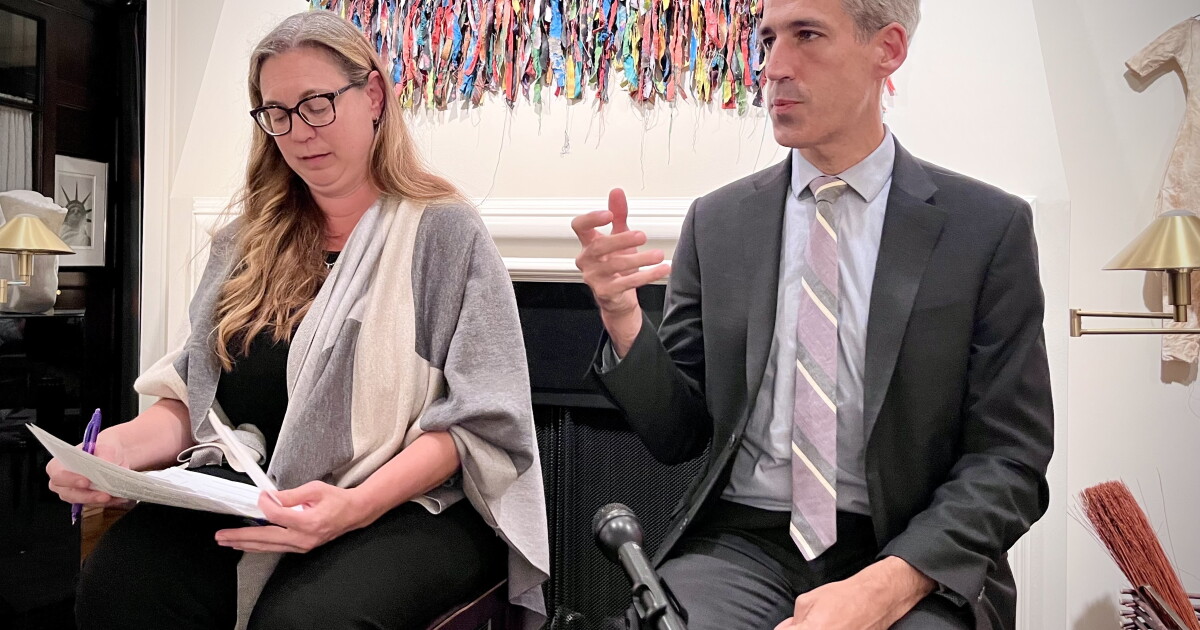
Michigan Jews for Democracy, a grassroots organization backing El-Sayed, has been hosting a series of private “house parties” across Southeast Michigan. The goal is to give ambivalent Jewish voters a space to voice concerns and hear from prominent Democratic figures — among them former Michigan Congressman Andy Levin and New York congressional candidate Brad Lander — in a setting less charged than social media or campaign rallies.
At a recent gathering in a historic Detroit home, community leader Alicia Chandler opened the discussion with a call for civil engagement: “We are bringing people together to engage in healthy, constructive dialogue. Unfortunately, that’s not something we see all the time in our communities. We have a lot of vitriol and social media yelling.”
Also speaking that evening was Daniel Biss, a congressional candidate from Illinois and former mayor of Evanston, who described his own experience with antisemitism firsthand. He recounted that white nationalists showed up at city council meetings, targeted him with slurs, and sent hate mail to his home.
“Our police department got worried based on the intel they had and pretty soon there was a squad car outside my home 24/7. I had to call my mother, whose parents survived the Holocaust, and explained that her grandchildren needed police protection because his father was a Jewish mayor, so these issues are real.”
Biss acknowledged that some of El-Sayed’s remarks have “landed imperfectly with some people,” but argued that the Senate candidate understands the connection between protecting different communities.
“A guy who knows in his bones that his kids’ safety as Muslim children is tied to Jewish children’s safety. And that if he doesn’t fight for the safety of Jewish children, he’s not fighting for his own kids.”
What Sparked the Concern
El-Sayed’s record on Israel has generated significant friction. He has said Israel is not an ally and described its actions as “bloodthirsty.” But the sharpest flashpoint came after a terrorist attack on Temple Israel synagogue and childcare center in West Bloomfield in March. El-Sayed initially responded by saying “hurt people hurt people” about the attacker — a comment widely seen as dismissive of Jewish suffering. He later apologized for the remark.
For many Jewish voters, the episode cut deep. “The Jewish community is not feeling safe,” said Rabbi Josh Whinston, who launched a formal campaign calling on El-Sayed to publicly commit to five “nonnegotiables” — including protecting Jewish safety in Michigan and affirming Israel’s right to exist as a Jewish state. As of late in the campaign, El-Sayed had not responded to those demands.
Whinston’s accountability campaign is itself a textbook example of civic engagement: rather than simply walking away or voting against a candidate, he created a structured public ask, documented it, and gave the candidate a clear opportunity to respond. That kind of organized pressure — transparent, issue-specific, and publicly visible — is precisely how voters in a democratic system hold candidates accountable and build or withhold trust.
Whinston said that voting for Republican Mike Rogers would be “completely antithetical to who I am as a liberal, progressive person.” But he was also honest that, just days from the election, he remained undecided.
“To be honest, I’ll likely decide as I look at the ballot. It is a very difficult and painful moment for me, and I know for many other Jews.”
Persuasion, Participation, and the Ballot Box
The house party format reflects something deeper than campaign strategy. It’s a form of voter engagement that happens away from official channels — neighbor talking to neighbor, community member listening to community member — the kind of organic democratic deliberation that shapes how people ultimately vote. Laura Kohn, a Huntington Woods resident who attended the Detroit gathering wearing an El-Sayed button and having already voted for him, gave voice to the ambivalence many others feel.
“I want to love Abdul, and I don’t. I feel like the reason I don’t is because he’s not soft with a piece of Jewishness that a lot of us carry, which is if you don’t go toward us and tell us how much you care about us and how much we mean, we’ll fill in the blanks. We’ve done that for so long, hundreds of years.”
Former Congressman Andy Levin urged the group to look at the broader historical picture. He pointed to sitting U.S. Senator Elissa Slotkin — who is Jewish and has endorsed El-Sayed — as a model for how Jewish Democrats might approach the race. “She’s a model for me about this and a model, I hope, for our whole community of grabbing this situation and saying, ‘This guy’s a fighter. He and I are going to duke it out with each other on some things.'”
Levin also noted that while Americans have elected hundreds of Jewish politicians to Congress, only four Muslims have ever served — all of them in the last two decades and all in the House. El-Sayed, if elected, would become the first Muslim U.S. senator. “I’m really proud of the idea that Michigan would have a Jewish and a Muslim senator,” Levin said. “That would just be really incredible.”
For Farmington Hills resident Caroline Trapp, who has family members who belong to Temple Israel and grandchildren in preschool, the March attack was personal. “I have grandchildren who are in preschool [and] family members who belong to Temple Israel,” she said. “So that attack [in March] was very worrisome.” But after the evening’s discussion, she came to a conclusion grounded less in enthusiasm than in democratic pragmatism. “To me, there’s just no question: We can’t elect another Republican senator,” Trapp said. “So I feel good about voting for him.” She paused, then added: “Better. After hearing tonight’s discussion.”
Whether voters like Trapp and Whinston show up for El-Sayed — or sit out the Senate race entirely — will speak to a broader truth about elections: candidates who fail to earn the trust of even small voting communities do so at real electoral cost. The organized debates, accountability campaigns, and community conversations happening among Michigan’s Jewish voters are not peripheral to the democratic process. They are the democratic process.