
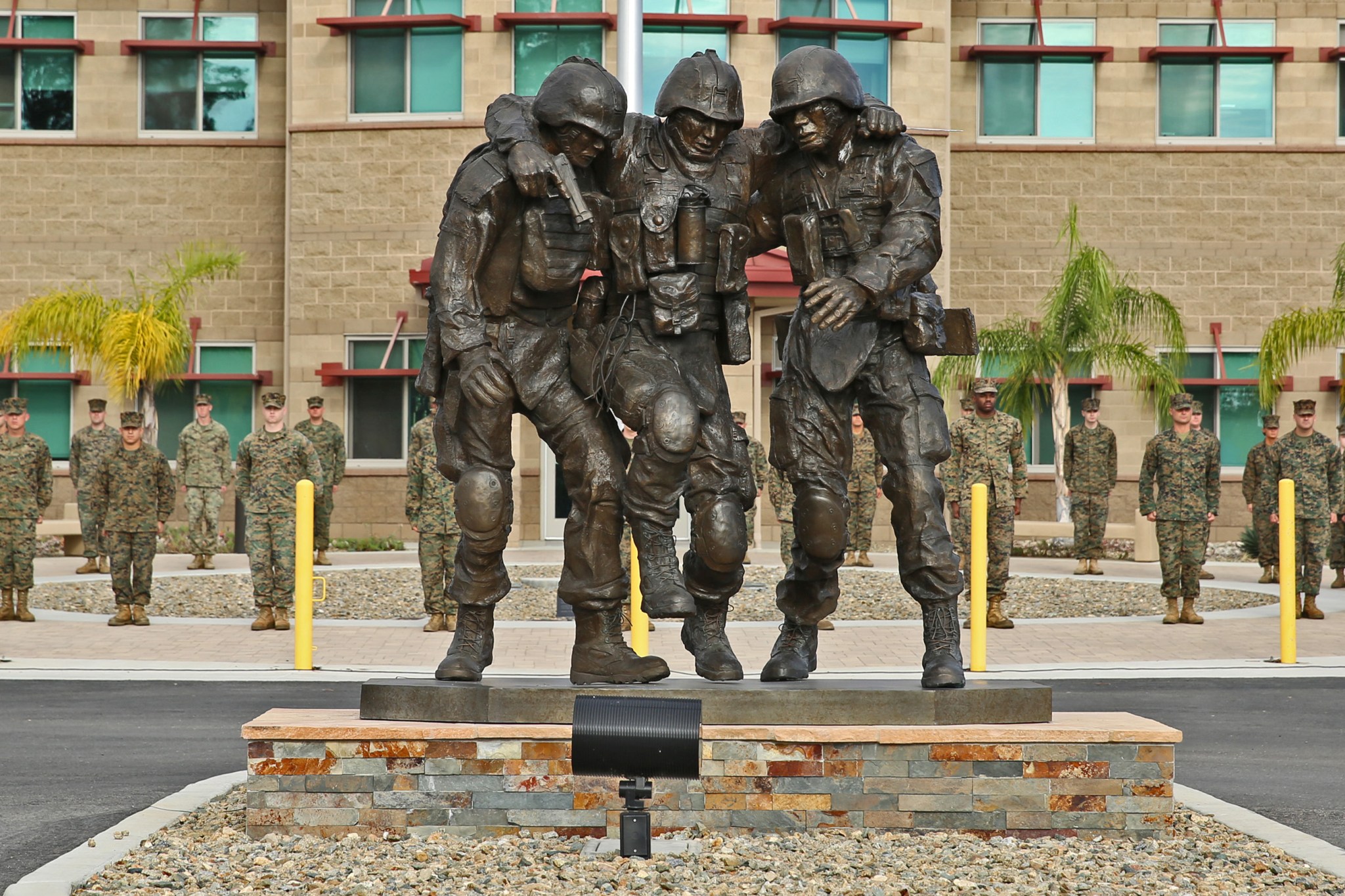
Few images from the Iraq War are more recognizable than the photograph of a bloodied Marine being carried out of a building in Fallujah — a symbol of sacrifice that was later cast in bronze and placed at two U.S. military bases. Now, the decorated veteran at the center of that image is under federal investigation.
Retired Marine Sgt. Maj. Bradley Kasal, one of the most decorated Marines of the post-9/11 era, is being investigated by the Naval Criminal Investigative Service (NCIS) over allegations related to his work as a civilian JROTC instructor at a Nevada high school. CBS News first broke the story, with Military Times subsequently confirming the probe.
The allegations stem from Kasal’s time as an instructor at the Basic Academy of International Studies in Henderson, Nevada, a school operated by the Clark County School District. He joined the district as a civilian JROTC instructor just three months after retiring from the Marine Corps in August 2018, following 34 years of service. He resigned from the position in August 2025, according to the school district.
A Marine Corps spokesperson confirmed awareness of the allegations to Military Times. Both the Marine Corps and NCIS declined to provide further specifics, citing a need to “protect the integrity of the investigation.” The school district did not respond to requests for comment.
The Man Behind the Iconic Photo
To understand why this story is drawing national attention, it helps to know who Bradley Kasal is. As a 1st sergeant with the 3rd Battalion, 1st Marine Regiment, Kasal served in the Second Battle of Fallujah in November 2004 — one of the bloodiest urban combat operations of the Iraq War — as part of Operation Phantom Fury.
During the battle, Kasal learned that fellow Marines were pinned down inside a building by an unknown number of enemy fighters. He entered the structure and moved toward a wounded Marine, only to come under heavy rifle fire alongside another Marine. Both were severely wounded in the legs and unable to move.
When insurgents threw grenades, Kasal shielded his fellow Marine with his own body, absorbing the shrapnel himself. Even after rescue arrived, he refused medical attention until the other wounded Marines had been treated first. He exited the building still clutching his pistol and K-Bar knife, supported on both sides by fellow Marines — his uniform soaked in blood.
Photographer Lucian Read captured that moment in a photograph that became one of the defining images of the Iraq War. The image later inspired two identical bronze sculptures titled “No Man Left Behind.” The first was installed at the Wounded Warrior Battalion at Camp Lejeune, North Carolina, in 2013. The second followed a year later at Wounded Warrior Battalion-West at Marine Corps Base Camp Pendleton, California.
A Record of Valor
For his actions in Fallujah, Kasal was awarded the Navy Cross in 2006 — the second-highest military decoration for combat valor in the U.S. Navy and Marine Corps. His full list of military honors, detailed in his official record, is extensive: the Legion of Merit with one gold star; the Purple Heart with one gold star; the Meritorious Service Medal with one gold star; the Navy Commendation Medal with Combat V and two gold stars; the Navy Achievement Medal with two gold stars; and the Combat Action Ribbon with one gold star.
His three-decade career with the U.S. Marine Corps made him one of the most recognizable figures in modern military history. That legacy is now being weighed against an active federal investigation — the details of which have not been publicly disclosed.
NCIS handles felony-level investigations for the Navy and Marine Corps. The agency has not indicated a timeline for when the investigation might be resolved, and no charges have been publicly announced.
Comments are closed.