
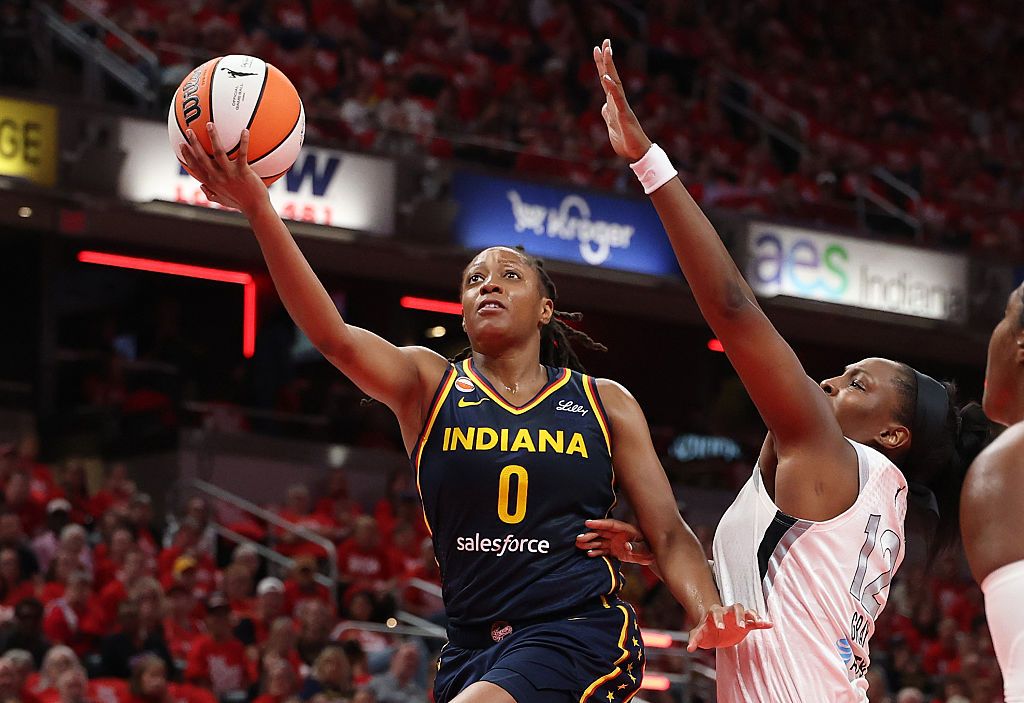
Kelsey Mitchell has spent years quietly becoming one of the most efficient scorers in the WNBA — yet her contributions have repeatedly been overshadowed by a teammate who, by several objective measures, has not matched her output. Now, as her contract future with the Indiana Fever hangs in the balance, the question isn’t just about basketball — it’s about whether the organization has truly valued what Mitchell brings to the court.
According to a recently published opinion piece by Nicky Childers, the case for Mitchell departing Indiana is grounded in both statistical reality and a broader pattern of institutional neglect that has defined her tenure with the Fever.
The Numbers Tell One Story. The Narrative Tells Another.
On the WNBA leaderboards for the 2026 regular season, Mitchell ranked second in the league in both points per game and three-point field goals — surpassing Caitlin Clark in both categories. Clark outpaced Mitchell only in assists and turnovers, with the assist advantage largely attributable to Clark’s role as the team’s primary point guard.
Despite this, the Fever’s end-of-season awards marketing campaign pushed a co-MVP narrative, effectively manufacturing a co-MVP conversation that inserted Clark into an award discussion that Mitchell’s numbers arguably had already secured on their own. Meanwhile, Clark continued to face criticism for ball-security issues and defensive vulnerabilities — areas where Mitchell and center Aliyah Boston repeatedly compensated.
A Pattern With Research Behind It
Sociological metrics tracked by the Harvard Kennedy School suggest that what Mitchell and Boston may be experiencing reflects a documented pattern in professional environments — one in which highly competent Black women see their achievements minimized or overlooked despite strong performance records. Research by Columbia University also points to professional penalties faced by Black women who attempt to set limits on overwork or push back against inequitable conditions.
For Mitchell, the professional pressure has come with physical consequences. During the 2025 playoffs, Mitchell collapsed on the court and was hospitalized with rhabdomyolysis — a severe muscle breakdown condition that caused temporary lower-extremity paralysis. The episode followed a stretch in which she was carrying the team’s offense largely on her own while Clark recovered from an injury. More recently, Mitchell left the game against the Toronto Tempo after overheating on the court.
A Hostile Environment Both On and Off the Court
Mitchell has spoken openly about the emotional weight of playing in Indiana. During her exit interview following the Fever’s first-round playoff loss to the Aces, she addressed the abuse she regularly receives from fans. During her exit interview, Mitchell said:
“If I showed y’all my DMs about the hate… specifically being an Indiana Fever basketball player… It’s a lot.”
Mitchell is not alone. Black players from multiple teams have raised alarms about racial harassment and safety threats directed at them in connection with Fever games. Yet in her own exit interview, Fever General Manager Amber Cox dismissed the issue, claiming during her exit interview that widespread criticisms of the fanbase
“have no basis in reality”
— a denial delivered the same day Mitchell publicly described a pattern of targeted harassment.
The response from parts of the media has been characterized by critics as a coordinated gaslighting campaign that conflates a player’s economic popularity with athletic merit. Some commentators have even framed Mitchell’s salary as something she owes to Clark, while others have implied the league is scripted to win around its highest-profile financial asset.
This dynamic calls to mind a high-profile corporate dispute at ABC News in 2020, when a white talent executive was reportedly asking what more anchor Robin Roberts could want during salary negotiations, and allegedly made an insidious reference to cotton-picking.
The Financial and Contract Picture
Mitchell’s future with Indiana also involves complicated financial considerations. The Fever are navigating a massive financial bottleneck with a salary cap that leaves little flexibility. Management has publicly stated it wants to retain Clark, Mitchell, and Boston as its core trio — but doing so while also extending Clark on a potentially large deal would strain the team’s ability to build competitive depth. Players like Myisha Hines-Allen and Sophie Cunningham would be at risk of being priced out in that scenario.
When asked whether she planned to re-sign with the Fever for the 2027 season, Mitchell offered a measured but telling response:
“I have to be selfish. I think that’s where I am in my career.”
Next season would be Mitchell’s tenth in the league. With a focus that stems in part on life after basketball, Mitchell is currently enrolled at Liberty University, pursuing a Ph.D. in Educational Leadership with the goal of becoming an athletic director — a position she has said she is drawn to in part because of the lack of Black women and women generally in those roles.
Other Players Have Found Better Fits Elsewhere
Angel Reese and DeWanna Bonner offer recent examples of players who found more supportive environments after departing difficult organizational situations. Reese left the Chicago Sky amid concerns about the franchise’s commitment to winning and joined the Atlanta Dream, where she was named Defensive Player of the Year. The Atlanta Dream, which also welcomed veteran DeWanna Bonner late in the season, had positioned itself as a championship contender, sitting just six wins from a WNBA title.
Mitchell faces a decision that is both professional and personal — one shaped by a deeply hostile public microscope, health concerns, a complicated salary cap situation, and a stated desire to be in an environment where her work is recognized for what it actually is. Whether she chooses to stay or move on, the conversation around her situation has raised broader questions about how elite players are evaluated, compensated, and protected — questions that extend well beyond Indiana.



Comments are closed.