
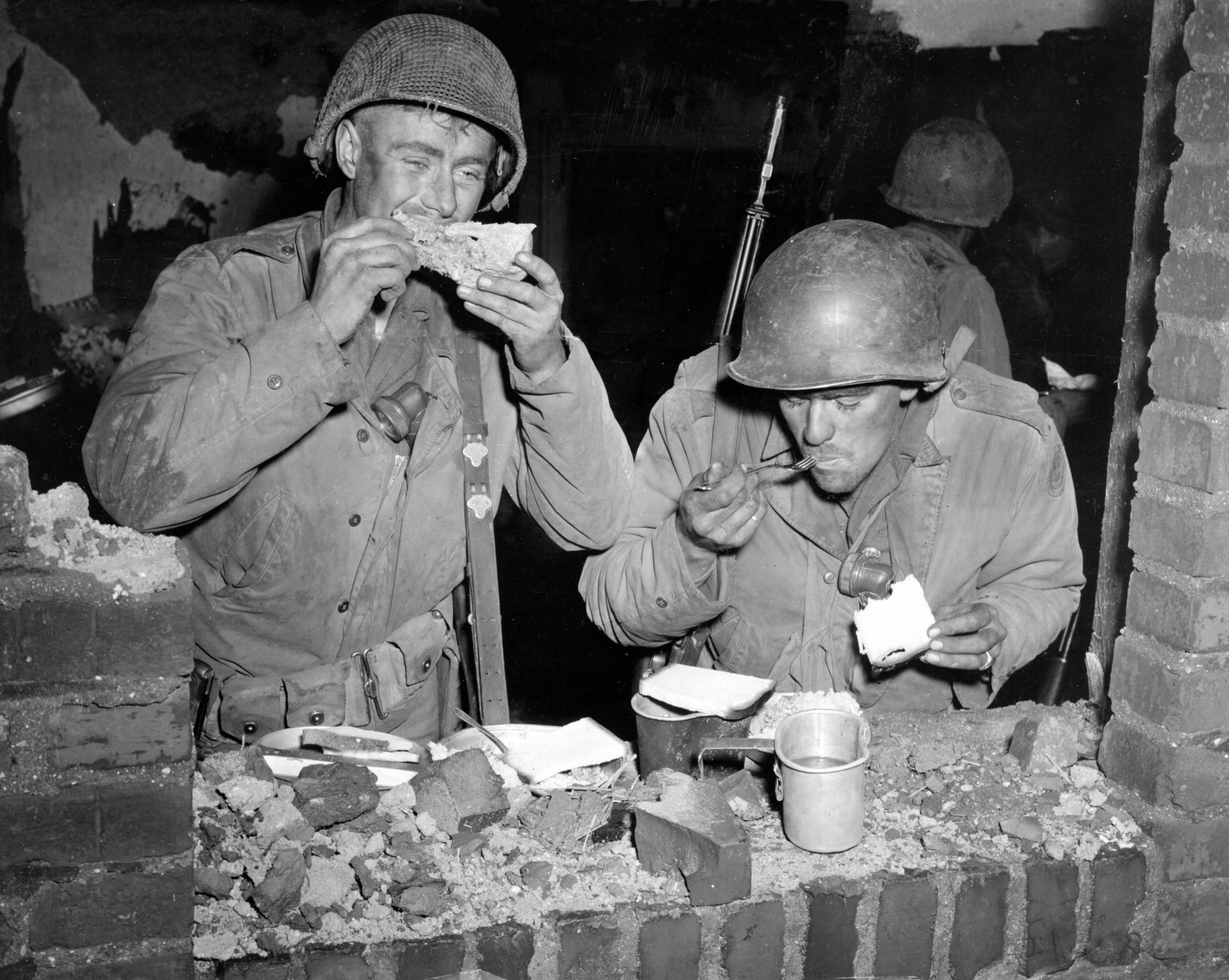
Eighty years ago, as Allied forces fought and died in the frozen forests of Europe, the U.S. military pulled off one of the most ambitious food-delivery operations in wartime history — getting a full Thanksgiving dinner to nearly two million troops on the front lines. The story of how that happened is a testament to both American logistical muscle and the enduring power of a home-cooked meal.
In November 1944, Gen. Dwight D. Eisenhower ordered that every American soldier stationed in Europe receive a traditional Thanksgiving dinner — turkey, stuffing, mashed potatoes, string beans, corn, cranberry sauce, celery, hot rolls, and pumpkin pie. For men who had been living on cold K-rations and C-rations for weeks, months, or even years, the meal was more than food. It was a lifeline to normalcy.
Planning Started Months in Advance
The operation did not come together overnight. The Army and the War Food Administration began coordinating Thanksgiving logistics as early as June 1944 — five months before the holiday. Mass turkey purchases for overseas shipment began in July. By October, the refrigerated cargo ship SS Great Republic had been loaded with 1,604 tons — 3,208,000 pounds — of frozen turkey and was sailing from New York to the French port of Le Havre. From there, the Army’s Transportation Corps moved the food to forward positions by truck, train, and whatever other means were available.
Once the food arrived near the front, soldiers cooked it on the gasoline-powered M-1937 Field Range, a modern upgrade over older coal- and wood-fired stoves. The M-1937 could boil, roast, bake, and fry — producing everything from stews and coffee to pies and baked goods. Insulated five-gallon containers called mermite cans kept food hot or cold and allowed meals to be carried forward to positions where the stoves themselves could not go.
Eisenhower’s Message to the Troops
On Thanksgiving Day, Eisenhower addressed the nation in a radio broadcast, acknowledging the dinner effort and issuing a sober reminder of what still lay ahead.
“There is just one way to gain the peace we want. Each of us must work with ever-increasing devotion and effectiveness up to the day the enemy capitulates,”
he said.
Brig. Gen. Andrew McNamara, the First Army’s Quartermaster, later confirmed the mission had succeeded.
“Every man in First Army had a fine Turkey dinner on that day,”
he stated.
A Meal in the Middle of Hell
For the soldiers fighting in the Hürtgen Forest — one of the most brutal campaigns of the entire war — that turkey dinner carried particular weight. The battle, launched in mid-September under Lt. Gen. Courtney Hodges as part of a push to cross the Rur River and capture critical dams, had ground into a bloody stalemate. The 28th Infantry Division had been reduced to what commanders described as “combat ineffective.” War correspondent Ernest Hemingway, who witnessed the fighting firsthand, compared the conditions to the worst of World War I. He called the campaign
“Passchendaele with tree bursts.”
Hemingway described how German artillery transformed the dense forest into a killing field:
“The woods were close-planted fir trees, and the shell-bursts tore and smashed them, and the splinters from the tree bursts were like javelins in the half-light of the forest.”
Even in that environment, depleted units rotated back from the front in shifts to eat a hot meal before returning to the line. Army Lt. Charles Scheffel of the 1st Infantry Division later recalled what it felt like to have Thanksgiving dinner delivered near his position in the Hürtgen sector.
“The artillery was still going, but for a few minutes, we could almost pretend we were home,”
he said.
The Army Quartermaster Corps and Transportation Corps, working in tandem, pulled off a feat that most civilian supply chains would never attempt — feeding roughly two million soldiers, many of them under fire, an estimated 1.5 pounds of turkey per person along with a full holiday spread. For the men who received it, it was a rare moment of comfort in the middle of a war that was far from over. Follow coverage of military history and veterans affairs at Military Times.

Comments are closed.