
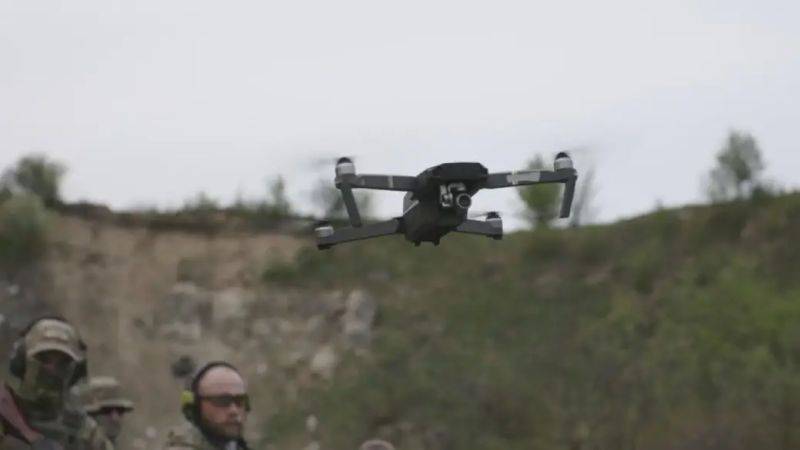
America’s military drones are increasingly flying into skies where GPS cannot be trusted — jammed, spoofed, or simply cut off by adversaries who know exactly how dependent U.S. forces are on satellite navigation. A defense technology company called SPARC AI believes it has found a way to keep those drones on course using software alone, no new hardware required.
The company’s product, called Overwatch, is a positioning service designed to help military drones and other autonomous systems find their location even when GPS goes dark. Matt McCrann, CEO of SPARC AI’s U.S. operation and a former Navy signals intelligence operator who later spent nearly two decades in defense technology, described the core idea simply:
“Our mission is to create a positioning service that does not require GPS. It requires no specialized software and no additional hardware.”
SPARC AI — which stands for Spatial Predictive Approximation and Radial Convolution — launched the Overwatch Positioning Network in August 2026, initially making it available to Ukrainian drone manufacturers and operators.
How Overwatch Actually Works
When a drone loses its GPS signal, it falls back on onboard inertial sensors that measure movement, direction, and orientation to estimate where it is. The problem is that those sensors accumulate small errors over time, causing the aircraft’s calculated position to drift further and further from reality. McCrann said a drone relying solely on those sensors could drift 40 to 60 meters off course within 30 to 60 minutes of losing GPS.
Overwatch tackles this by pulling the drone’s existing flight telemetry — basic data the aircraft is already generating — and sending it over an API to off-board servers. Those servers apply machine learning and geometric calculations to identify and correct the sensor errors, then send back accurate coordinates within approximately 300 milliseconds. The corrected position can be delivered as standard latitude and longitude or in the Military Grid Reference System used by U.S. forces.
McCrann said the machine-learning component is key because sensors are inherently imperfect.
“All sensors have a bias, and cheaper sensors can introduce noise. We can receive that raw data and make the corrections.”
This matters especially for lower-cost drones built with inexpensive components, which are increasingly common on modern battlefields.
Depending on how it is configured, Overwatch can also use camera footage of recognizable terrain features. If the system knows the coordinates of a visible landmark and the angle from which the drone sees it, it can work backward to estimate the drone’s precise position. Terrain elevation data is factored in as well. McCrann said the service can reduce positioning error to roughly 3 or 4 meters, though that figure depends on the specific drone, its sensor quality, and operating conditions — and has not been independently verified by the U.S. military.
Why GPS Vulnerability Is a Growing Concern
The Defense Department relies on GPS for far more than navigation — aircraft, ships, ground vehicles, guided weapons, and troop movements all depend on GPS-derived positioning and timing data. Government Accountability Office and Defense Department reviews have identified jamming, spoofing, cyberattacks, and direct attacks on satellites as ongoing threats, pushing the military to invest in alternative navigation systems.
Jamming works by flooding a GPS receiver with interference until it can no longer lock onto a usable signal. Spoofing is more subtle — it transmits false positioning data that tricks a receiver into reporting the wrong location, potentially sending a drone or weapon off course without the operator knowing anything is wrong.
Overwatch can run alongside a drone’s existing GPS receiver and compare the satellite-reported position against SPARC AI’s independently calculated position. A growing gap between the two readings serves as an early warning that something may be wrong.
“If all of a sudden there’s a huge contrast, we show the difference between where the drone thinks it is and where its actual position is,”
McCrann said.
A Tradeoff: Connectivity
Overwatch’s reliance on a network connection is its most significant limitation. While the service itself cannot be jammed the way GPS can, the communications link between the drone and SPARC AI’s servers is a potential target. McCrann acknowledged this directly:
“You can’t jam the positioning service itself, but you can potentially jam the link that it’s leveraging.”
To address different operational environments, SPARC AI offers flexibility in how Overwatch is deployed. The service can run through commercial cloud infrastructure, a customer’s private network, or a local computer positioned near the area of operations. McCrann also said the entire system can be loaded onto the drone itself, removing any dependence on an outside connection — though that approach means the software is aboard an aircraft that could be shot down or recovered by an adversary.
What Sets Overwatch Apart from Other GPS Backups
The military already has several tools for operating when GPS fails. Jam-resistant antennas and receivers try to maintain a satellite lock under interference. Inertial navigation systems estimate movement without any external signal. Camera-based systems match ground imagery against stored maps. Radar and lidar can measure surroundings, but they add weight, power consumption, and hardware cost.
Overwatch draws on elements of several of these approaches — inertial data, terrain information, and camera observations — but delivers them differently. Rather than selling a dedicated navigation payload for each drone, SPARC AI processes data from hardware already on the aircraft and returns corrected coordinates as a service subscription.
McCrann described it this way:
“Not even a software update. Think of it as more like a service. Connecting the drone to the service or subscribing to the service.”
That model could make it practical to improve positioning accuracy across large, mixed fleets of drones from different manufacturers without swapping out existing navigation equipment on each one. The network-dependent version still requires a communications link to function, but the onboard version removes that constraint at the cost of placing the system on a vulnerable aircraft. Neither the Defense Department nor any branch of the U.S. military has publicly announced a contract for Overwatch.






Comments are closed.