
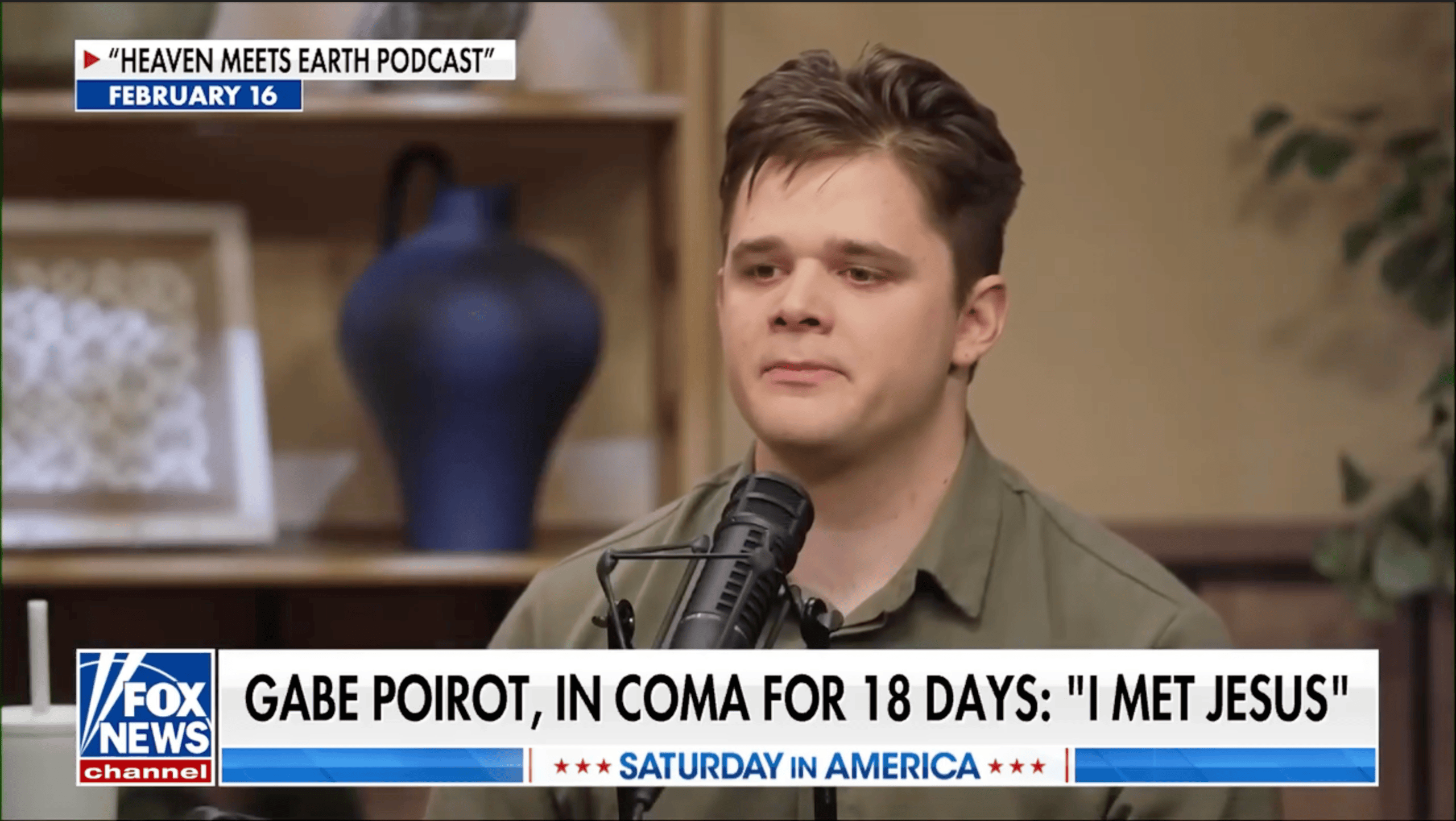
A conservative YouTube influencer is drawing widespread attention after describing his near-death experience meeting Jesus in terms that have left many viewers raising their eyebrows. The interview, which aired on Fox News, quickly spread across social media and sparked debate about the intersection of faith, politics, and personality.
Gabe Poirot, a YouTube personality, sat down with Fox News host Kayleigh McEnany to discuss his memoir, 18 Days in Heaven: I Left My Body. I Met Jesus. What He Told Me Will Alter Your Eternity. The book is based on a skateboarding accident in October 2021 that left him in an 18-day coma. During the interview, Poirot described encountering Jesus Christ in vivid and unconventional terms that quickly went viral.
A post from the account Christian Nightmares on October 4, 2026, which included a video clip of Poirot’s remarks, helped fuel the viral spread of the interview.
During the Fox News segment, Poirot pushed back against what he described as a softened cultural image of Jesus, telling McEnany:
“They didn’t meet a female Jesus. They didn’t meet a soft or a passive Jesus. Jesus is a man. And especially in America, he’s been misrepresented…. There’s so many cultural things that present him as if he’s just some tolerant guy.”
He then elaborated on the nature of Jesus’s strength in more metaphorical language:
“He’s a lion, but he’s not a lion angry against me; he’s a lion angry for me. He’s a mustang on my behalf. He did it all for me.”
When McEnany asked Poirot to physically describe what Jesus looked like, his response became the centerpiece of online discussion:
“Pure fire. He is a LION. He was 5’11 as tall as eternity. He was like an ocean of love, yet his eyes were burning white and red. And, I mean, talk about testosterone.”
Poirot continued his description, saying:
“Like a mustang, I’m telling you. He’s the lion of Judah, and there’s a roar within his voice.”
Several other comments from the interview also caught listeners’ attention. Poirot described the experience with deeply personal language:
“Well, I didn’t originally see him face-to-face, because my face was down…”
“He did it just for me, like I was his only one. I’ll forever be his only one. He waited his entire life just for me.”
“His love is literally what I was struck with. When I look into his eyes, I was forever captured.”
Political Dimensions of the Interview
Beyond the religious imagery, the interview touched on political ground. McEnany referenced Poirot’s book in connection with Charlie Kirk, the right-wing influencer who was shot and killed last year. McEnany read from Poirot’s book, describing Kirk as a “friend,” and asked Poirot for his thoughts on Kirk’s death. Poirot, who has been linked to the late white supremacist, responded:
“He didn’t experience an ounce of pain or grief. In fact…Charlie doesn’t even know he’s dead, because he’s alive.”
Poirot has also addressed his online critics directly. Despite being widely described as a MAGA-aligned figure, he posted on social media insisting otherwise:
“I’m on social media to testify of Christ. I’m NOT a ‘MAGA influencer.’ I’ll address cultural issues through a biblical lens—including confronting racist, white-supremacist organizations like Planned Parenthood, founded by Margaret Sanger, KKK rally speaker.”
That claim regarding Planned Parenthood echoes language commonly used in anti-abortion advocacy circles. Critics have noted that Poirot’s comments about Planned Parenthood and his association with figures like Kirk are consistent with talking points associated with the MAGA political movement, even as he distances himself from that label.
The interview has reignited broader conversations about how religious testimony intersects with political identity in today’s media landscape, particularly on platforms like Fox News, which has featured other figures whose faith and conservative politics are closely intertwined — such as Pete Hegseth and, most recently, Karoline Leavitt, who is on her way to Fox News. Critics and observers continue to debate where sincere personal faith ends and political performance begins — a question Poirot’s interview has placed squarely back in the public conversation. References to Natalie Harp and her letters to the president have also surfaced in online commentary comparing different styles of fervent devotion in conservative media circles.




Comments are closed.