
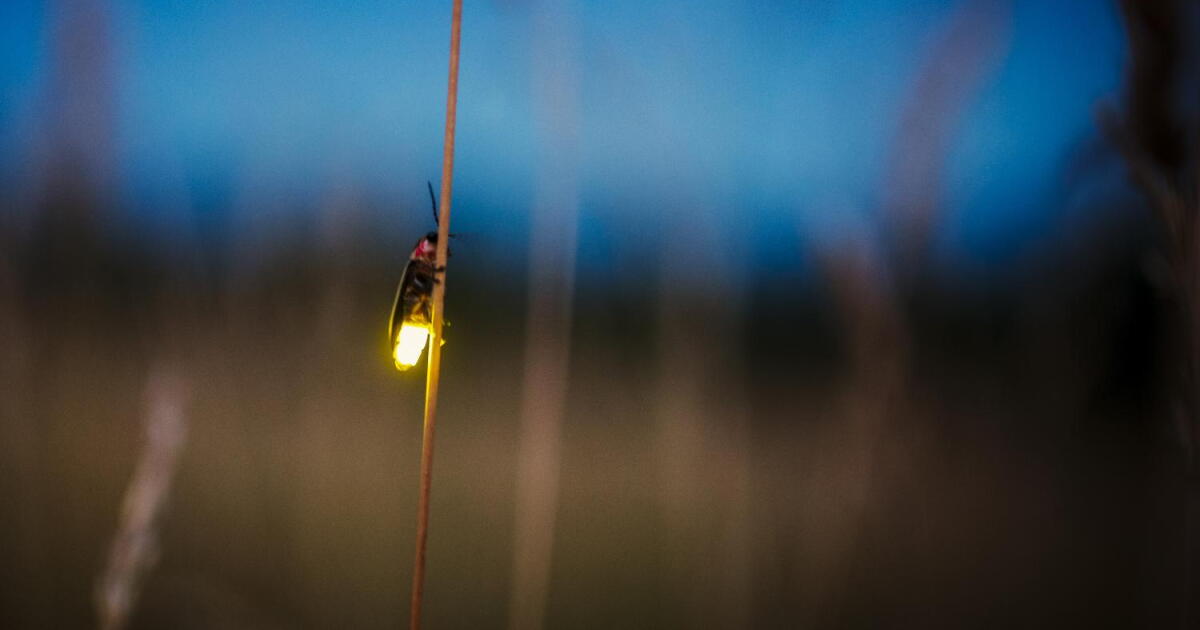
Most people picture fireflies lighting up warm summer evenings in the South or Midwest — not the Sonoran Desert. But a new report from the Nature Conservancy confirms that Arizona is home to multiple firefly species, and knowing exactly where and when to look can make all the difference.
Gita Bodner, a conservation ecologist with the Nature Conservancy, which recently released a report documenting fireflies in Arizona, spoke with KJZZ’s Lauren Gilger on The Show about the surprising discovery and what it means for conservation in the state.
Arizona’s Fireflies Live Near Water — Rare Water
Bodner says the fireflies found in Arizona aren’t scattered randomly across the landscape. They depend almost entirely on perennial wetlands — places where water flows or pools year-round. In a desert state, that makes them exceptionally rare.
“The fireflies that we have here in Arizona, the ones that look and act like you expect a firefly to look and act, are specialized to our rivers, to our perennial wetlands. So that makes them even more precious here because we don’t have very many of those wetlands.”
Two species have been identified as Arizona’s primary “flying, blinking” fireflies: the Southwest springs firefly and the Southwest synchronous firefly. Documented sightings have been recorded along the Santa Cruz River, the San Pedro River, Cienega Creek, the Verde River, and near Tumacácori in Southern Arizona.
Timing, Location, and Darkness All Matter
Finding these insects takes patience and a bit of luck. Bodner explains that the fireflies emerge close to the monsoon season and are only active at dusk and into the nighttime hours. Visitors also need to be prepared to go completely dark — literally.
“You have to be at the right place in the right season at the right time. And then you have to turn all of your lights off. If your lights are on, theirs won’t come. They will stop blinking and just hang out on the grass if they think that something else might be watching them or if other lights are too bright.”
Bodner has personally witnessed fireflies at two Arizona locations: Las Cienegas National Conservation Area and the Patagonia Sonoita Creek Preserve, one of the Nature Conservancy’s Arizona properties. She described her most memorable encounter as feeling like
“a tiny little green meteor shower.”
Both Species Are Being Considered for Endangered Species Listing
The stakes for these glowing insects go beyond novelty. Both the Southwest synchronous and Southwest springs fireflies have been formally petitioned for listing under the Endangered Species Act. Researchers and conservationists are currently working to map populations, identify threats, and determine what conditions help the species thrive — all information that will inform any future listing and management decisions.
This concern is part of a broader conservation picture in Arizona. Environmental nonprofits have already filed suit against the federal government, alleging violations of the Endangered Species Act along the Verde River, where several protected species make their home.
How to See Them Responsibly
Bodner strongly recommends going out with a guided group rather than searching solo. The Xerces Society has organized public firefly outings in recent summers, offering people the chance to see the insects in the wild while ensuring proper land access and minimal disruption to the habitat.
“That way you’ll be going with people who know how to find them, and you’ll be going to places where they’ve been documented with permission to be on those lands at those times. So that’s a really great way to start out your firefly quest.”
The firefly findings are part of a larger Nature Conservancy report summarizing scientific discoveries made on its Arizona preserves over more than two decades. Among the other highlights: frogs that can cure themselves of fungal diseases by resting in hot springs, long-running studies on climate change’s effects on soil and microbial processes, and research into the continental-scale migrations of nectar bats.
Arizona’s environment and wildlife continue to generate scientific interest beyond fireflies. Recent coverage from KJZZ includes new radio-tracking technology offering the most detailed look yet at monarch butterfly migration, reported by Trenton Ashdown, as well as a tribal nation’s call for hunters to switch to non-lead ammunition to protect eagles in the Mountain West. The Arizona Game and Fish Department has also warned residents to watch for the New World screwworm, a flesh-eating parasite recently detected in neighboring states, as reported by Nina Kravinsky. And on the federal level, the Bureau of Land Management announced a significant investment in fertility control for wild horses, a move welcomed by advocates pushing back against helicopter roundups.





Comments are closed.