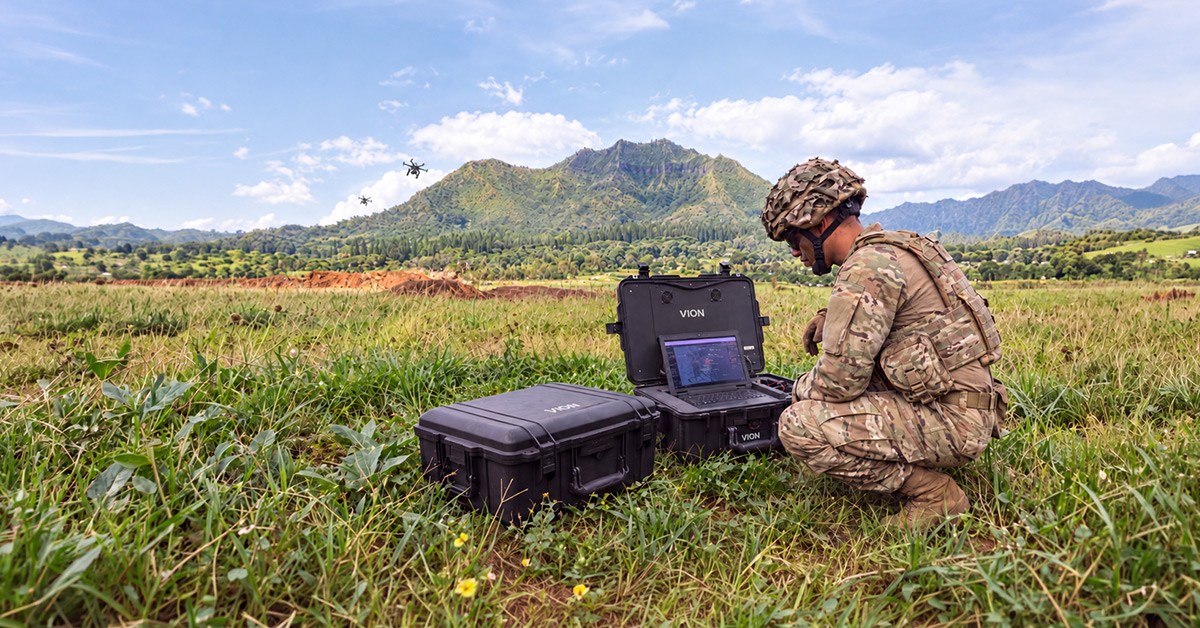
When allied forces can’t communicate clearly, the consequences can be fatal — as demonstrated by a friendly fire incident in March in which Kuwaiti air defenses mistakenly shot down three U.S. F-15E Strike Eagle fighter jets. Now, General Dynamics is unveiling a portable, AI-powered communications system designed to make sure troops and their allies are always on the same page.
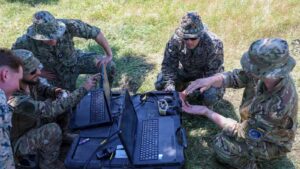
The system, called Vion, was announced Thursday by General Dynamics Information Technology. About the size of a suitcase, it is built to let ground troops quickly set up secure communications with command centers and coalition partners — even from remote locations. The company describes it as a Mission Partner Environment solution, meaning its core purpose is enabling different allied military systems to talk to one another seamlessly.
Jason Myers, vice president of defense agencies at General Dynamics Information Technology, told Military Times that Vion goes beyond simply sending messages and files. Using open architecture and artificial intelligence, the system can connect with outside networks, adapt to or patch connections, and translate written messages, voice memos, and videos — all while maintaining zero-trust cybersecurity protections that limit access at every level to reduce the risk of breaches.
Built to Avoid Lock-In
One of the central design goals for Vion was flexibility. Myers said many existing systems force military units to use only specific, proprietary hardware and software — making updates expensive and complicated. Vion was designed specifically to avoid that problem.
“We wanted to provide an all-encompassing offering, but we didn’t want to lock somebody into an offering or not be able to use where they’ve already invested,”
Myers said.
He explained that the system is built on a modular architecture, meaning individual components can be swapped out as better technology becomes available — without overhauling the entire platform.
“What we wanted to do is say, ‘Yes, we’re going to use proven technologies,’ but as new things come out, we are absolutely ripping and replacing those, and how to do that securely, in that modular architecture, is really, really different than how things are being done today,”
he said.
A Military-Wide Push to Connect Allied Networks
Vion’s development comes alongside a broader effort across the U.S. military to tear down communication barriers between American forces and their international partners. The Defense Information Systems Agency, known as DISA, has been leading that charge through an initiative called the Coalition Information Environment, or CIE — described as a modernized architecture built on principles of zero trust and data centricity.
General Dynamics participated in a Joint Staff J6-led demonstration called Olympus Fires, where DISA tested ways to improve that coalition network. At a panel discussion in June, U.S. Army Lt. Col. David Courter, DISA’s Combatant Command Integration and Plans chief, laid out the goal plainly: to
“broker and federate our environments together without replicating a new environment every time.”
Jason Martin, DISA’s Component Acquisition Executive, pointed directly to the March friendly fire incident to underscore why this work is urgent.
“We’ve spent the past 50 years building siloed networks, siloed applications and siloed environments to collaborate internally with our own data. We can no longer do that,”
Martin said.
“We have to converge networks. We have to plug and play. We have to talk to one another … We have to operate and maintain command and control with a single voice.”
Myers confirmed that GDIT is currently working through the acquisitions process for Vion, though he declined to identify the specific parties involved. He expressed confidence that the system would have staying power, saying he believes Vion will
“have a very long life in where it can add value to the mission.”