When a Marine is wounded in a remote battlefield, the difference between life and death often comes down to the tools and training available in those first critical minutes. The U.S. Marine Corps is now fast-tracking two medical technologies — a smart portable ultrasound and a compact blood refrigerator — that could extend survival windows far beyond what’s possible today.
The push stems directly from lessons learned during battlefield injuries sustained during Operation Epic Fury, which made clear that the Corps needed to move faster on technology designed to keep wounded troops alive longer at forward triage points, before they can be evacuated to a fully equipped hospital.
Col. Paul Gillikin, the Marine Corps’ program manager for combat support systems, said the service is getting feedback directly from the medical personnel working in conflict zones — including those forward-based in the Pacific — to understand what’s working and what isn’t.
“I’m talking with maybe lieutenants running surgical centers; that’s the level of detail we’re getting to. I’m talking to that lieutenant, lieutenant colonel over SIPR and NIPR [military networks] to find out exactly what they’re experiencing and how I can make their life better and how I can make operations and support better for them … it’s an all-engine stop affair.”
A Lighter, Smarter Blood Refrigerator for the Front Lines
One of the two devices being accelerated is the Expeditionary Medical Refrigeration Unit, or EMRU — a 62-pound portable cooler designed to maintain a reliable cold chain for blood supplies in field environments. Lt. Cmdr. Kyleigh Hupfl, the Marine Corps’ clinical lead for expeditionary medical systems, said the device replaces a much bulkier 140-pound unit that required significantly more manpower to move and could only sustain refrigeration for about 24 hours under ideal conditions.
The EMRU runs on rechargeable batteries and is built for long-term use in austere settings. Importantly, it can both keep blood bags cold and warm them if they freeze in Arctic conditions — a critical capability for units operating in extreme environments. Medical providers who received early units during deployments to the Middle East reported strong results.
Hupfl said the feedback was clear:
“We were told that the gear was instrumental to their ability to maintain a revolving lead bank to ensure that they had what they needed to be ready to care for injured service members.”
That early success has now translated into a full fielding plan, with the EMRU set to reach full operational capability across the Marine Corps by the second quarter of 2027. Units at the point of need will receive priority.
“We want to get it as far out as we possibly can,”
Hupfl said.
AI-Assisted Ultrasound Pushed to Frontline Corpsmen
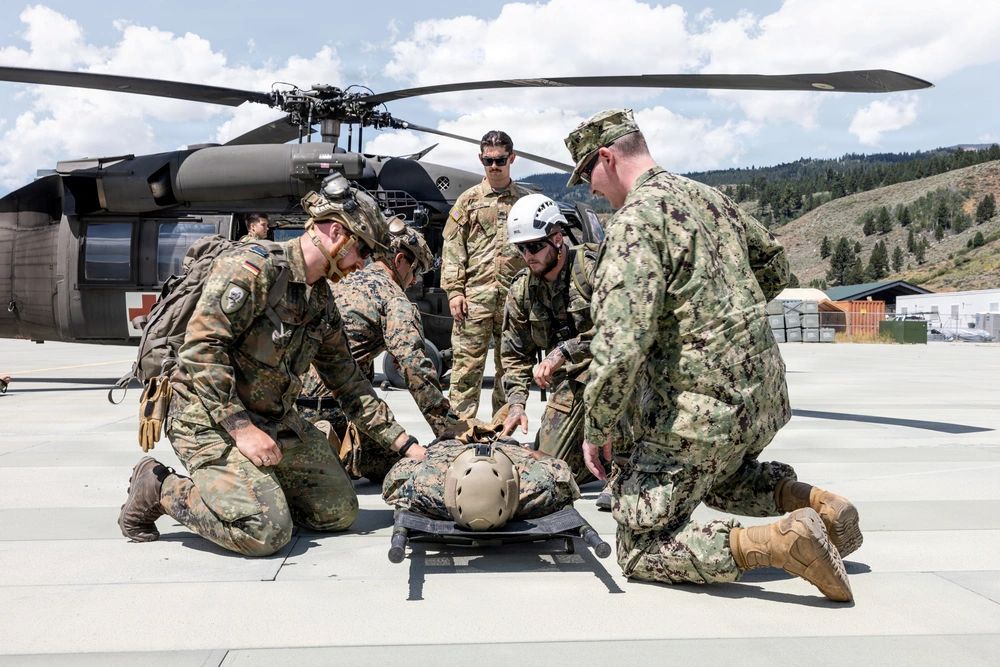
The second device moving toward expanded fielding is the Kosmos, a portable ultrasound unit equipped with artificial intelligence that can guide a corpsman through a trauma exam in the field. Traditionally, ultrasounds have been performed only at Role 2 facilities — advanced mobile trauma units staffed by physicians. The Marine Corps is now pushing the Kosmos to Role 1 units, the smaller immediate-aid stations and individual corpsmen who are typically the first to reach a casualty.
Hupfl said the AI component is what makes this possible for medical personnel who don’t have years of specialized clinical experience interpreting imaging.
“Using the ultrasound probe is not the thing that’s the hard part, right? What’s hard is you’re looking at an image, and you don’t know what it means. With the AI assistants, somebody who doesn’t have many years of clinical experience doing ultrasound can look at that screen, and it helps them to identify, ‘Hey, this is what I’m looking at, and there might there’s an injury here.'”
The Corps isn’t waiting for a phased rollout on this one.
“We are not waiting, because we’ve heard that … the units want it now,”
Hupfl said.
Moving Beyond the “Golden Hour”
Underlying both initiatives is a fundamental shift in how the Marine Corps thinks about battlefield medicine. The long-standing concept of the “Golden Hour” — the idea that the first 60 minutes after a wound are the most critical — is giving way to a broader framework that assumes medevac to a rear hospital may not come quickly, or at all, in a contested environment.
Hupfl described the goal plainly:
“What we’re trying to get after with the equipment is identifying those things that are saving that life in that first hour and ensuring that they can be distributed, they can be applied, they can be carried on the back of a corpsman, and they’re supported logistically.”
She added that the demands of distributed operations require more self-sufficient medical capabilities.
“We need to be able to bring cold chain distribution forward without relying on heavy generators, and we need to be able to do that in a sustainable way. We need to be able to warm that blood so that we don’t get that patient in a worse-off situation, and we need to be able to see … whether they have continued bleeding, so that the commander can make a risk decision on putting an evacuation asset at risk to get that patient out.”
Brig. Gen. Tamara Campbell, commander of Marine Corps Systems Command, framed the broader strategic picture driving these changes.
“I think that we need to understand that we will be in a contested environment. And whatever we need to apply care to sustain that life until we can get them to a different point of care [will need to be] at that point of injury.”