
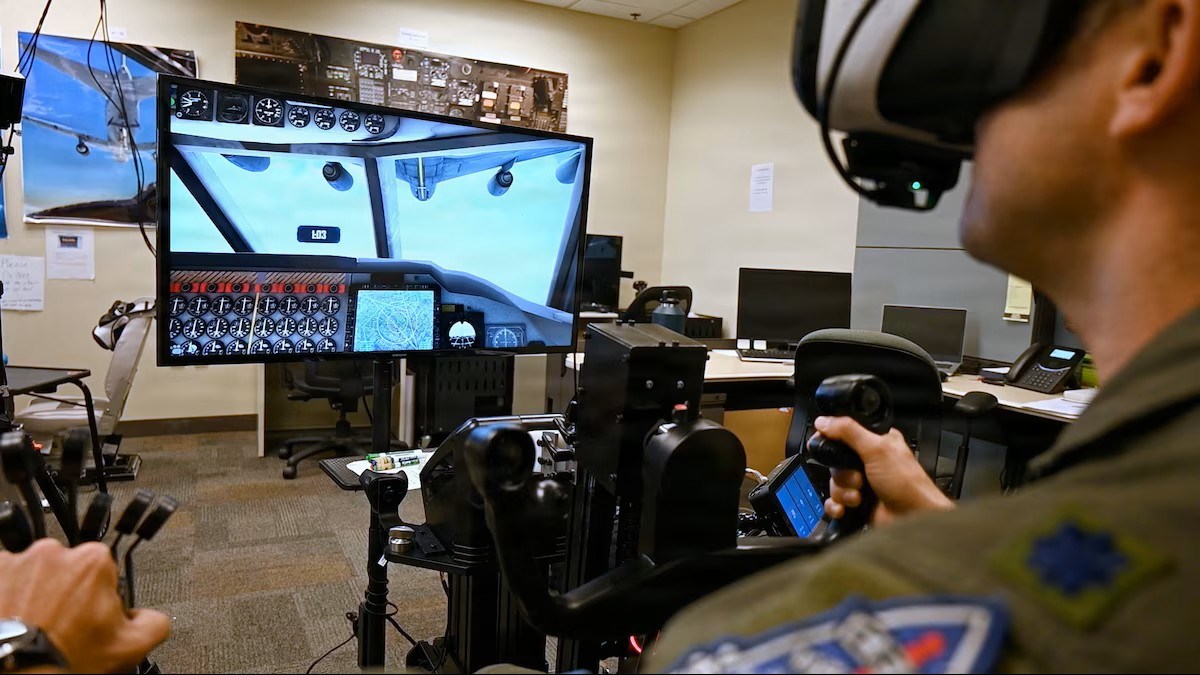
Refueling a fighter jet in midair while traveling hundreds of miles per hour is one of the most demanding skills a military pilot can master — and until recently, learning it required burning through tens of thousands of pounds of jet fuel per training session. The U.S. Air Force has found a smarter way to get pilots ready, and it fits in roughly the same amount of space as an exercise bike.
The Air Force is rolling out a compact virtual reality training system called EARL — the Experiential Air Refueling Lightweight simulator — built by a company called Specular Theory. As of this month, eight operational wings and commands have adopted the system, including Air Force Global Strike Command, Air Force Reserve Command, and Air Mobility Command.
Installations with major strategic importance are already using EARL, including Joint Base Elmendorf-Richardson in Alaska — a key hub for U.S. operations in the Arctic — and Minot Air Force Base in North Dakota, the only base in the Air Force operating two nuclear-capable wings simultaneously.
What EARL Actually Does
Aerial refueling is a high-stakes maneuver that requires a pilot to guide their aircraft precisely into position behind a tanker while both planes are in motion. The margin for error is slim, and the consequences of a mistake can be severe. Last July, that reality played out when a KC-46 Pegasus tanker’s refueling boom became stuck inside an F-22 Raptor mid-flight, forcing an emergency breakaway. No one was hurt, but the episode was a stark reminder of the risks involved.
EARL addresses those risks by giving pilots a realistic, immersive training environment before they ever attempt the real thing. The system replicates the exact aerodynamics and flight controls of specific aircraft, walks trainees through each step using artificial intelligence, and can be set up quickly at a squadron’s home base — no long trips to a separate training facility required.
Previously, training on aerial refueling meant either logging extensive real flight hours — which the Air Force says consumed “tens of thousands of pounds of fuel per sortie” — or traveling to larger, fixed simulator installations. EARL changes that equation by being portable enough to bring directly to the airmen who need it.
Saving Fuel, Freeing Up Resources
The cost savings are a major part of the program’s appeal. Jim Hartle, associate deputy assistant secretary of the Air Force for operational energy, explained the broader strategic benefit in a statement:
“Innovative platforms like EARL are fundamentally altering how we view training and energy resources across the enterprise.”
Hartle continued:
“Our warfighters need to maximize operational capability with every gallon of fuel we consume. By moving repetitive proficiency rehearsals into trainers directly at the squadron level, we are taking strain off our tanker fleet, saving millions of gallons of fuel and ultimately returning those flying hours to high-end combat and tactical employment.”
EARL is designed for co-pilots and aircraft commander candidates, but the system also includes a companion device called BART — the Boom Air Refueling Trainer — which trains the boom operators who physically manage the fuel transfer from the tanker side. Together, the two systems allow pilots and boom operators at different bases to run joint virtual refueling missions in real time, simulating the full coordination required in an actual operation.
What Comes Next
The Air Force isn’t stopping with aerial refueling. The service has indicated plans to expand its simulator programs and develop software that covers high-pressure scenarios such as tactical airdrops, takeoffs from rough terrain, and short-field assault landings — the kinds of demanding situations that are difficult and expensive to replicate through live flight training alone.






Comments are closed.