
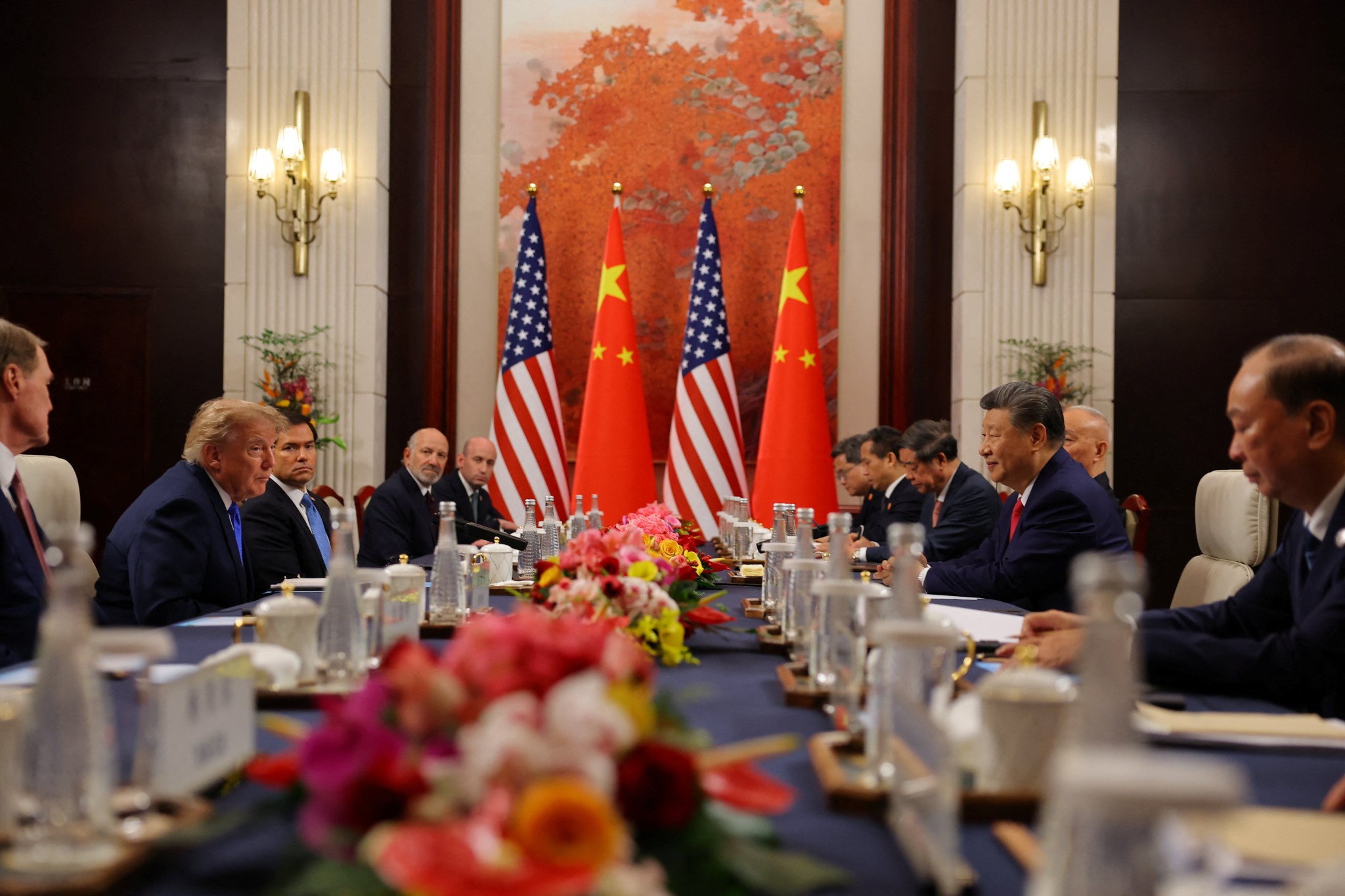
As artificial intelligence reshapes modern warfare, a key question looms over every military power on Earth: who — or what — should have the final say in launching a major attack? A new agreement between the United States and China attempts to draw a firm line on that question, with both nations committing that humans must remain in control.
Treasury Secretary Scott Bessent announced Friday that President Donald Trump and Chinese President Xi Jinping reached an understanding during Trump’s visit to Shenzhen, China: no major military decisions involving artificial intelligence should be made without a human being involved. The agreement was described by Bessent as one of the most significant outcomes of Trump’s Asia trip.
Speaking to CNBC after returning from the meeting, Bessent explained the scope of what the two leaders agreed to:
“I think it was very important that President Trump and President Xi agreed that humans should always be involved in any military decisions that SI makes, and the SI should not be allowed to be autonomous for major military actions.”
Bessent used the term “SI,” short for “super intelligence,” which is the Trump administration’s preferred label for advanced AI technology.
Bessent was clear that this commitment to human oversight does not interfere with the broader technological rivalry between Washington and Beijing. The two nations continue to compete for AI supremacy, and Bessent stressed that American AI labs must stay ahead of what he described as “dangerous” Chinese AI models already being used in cyberattacks.
“But there’s nothing to do with competition when it says that both sides agree that no major military operation should be launched without a human being involved,”
Bessent said.
Chip Restrictions and the Nvidia Controversy
Bessent also addressed ongoing restrictions on the sale of advanced AI chips to China. He confirmed that Nvidia’s H200 chip remains the most advanced semiconductor China can purchase with proper licenses, following what he described as Trump taking a
“very firm line”
on the matter.
Despite access to the H200, Bessent indicated China has not been rushing to place orders.
“I think what we have seen is a paucity of orders from the Chinese on the H200s as they try to build out their own chip stack, and I think that they are probably many years behind,”
he said.
The remarks came amid scrutiny surrounding Nvidia following spying allegations connected to a Chinese national romantically linked to former Nvidia CEO Jensen Huang. Bessent confirmed that topic did not surface during the formal Trump-Xi bilateral meeting.
Separately, the Commerce Department moved on Monday to tighten restrictions on China’s access to advanced AI chips, including chips accessible through overseas data centers where Chinese entities can rent computing power remotely. Bessent backed the move, saying,
“I think we are going to see that the proper chip restrictions are in place, and the remote access has been curtailed.”
Bessent also pushed back on reports of a rift between himself and Commerce Secretary Howard Lutnick over AI chip policy, saying Trump administration officials were
“all committed to following President Trump’s instructions.”





Comments are closed.