
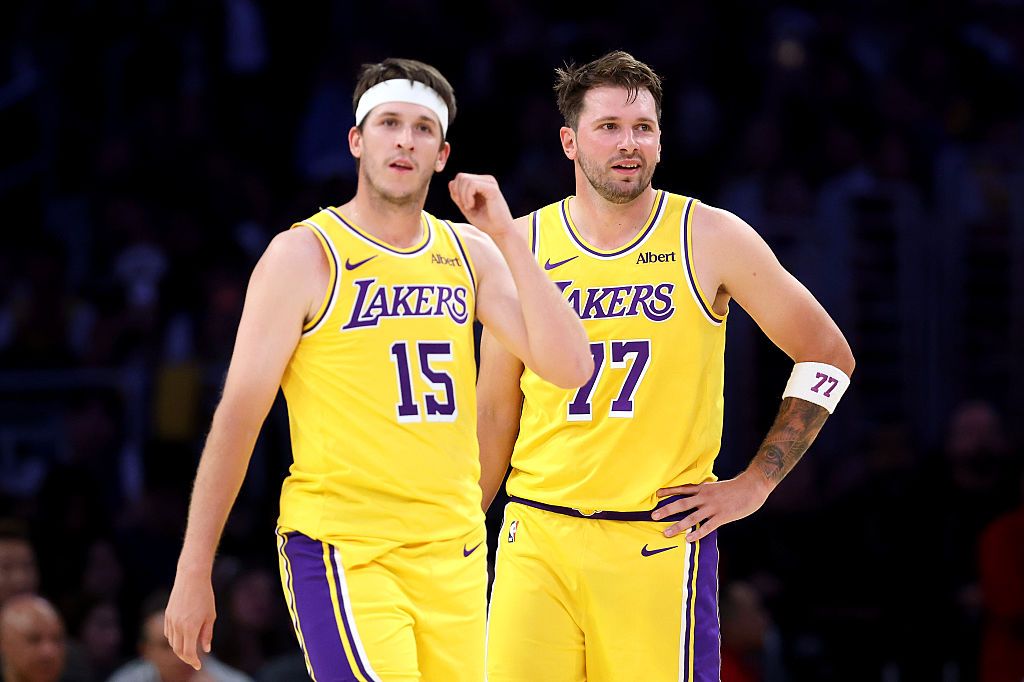
The Los Angeles Lakers have long been synonymous with Black basketball excellence — from Magic Johnson’s Showtime era to Kobe Bryant’s two decades of dominance. But as the franchise undergoes a high-profile ownership transition and its roster takes on a noticeably different look, some observers are raising questions about race, culture, and the visual symbolism playing out in real time.
At the center of the conversation is a starting lineup that is expected to feature Luka Dončić, Austin Reaves, and Walker Kessler — three white players — alongside other contributors. Head coach JJ Redick addressed the optics publicly during media day, where he acknowledged the scrutiny surrounding the team’s starting lineup composition.
A Franchise Built on Black Excellence
The Los Angeles Lakers have historically been defined by some of the most celebrated Black athletes in sports history. Magic Johnson and Kareem Abdul-Jabbar built the Showtime dynasty of the 1980s. Kobe Bryant became a global icon over two decades in purple and gold. Shaquille O’Neal brought three consecutive championships at the turn of the millennium, and LeBron James delivered a title in 2020. These players didn’t simply perform — they helped transform the Lakers into a billion-dollar cultural institution.
That history is part of what makes the current roster composition a talking point beyond the world of basketball strategy. The debate is not about whether white players belong in the NBA — legends like Larry Bird, nicknamed “The Hick from French Lick,” Bryan Reese, known as “Big Country,” Brian Scalabrine, called the “White Mamba,” and Jason Williams, dubbed “White Chocolate,” are well-established examples of white players who made their mark. The discussion is about what the visual shift at one of the NBA’s most culturally significant franchises means in a broader context.
A Billion-Dollar Ownership Shake-Up
The roster changes are unfolding alongside a major ownership transition. Billionaire Mark Walter acquired a majority stake in the Lakers in 2025. Then, in August 2026, former Disney CEO Bob Iger and venture capitalist Joshua Kushner — the brother of former White House advisor Jared Kushner — agreed to purchase the franchise at a reported valuation of $12.5 billion, pending required approvals. The Los Angeles Times reported on the latest ownership shake-up.
Joshua Kushner has described himself publicly as a lifelong Democrat, though his business dealings have drawn scrutiny. Kushner is a prominent backer of Anduril Industries, a defense and artificial intelligence company. The White House under the Trump administration recently awarded Anduril a defense contract worth up to $20 billion, a detail critics have pointed to when assessing Kushner’s political positioning.
No evidence has surfaced suggesting that the ownership changes were made with any intent to alter the racial composition of the roster. The team’s basketball decisions appear to be driven by a strategic pivot built around Dončić and Reaves. However, commentators have noted that the optics — a predominantly white starting lineup, a franchise in ownership transition, and new ownership with ties to a politically charged family — are difficult to view in isolation.
Race, Ownership, and the NBA’s Broader Landscape
The debate reflects a wider tension that has long existed in professional sports: Black athletes have historically driven the cultural and commercial value of leagues like the NBA, while ownership and executive leadership have remained overwhelmingly white. Black players helped build the NBA into the entertainment juggernaut that billionaires now pay record-setting sums to own — a dynamic that continues to spark discussion about equity, representation, and power within professional sports institutions.
The Los Angeles Lakers’ situation has amplified that conversation, particularly given the franchise’s specific legacy and cultural weight. Whether the team’s on-court identity represents a turning point or a temporary roster construction will likely depend on results — and on how the new ownership group shapes the franchise’s direction in the years ahead.


Comments are closed.