
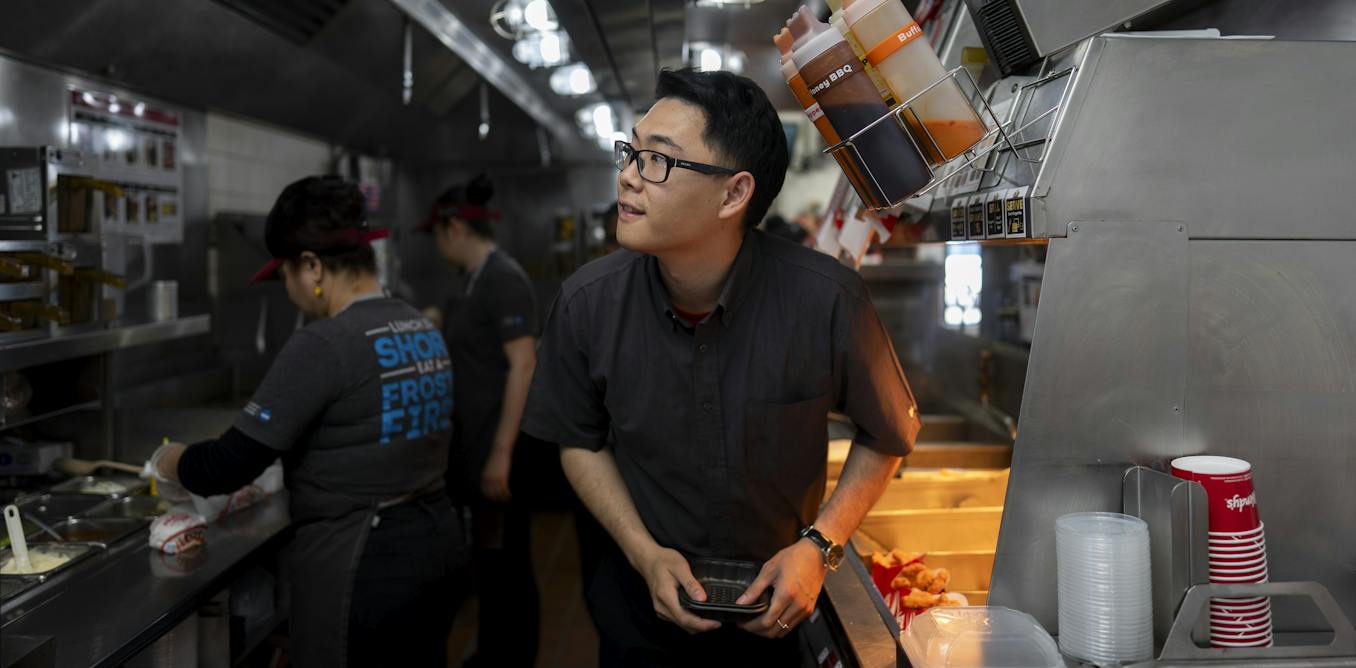
Millions of American workers have seen their paychecks grow as states push ahead with minimum wage increases, but a closer look at California’s experiment with fast-food pay floors reveals a more complicated picture — one where the size of a business may determine whether higher wages help workers or hurt them.
In April 2024, California became the first state to mandate a sector-specific minimum wage for fast food, requiring chains with more than 60 nationwide locations to pay workers at least $20 an hour — $4 more than the state’s general minimum at the time. The rule was estimated to cover more than 500,000 workers. Now, more than two years later, researchers are beginning to understand what actually happened.
What the Research Found
A team of economists — including a researcher of health and labor markets, David Neumark, Gary Wagner, and Vitor Melo — conducted a study tracking employment, business locations, openings, and closures across California’s fast-food industry from 2019 through 2025. They compared California restaurants against those in other states and tracked results separately for the 20 largest chains versus 261 smaller ones covered by the law.
At the statewide level, total employment in covered restaurants showed no statistically significant change. The largest 20 chains, which account for roughly 60% of the jobs affected by the law, recorded no detectable impact across any of the measures the researchers tracked.
But the picture looked very different for the smaller chains caught under the same rule. Those businesses saw employment fall by approximately 20%, the number of locations drop by about 10%, new openings decline by 17% to 20%, and closures increase by 9% to 21%. Critically, that employment decline came almost entirely from chains shutting down California locations entirely — not from cutting staff at restaurants that remained open.
The researchers noted that the largest chains tend to rely more heavily on automation, including self-serve kiosks, which may have cushioned the financial blow of higher wages and helped explain the muted employment response among the biggest brands. The smaller chains covered by the law, by contrast, likely lack the same scale, pricing power, and automation capabilities as national brands, making them far more sensitive to the new wage floor.
The study also found that the reduced presence of smaller chains may have actually eased competitive pressure on the largest ones, potentially shifting California’s fast-food market further toward dominant national brands — a pattern other researchers documented in a comparable study examining Germany’s national minimum wage.
A Broader Policy Debate
The question of whether minimum wage hikes cost jobs remains one of the most actively debated topics in economics. Some studies have found that California’s $20 fast-food wage caused small declines in employment relative to other states, while others contend the effect on jobs is essentially zero. Research also suggests that employment effects tend to grow larger in the long run as companies have more time to adapt.
Proponents of higher wages point to the fact that the federal minimum wage sits at just $7.25 an hour and has not changed since 2009, arguing that states and cities must act independently. Many have done exactly that. Across the country, states have been raising their minimum wages, and 16 states are set to raise their minimum wages again on January 1, 2027.
Los Angeles is phasing in a $30 wage for hotel and airport workers, California’s healthcare workers received another scheduled increase, and Vermont lawmakers have proposed their own $20 fast-food minimum wage.
The researchers were careful to note that the absence of a clear short-term employment effect doesn’t guarantee the policy won’t produce larger job losses over time as businesses continue to adapt. They also acknowledged they could not track what happened to individual workers displaced from the most affected restaurants, nor what happened to prices at those establishments — though other research suggests prices at covered fast-food restaurants rose by 3% to 4%.
For the growing number of cities and states weighing their own wage floors, the California data offers no clean verdict. The evidence shows that the costs of sector-specific minimum wages fall first and hardest on smaller businesses within the targeted industry — but whether the largest chains ultimately feel a meaningful impact remains an open question.








Comments are closed.