
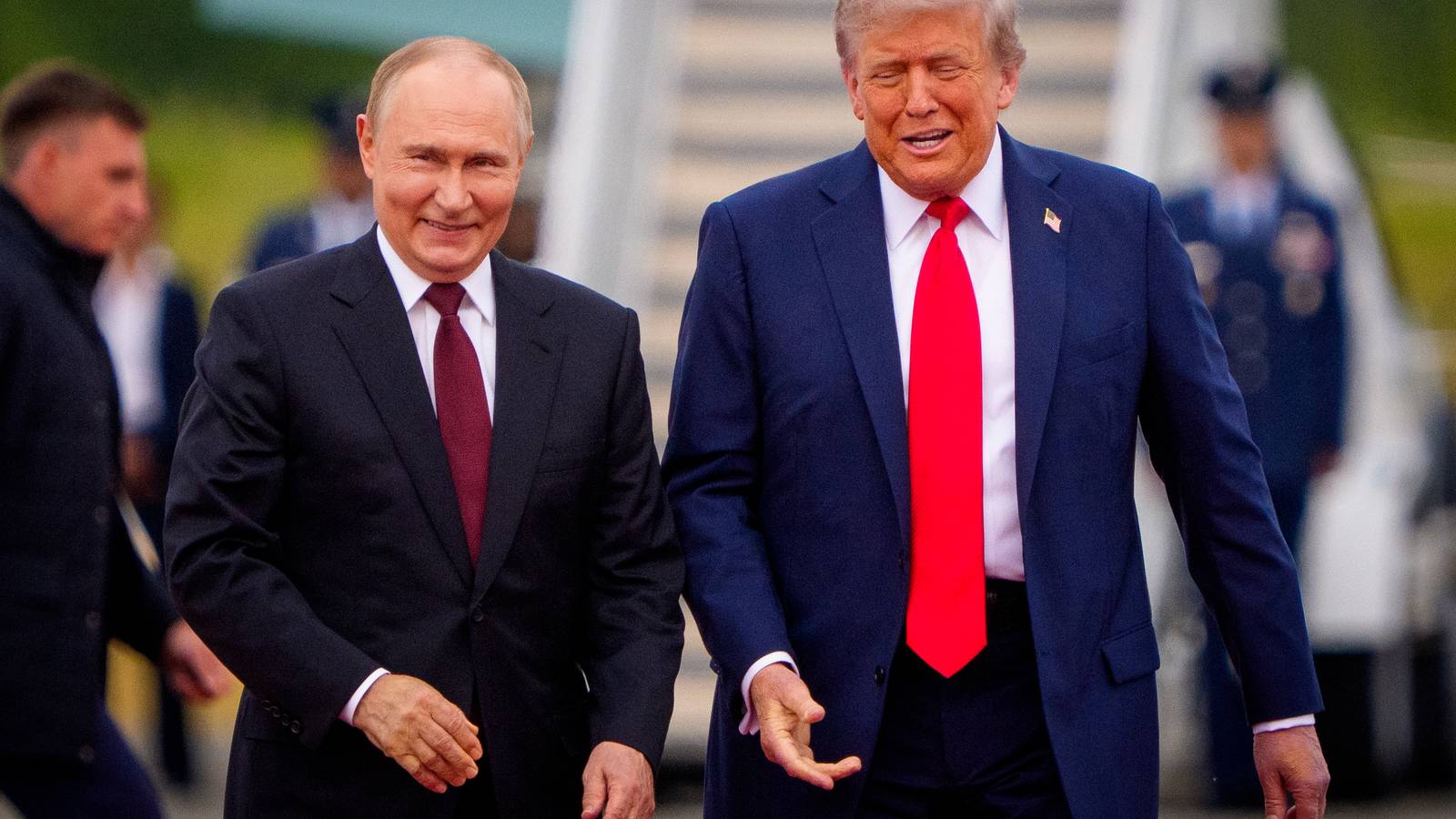
Hours after Russia launched one of its most intense missile and drone attacks on Ukraine in recent memory, President Donald Trump stood at the White House podium and called Vladimir Putin his friend — and said both sides are equally stuck in a war neither knows how to end. The remarks have drawn fresh scrutiny over where U.S. policy on the conflict actually stands.
Trump held a wide-ranging news conference Friday after returning from China, where he met separately and jointly with Putin and Chinese President Xi Jinping. When pressed on whether Putin is a friend to the United States — not just to Trump personally — the president declined to answer directly.
“I can’t speak to America,”
Trump said, without further explanation.
He quickly pivoted to describing his personal rapport with the Russian leader, saying,
“I consider him to be somebody that I have a very good relationship (with). It’s actually very good.”
Trump also tied the relationship to his long-running complaints about the extended federal probe into Russian interference in the 2016 election.
“I’ve been dealing with Putin”
since
“the fake Russia, Russia, Russia hoax,”
Trump said, adding that the investigation
“was a hoax made up by the Democrats”
and
“probably helped me win.”
A Massive Attack, and a Call for Shared Blame
Trump’s remarks came just hours after Russia carried out a nighttime bombardment of Ukraine. Ukrainian President Volodymyr Zelenskyy said the assault killed at least eight civilians and wounded more than two dozen. Russia fired more than 400 drones and over 110 missiles — 27 of them ballistic — some equipped with cluster warheads designed to scatter dozens of smaller bomblets across wide areas.
The attack appeared to be retaliation for Ukrainian strikes that severely damaged the Kerch bridge, a strategically vital crossing linking Russian-occupied Crimea to the Russian mainland. The assault fit a well-established pattern of heavy Russian responses to eye-catching Ukrainian attacks.
Separately, two Russian missiles and a suspected drone also came down in Poland on Friday. Poland’s prime minister suggested the incursion was likely a deliberate provocation timed to coincide with European military exercises taking place on Polish soil in preparation for a possible postwar mission in Ukraine. Moscow did not immediately respond to the incident.
Despite the scale of the attack, Trump insisted that Putin has expressed a desire to end the war
“by diplomatic means,”
and said there is
“a real good chance”
a peace with Ukraine can be brokered. He framed both leaders as equally responsible for the conflict’s continuation.
“He’d love to end the war,”
Trump said of Putin.
“But you have two guys that don’t know how to end it. We’re trying to help them. You have two people that hate each other, Zelenskyy and Putin. They don’t know how to end it. They want to end it. They’re both stuck in it.”
Kushner’s Claims Meet Russian Pushback
Adding to the diplomatic complexity, U.S. envoy Jared Kushner said Thursday that he believes Russia is “comfortable” with NATO-like security guarantees for a postwar Ukraine — a significant claim given that Ukraine has long sought membership in the alliance and the collective defense protections that come with it under Article 5.
“I think we’ve gotten the Russians comfortable with that concept where any security guarantee for Ukraine would be based on Article 5,”
Kushner said.
“And I think that that comes with at least what the Russians are saying, which is their intention is when this war is over to not have another war in the future.”
Russia moved quickly to contradict that characterization. Russian Deputy Foreign Minister Sergei Ryabkov said Friday that even a
“quasi-membership”
of NATO for Ukraine would be unacceptable, according to Interfax news agency. Ryabkov added:
“We discuss security guarantees primarily in terms of ensuring the security of our own country, and that’s what we’re talking about.”
When a reporter raised Russia’s public rejection of Kushner’s statements, Trump dismissed the significance of the contradiction, suggesting both sides are playing to their domestic audiences.
“It is also a public relations war. And we’ll say things and they’ll say things,”
Trump said. He also declined to get into specifics on security guarantees, saying,
“we got to get a deal first.”
Rubio Defends Trump’s Approach to World Leaders
Secretary of State Marco Rubio, who accompanied Trump on the Asia trip and appeared alongside him at the news conference, addressed criticism that the administration has been too cozy with authoritarian leaders. Rubio argued that strong personal relationships between heads of state serve American interests across the board.
“I want everybody to understand the relationships between heads of state are invaluable,”
Rubio said.
“It sets the tone for the entire relationship. It sets the tone for our trade negotiators. It sets the tone for our diplomats.”
Trump echoed that view, suggesting Americans should consider themselves fortunate to have a president with direct access to the world’s most powerful leaders.
“You know, you’re very lucky to have somebody that has a relationship with the heads of the most powerful countries,”
he said. For the latest on this developing story and other military and foreign policy news, visit Military Daily News.





Comments are closed.