
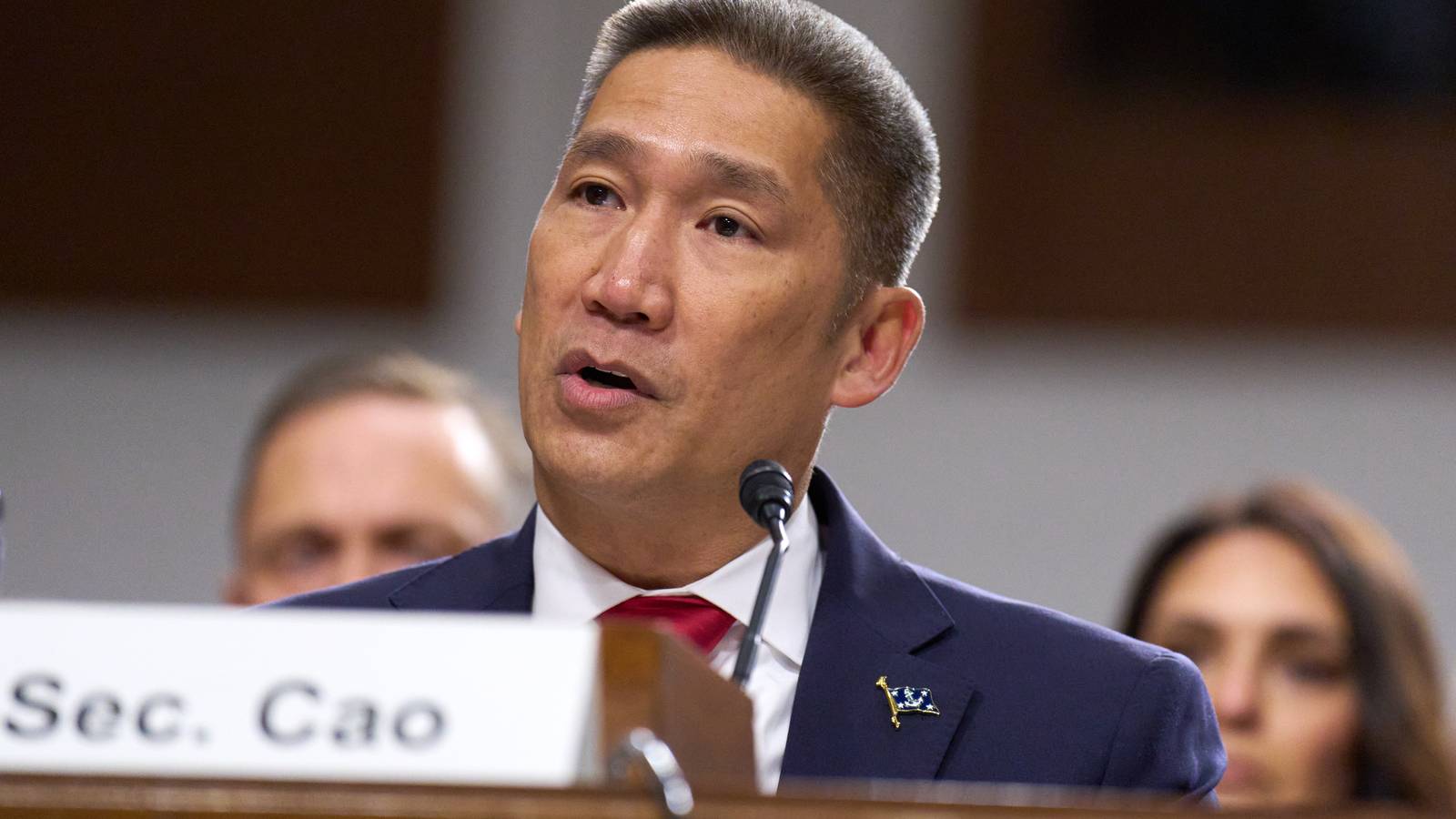
When a sailor reportedly lost more than 45 pounds during a single deployment and eight of his shipmates attempted suicide, the man nominated to lead the U.S. Navy had answers that raised more questions than they resolved. Acting Navy Secretary Hung Cao’s confirmation hearing before the Senate Armed Services Committee on Tuesday exposed deep concerns about the welfare of deployed sailors — and about how much Congress has been kept in the dark.
Cao, a retired Navy captain who has served as acting secretary since April, is President Donald Trump’s nominee to permanently lead the service. He replaced former Secretary John Phelan, who was relieved by the president in a move widely tied to slow shipbuilding progress. Before entering government, Cao ran for a U.S. Senate seat in Virginia in 2024, winning the Republican primary but losing the general election to Democratic Sen. Tim Kaine by double digits.
Senators from both parties pressed Cao on some of the Navy’s most pressing issues: extended deployments, sailors’ living conditions aboard warships stationed in the Middle East, and whether Congress has received the transparency it is owed.
Suicide Attempts Reframed as “Mitigations”
The hearing’s sharpest moments centered on mental health. Democratic Sen. Richard Blumenthal of Connecticut told Cao he was
“failing these sailors and their families.”
When Blumenthal raised the issue of eight suicide attempts aboard deployed ships, Cao reframed them — calling each one a
“suicide mitigation.”
He credited chaplains, resiliency counselors, and mental health specialists, noting that most carrier strike groups typically see
“one or two suicides”
during deployments.
Those eight attempts occurred on the USS Abraham Lincoln carrier strike group. Cao disclosed the figure to Congress in September after a written request from Democratic Sen. Kirsten Gillibrand of New York. Notably, the Navy had publicly denied reports of growing mental health problems aboard the Lincoln just weeks before that disclosure — then, two days after that denial, announced it was sending additional mental health support to the carrier.
Gillibrand called Cao’s use of the word “mitigation” insulting. She also pressed him about a sailor who went over the side of the ship in March. Cao maintained the incident was not a suicide attempt, saying the sailor
“jumped overboard with a life preserver on, and again he admitted it to the commanding officer afterward.”
Gillibrand pushed back sharply.
“What was he trying to do? Swim to Guam?”
she said, suggesting the sailor likely denied suicidal intent to avoid military discipline.
Food Shortages and Grueling Deployments
Democratic Sen. Mark Kelly of Arizona — himself a former Navy astronaut — told the committee his office had received reports of food shortages and inadequate supplies aboard deployed warships. Among the accounts: a parent who said their child lost more than 45 pounds over six months at sea.
Cao responded that no Navy vessel has
“ever gotten to zero”
on food, and compared the complaints to children raiding a refrigerator.
“It’s like my kids opening up the refrigerator door and saying, ‘There’s nothing to eat in here,'”
he said. Kelly responded bluntly that a person does not lose 45 pounds simply from disliking their meal options.
On the question of deployment length, Cao pointed to the size of the current fleet as the core problem.
“The reason why we had to have these extended deployments is really because we only have 286 ships today,”
he said.
“We need 355, and we’re doing the best we can to get these ships out there as quickly as we can.”
The numbers back up how stretched the Navy has become. The USS Gerald R. Ford returned home in May after a 326-day deployment — the longest for a U.S. carrier since the Vietnam War. The USS Abraham Lincoln recently finished a 322-day deployment. The USS George H.W. Bush arrived in the Middle East in April, and the USS George Washington deployed to the region in August. On Monday — one day before Cao’s hearing — the USS Theodore Roosevelt also deployed, joining the growing presence.
Cao told the panel he views every decision through a personal lens:
“How will this affect my son, a United States Marine, all his fellow Marines and his shipmates.”
Congress Left Out of Key Briefings
Transparency concerns surfaced from an unexpected corner — a Republican. Sen. Mike Rounds of South Dakota noted that Democratic members of the committee had been excluded from certain classified briefings.
“Pretty tough to ask all of my colleagues to support that if they’re not even invited in to hear the information in the first place,”
Rounds said, referring to a future defense spending request. Cao pledged to be
“open and honest with the entire Senate and the Congress.”
Democratic lawmakers also raised concerns that the Navy failed to inform Congress when it fired the leadership of a nuclear-powered attack submarine following a possible underwater mishap. Navy Times reported that the commanding officer, executive officer, and chief of the boat of the USS South Dakota were relieved on October 14, with congressional letters tying the action to an alleged grounding of the vessel.
Cao defended the Navy’s practice of not publicly announcing leadership removals.
“We relieve commanding officers for everything from negligence to even just fraternization or, you know, harassment,”
he said, adding that he wants
“to make sure that we don’t destroy their careers.”
But in response to questioning by Democratic Sen. Jeanne Shaheen of New Hampshire about unanswered questions from early in his tenure, Cao acknowledged falling short.
“I failed you,”
he told her.
A Legal Hurdle Beyond the Confirmation Vote
Even if confirmed by the Senate, Cao would face an additional legal obstacle. Federal law 10 U.S.C. 8013 bars anyone from being appointed Navy secretary within seven years of leaving active duty as a commissioned officer. Cao left active duty in 2021 — meaning he would not meet that threshold without a congressional waiver.
Getting that waiver would require legislation passing both chambers of Congress. In the Senate, it would need 60 votes to overcome a filibuster — a threshold that would require Democratic support. Based on Tuesday’s hearing, that support appears unlikely. No Democrat on the committee publicly backed Cao during the proceedings.
Democratic Sen. Tammy Duckworth of Illinois, a military veteran, was direct about her opposition.
“I cannot vote for you because you’re going to be another yes-man,”
she said.








Comments are closed.