
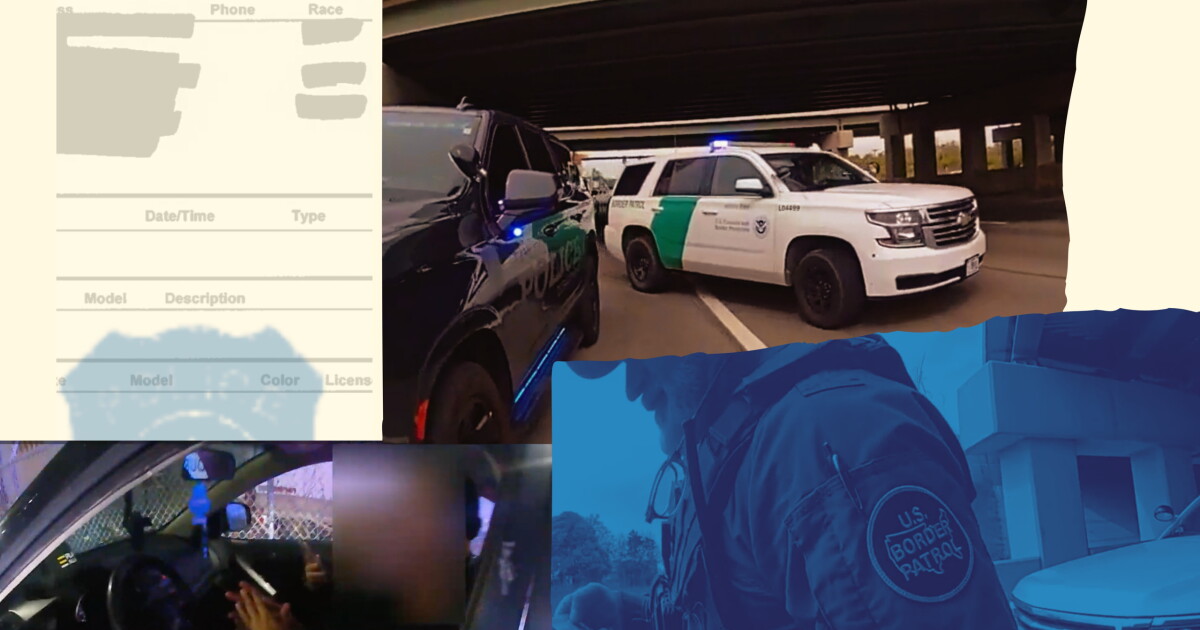
A burned-out headlight. A foreign driver’s license. A call to Border Patrol. For one woman driving through Brownstown Township on a spring evening in 2025, that sequence of events ended in a federal immigration arrest — not a ticket. Across Michigan, this scenario is playing out hundreds of times, and a failed state law is a central reason why.
When Brownstown Township Officer Matthew Lyles stopped a black SUV for a single broken headlight, the driver handed over a Colombian license. Rather than issuing a citation, Lyles called Border Patrol to “validate” the document. Federal agents arrived and arrested the driver. Michigan generally recognizes driver’s licenses from foreign countries, and local police are not required to assist with federal immigration enforcement. But in this case, and in hundreds of others, they did anyway.
A joint investigation by Koby Levin of Outlier Media and Adam Yahya Rayes of Michigan Public found that local police reported migrants to Border Patrol at least 388 times since 2021. In the majority of those cases, the initial offense was minor — the kind of infraction that ordinarily results in a warning or a fine.
A Law That Bars Migrants From Getting Licensed
At the heart of this issue is a Michigan law that prevents undocumented immigrants from obtaining a state driver’s license. A 2008 law requires license applicants to show proof of a valid immigration status. That means someone with a visa can get a license, but someone who entered without authorization cannot — even if they have applied for asylum.
It wasn’t always this way. In 1995, Democratic Attorney General Frank Kelley gave everyone access to licenses as long as they could pass a driving test and prove Michigan residency. In 2007, Republican Attorney General Mike Cox reversed Kelley’s decision, citing national security concerns and the potential for fraud. The 2008 law followed, locking in those restrictions.
More than a dozen other states have taken the opposite approach. According to the National Conference of State Legislatures, those states give migrants access to driver’s licenses regardless of immigration status. Some have also adopted policies limiting local police cooperation with federal immigration agents. A 2017 Illinois law, for example, prohibits police from transferring individuals to ICE without a criminal warrant signed by a judge.
The Case for Reform — and Why It Failed
Immigrant advocates spent years arguing that expanding license access improves public safety. Their public safety case rested on a straightforward argument: licenses require applicants to pass a driving test and enter state databases, making roads safer for everyone. Without that option, migrants drive anyway — and a routine traffic stop can become a federal enforcement event.
Immigration attorney Shahad Atiya, who practices in metro Detroit, describes this pattern regularly in her work.
“Usually, my clients get detained because they’re driving and a local police officer will pull them over. Let’s say they run a stop sign. When they cannot produce the driver’s license, usually that’s used as evidence that someone might have a legal status issue.”
When Democrats gained full control of Michigan’s government in 2022, advocates renewed their push under a campaign called Drive SAFE. But the bills stalled in the state House during a dysfunctional session in late 2024, along with numerous other Democratic priorities.
In 2025, after Republicans regained control of the state House, they brought the driver’s license bill to a floor vote. The measure failed 39-64, with six Democrats voting against it alongside Republicans. Just one month before the Brownstown arrest, state lawmakers shot down the latest version of the bill entirely.
State Senator Stephanie Chang (D-Detroit), one of the bill’s longtime supporters, said some Democrats considered the issue too politically sensitive to support.
“I don’t know if there’s a way to know exactly how many people have been deported … because of our failure as a state to get this done in 2024.”
State Representative Josh Schriver (R-Oxford) voiced the opposition’s view during debate on the bill.
“If this bill passes, Michigan would become a destination state for every illegal alien and prospective illegal alien all over the world.”
The Stakes Under the Current Administration
Advocates say the consequences of inaction have grown sharper since the Trump administration intensified its immigration enforcement efforts. Senator Chang described the shift in how Border Patrol now responds to local referrals.
“Now, [if] you call Border Patrol, there is no question — even if there is no warrant at all, no history of criminal behavior — Border Patrol is coming. I think the ramifications of someone not having a driver’s license or state ID now [are] that much greater.”
Community organizer Danny Celaya, who was involved in the Drive SAFE campaign, said the Democrats who voted against the bill showed “cowardice.” He warned that without reform, it will remain routine for “a grocery trip to lead to a family separation.”
Some Michigan police chiefs have also raised concerns, arguing that when local departments act as immigration enforcers, it discourages crime victims and witnesses from contacting police. Others — those more aligned with the current federal administration — see cooperating with immigration agents as part of their responsibilities. Michigan state law leaves that decision to individual municipalities, unlike states such as Illinois that have set firm statewide limits.
For a deeper look at which Michigan departments are involved, see the full investigation: Is your Michigan police department reporting migrants to immigration? Reporters also examined whether some officers are targeting immigrants through minor stops and how the investigation tracked local police collaboration with immigration enforcement.
Both Chang and Celaya said they believe Michigan will eventually pass the reforms, potentially if Democrats retake the state House in upcoming elections. Until then, the gap between what state law allows and what some officers do during traffic stops continues to reshape the lives of Michigan residents.







Comments are closed.