The U.S. military presence in the Caribbean has significantly increased as the Trump administration focuses on counter-narcotics operations targeting Venezuela. This strategic move, aimed at the regime of Nicolás Maduro, has seen a large deployment of U.S. Marines and naval assets to the region, and there is potential for these operations to escalate into direct intervention. Read more about potential shifts into direct intervention here.
Military Build-Up Near Venezuela
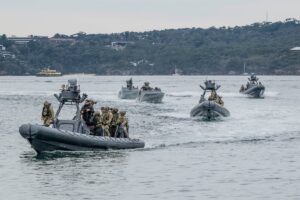
The U.S. military has positioned considerable forces near Venezuela’s coast. The arrival of the USS Gerald Ford carrier strike group, accompanied by B-1B bombers near Venezuelan airspace, signals a robust show of strength. Additionally, destroyers like the USS Gravely have docked in Trinidad and Tobago for joint military exercises, a move that led Venezuela to sever ties with the island nation. These deployments come on the heels of statements from President Donald J. Trump regarding the Maduro regime, prompting concerns over a potential escalation in the region.
The U.S. Marine Corps has a long history of collaboration with Trinidad and Tobago, having participated in exercises such as TRADEWINDS 2017 and 2025 to enhance regional security. As an Operations Officer mentioned, “The island nation provides a perfect opportunity to train with multinational partners in SOUTHCOM.” In 2017, a Marine Officer emphasized, “The United States is interested in helping (partner nations) develop their capabilities because the safer the Caribbean waters are, the safer the United States is.”
Preparing for Venezuelan Terrain
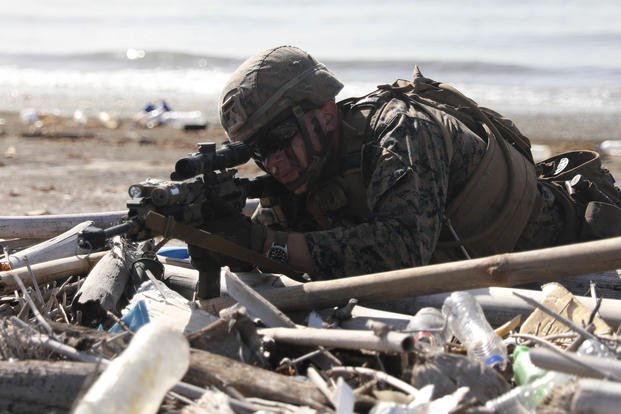
U.S. Marines are intensifying their training to align with the unique challenges of operating in Venezuela’s environment. At the Jungle Warfare Training Center in Okinawa, Japan, Marines are honing skills in navigation, survival, and small-unit tactics essential for jungle warfare. Amphibious operations are also a focus, with UNITAS exercises involving Latin American and Caribbean allies simulating critical beach landings and river crossings. These drills prepare Marines for potential operations in both urban and rural Venezuelan settings.
Strategic Importance of the Marines
The presence of U.S. Marines in the Caribbean plays a strategic role should a conflict with Venezuela arise. Currently, thousands of Marines are stationed in the region, with the capability to increase their numbers substantially if needed. Their amphibious vehicles and air support enable swift action against strategic targets. The integration with SOCOM and Air Force elements creates a formidable multi-domain force to counter Venezuelan defenses, which include Russian-supplied systems as detailed here.
In a potential conflict, strategies might involve blockades, airstrikes, and Marine incursions. These actions could include securing borders with Colombia or executing amphibious landings near Caracas. Despite Venezuela’s mobilization of 125,000 troops and civilians, the technological and training superiority of U.S. forces, coupled with a strong coalition of Latin American and Caribbean nations, could prove decisive. The involvement of private military contractors like the Wagner Group adds another layer of complexity to the situation.
Operational Challenges and Readiness
The logistics of sustained military operations in the Caribbean present significant challenges, particularly in maintaining supply lines. Recent operations against narco-traffickers have showcased the lethal precision of U.S. forces, with numerous designated terrorists eliminated in international waters. Training programs incorporate lessons learned from conflicts in Ukraine and the Middle East to counter drones and other asymmetric threats. Commanders emphasize the need for adaptability, with units such as the 22nd Marine Expeditionary Unit on standby for rapid deployment.
As tensions continue to rise, the Marines remain a critical component of U.S. strategy in the region. Their readiness and capability serve as a deterrent, potentially preventing conflict through a display of strength.